

Meta Conversions API Gateway Hosting
Best-in-class pricing
 EUR
EUR
EUR
EUR
 USD
USD
1 pixel
Automatic setup
Custom subdomain
10 pixel
Automatic setup
Custom subdomain
100 pixel
Automatic setup
Custom subdomain
Support included
What is the Meta Conversions API Gateway?
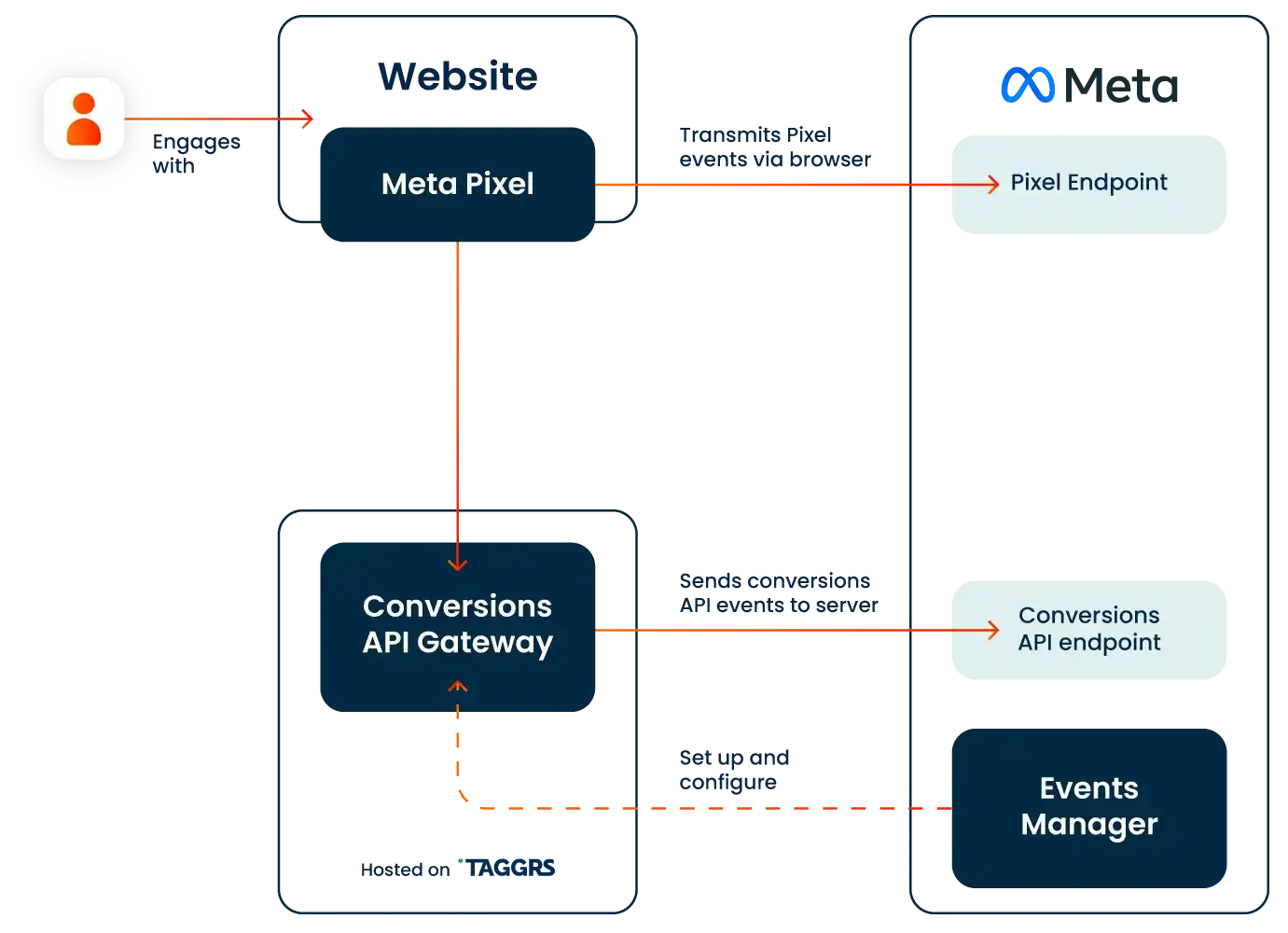
What is the Meta Conversions API Gateway?

Give your Meta-campaigns the data they deserve
How teams use TAGGRS sGTM hosting

Best price-quality
At TAGGRS, you get the best solution at the best price. TAGGRS offers advanced tracking functionalities without the high costs and complexity of other tools, allowing you to get more value from your marketing budget.

Fully hosted solution
No need for your own servers or technical setup. TAGGRS handles hosting, updates, and maintenance, so you can focus on your campaigns.

Premium Support
With our premium support, you get direct assistance and keep your tracking always up-to-date and performing optimally.
How to set up the Meta Conversion API Gateway?
Questions and answers
Our servers are monitored 24/7. In case of an outage, a backup is always available. The current server status can be found on our server status page.
The Meta Conversions API Gateway is a simple solution specifically for implementing the Meta Conversions API. Server Google Tag Manager offers more flexibility and supports multiple platforms but requires more technical knowledge and configuration. As a result, Server GTM provides more control over data processing, while the Gateway offers a faster and easier setup.
Yes, the Meta Conversions API Gateway pixels are included in the partner kickback fee.
The data is hosted via the Google Cloud network. A location can be selected that meets the client’s requirements. However, please note that Google Cloud falls under the U.S. Cloud Act, which means that data can be accessed by U.S. authorities. If you want to prevent this, we recommend setting up the Conversions API via sGTM.
Yes. By optimizing data collection from the Facebook pixel, you can improve Event Match Quality (EMQ). In addition, the TAGGRS CAPI Gateway analytics dashboard allows you to monitor your average EMQ score, event coverage, and deduplication status in real time, so you can verify the impact of your implementation.
Yes, you can use a TAGGRS subdomain, but you won’t have first-party tracking.