Google Ads Server-side Tracking: how to set up conversion tracking in a server container
Set up Google Ads in a server container: Conversion Linker, conversion and remarketing tags, enhanced conversions, diagnostics, profit and offline data.

Content Marketer
14 min read
Google Ads Server-side Tracking sends your conversions to Google Ads from a server container you control, instead of from conversion tags in the visitor’s browser. The Google tag still collects events on your site. Your server container receives them, and the Google Ads tags there turn them into conversions and remarketing data.
Most setups go wrong at the click. A conversion only counts toward a campaign when Google can tie it to the ad click, through the click ID that the Conversion Linker stores or through the customer data sent with enhanced conversions. Without a Conversion Linker in the server container, server-side conversions arrive with no click to attach to.
This guide covers what the browser and the server each do, how Google Ads handles duplicates, the two server-side routes, the setup in four steps, enhanced conversions, profit and offline conversions, the enhanced conversions diagnostics and how to test it all.
What is Google Ads Server-side Tracking?
Google Ads Server-side Tracking moves your Conversion Linker, conversion tracking and remarketing tags from the browser to a server container on your own subdomain. The browser sends one stream of events to that container, and the Google Ads tags there send conversions to Google Ads with the click ID and, optionally, hashed customer data.
Attribution works the same way as before. Google ties a conversion to an ad click through the gclid, the click ID in the landing page URL, or through customer data that matches a signed-in Google account when you use enhanced conversions.
For the wider picture of why browser tracking loses conversions, see why your Meta, GA4 and Google Ads conversions don’t match.
Main benefits
More conversions tied to the click
The gclid only helps when it is still there at the moment of the conversion. A server container on your own domain can keep the click ID in a cookie it sets itself, which browsers treat more leniently than a cookie written by JavaScript. Enhanced conversions add a second way to match when the cookie is gone.
Better input for Smart Bidding
Smart Bidding optimizes on the conversions it receives. When part of them never arrive, it learns from a partial sample and favors the clicks whose conversions survive the browser. Server-side conversions give it a more complete count, with the confirmed order value attached. Learn how Server-side Tracking improves Smart Bidding and automated campaign performance.
Conversions that happen after the visit
A deal closed by your sales team or a phone order never reaches the browser, so a conversion tag has nothing to capture. With offline conversions, your backend sends them to Google Ads through the same server container, tied to the original click.
Control over what Google Ads receives
Every event passes through a server container you control. You decide which fields are forwarded, you can send profit instead of revenue as the conversion value, and the server container encrypts the conversion value it returns to the browser.
| Criterion | Browser only | Server-side with TAGGRS |
|---|---|---|
| Click cookie in Safari | Drawback: Can be capped at one day | Advantage: First-party, set by your server |
| Ad blockers and tracking prevention | Drawback: Often blocked | Advantage: Less affected |
| Customer data for enhanced conversions | Neutral: Only what the browser holds | Advantage: Added from your order data |
| Conversions after the visit | Drawback: Not tracked | Advantage: Sent as offline conversions |
| Control over what Google Ads receives | Drawback: Limited | Advantage: Filter, hash or hold back fields |
“If I didn’t need it, I wouldn’t use it. Our campaigns are guided by AI bots that literally read data and look for ways to improve. But we can only do that if we measure correctly, and Server-side Tracking allows that.”

Google tag, server-side tags or both?
A server-side setup still needs the browser. The Google tag in your web container collects the events and the click context, and the Google Ads tags in your server container turn them into conversions.
| The browser side | The server side |
|---|---|
| Runs the Google tag and sends events to your server | Stores the click ID with the Conversion Linker |
| Sees the landing page URL with the gclid | Sends conversions with the conversion tracking tag |
| Reads order data and customer data from the data layer | Adds hashed customer data for enhanced conversions |
| Reads the consent state from your consent banner | Builds remarketing audiences with the remarketing tag |
Google Ads has no event ID like Meta’s to pair a browser copy with a server copy. It drops a duplicate only when two conversions for the same conversion action carry the same transaction ID. If you keep a browser conversion tag running while you test the server tag, point both at the same conversion action and pass the same transaction ID, or each purchase counts twice. Once the server tag works, remove the equivalent tag from the web container, as Google recommends.
Choose your server-side route
There are two ways to send conversions to Google Ads from a server. They cover different conversions, and TAGGRS runs both from the same server container.
| Route | Best for | What to know |
|---|---|---|
| Conversion tracking tag in server-side GTM | Website conversions: purchases, leads, sign-ups | Needs the Google tag in the browser and a Conversion Linker in the server container. Works with enhanced conversions and remarketing. |
| Offline conversion import | Conversions after the visit: closed deals, phone orders, in-store sales | Needs the gclid or customer data from the original visit, stored with the lead. Since June 2026, Google takes programmatic offline imports through its Data Manager API. |
Server-side Tracking and GDPR
Server-side Tracking gives you one place to apply consent decisions and data minimization before anything reaches Google. With TAGGRS, you decide which information is collected and forwarded, and you can filter or anonymize sensitive fields such as IP addresses before they leave TAGGRS servers. With server-side GTM hosting, you choose where your server processes data, including locations within the EU.
For visitors in the European Economic Area, Google requires consent signals before it uses your data for measurement and personalized ads. Consent mode v2 passes four of them: ad_storage, analytics_storage, ad_user_data and ad_personalization. When ad_personalization is denied, remarketing receives no data for that visitor. You set up consent mode in the web container only. The Google tag sends the consent state with each request, and the Google Ads tags in your server container adjust to it.
This supports GDPR principles such as data minimization and purpose limitation. It does not replace a lawful basis for processing. A conversion a visitor declined should not be sent at all, whether it comes from the browser or your server. Read more in Server-side Tracking and the GDPR, on our security page and in our guide to Google Consent Mode V2.
Expert insight. The Conversion Linker stores the gclid from the ad click in the
_gcl_awcookie, written by JavaScript on the landing page. Safari deletes cookies written by JavaScript after seven days without a visit. When the visitor lands from a domain Safari classifies as a cross-site tracker on a URL with a query string, which every gclid URL has, Safari caps them at 24 hours. A click on Monday and a purchase on Thursday then become two unconnected events. A cookie set by your own server through the Set-Cookie header is not subject to these caps, as long as the server runs on your own domain (see step 1).
Set up Google Ads Server-side Tracking
Our documentation includes step-by-step guides for each part of the setup. Work through them in this order.
In the video below, Lowie Verschelden shows step by step how to set up Google Ads Server-side Tracking.
1. Create a server container in Google Tag Manager
A server container is where your events arrive before they are forwarded to Google Ads. It runs on a first-party tagging URL on your own domain, such as sending.example.com. Pointing a subdomain at an external service is not enough on its own, because Safari compares IP addresses before it decides whether to extend a cookie’s lifetime.
The Google Ads tags in the server container run on the events the GA4 client receives, so set up the Google tag in your web container to send to your server first. The GA4 Server-side Tracking guide covers that part.
2. Install the Conversion Linker
The Conversion Linker reads the click ID from the landing page URL and stores it, so a conversion later in the visit can be tied to the ad. Add it to your server container and fire it on all pages, because any page can be a landing page. Without it, the conversion tag has no click to report.
3. Set up the conversion tracking tag
Create a conversion action in Google Ads for each conversion you want to count, such as a purchase or a lead, and copy its Conversion ID and Conversion Label. In the server container, add a Google Ads Conversion Tracking tag with both values and trigger it on the event name your web container sends, such as purchase.
The tag reads the transaction ID, conversion value and currency from the ecommerce data in the event. Pass all three: the transaction ID is what Google Ads uses to drop duplicates, and a value needs a currency.
4. Set up the remarketing tag
The Google Ads Remarketing tag builds audiences from your site visitors for Search, YouTube and the Display Network. Add it to your server container with your Conversion ID and fire it on events from the GA4 client.
For dynamic remarketing, the tag expects product IDs in an id field, while a standard GA4 setup sends them as item_id. If your audiences stay empty after switching to server-side, map one to the other. The docs show how.
Set up enhanced conversions server-side
Enhanced conversions send first-party customer data, such as an email address, with each conversion. Google hashes it with SHA-256 and matches it to signed-in Google accounts, which ties conversions to ads when the click ID is missing.
Turn the feature on in Google Ads under Goals, Settings, in the Customer data use panel, and accept the customer data terms. In your web container, set the user_data parameter on the Google tag to a User-provided Data variable. The code method, a data layer push, gives the most consistent data. The Conversion Tracking tag in your server container sends whatever customer data arrives with the event.
Keep in mind:
- Send at least an email address or a phone number. An address needs first name, last name, postal code and country.
- Phone numbers need the E.164 format, with a plus sign and the country code.
- You can send the data unhashed and let Google normalize and hash it, or hash it yourself with SHA-256 after trimming spaces and converting it to lowercase.
- Leave out fields your site doesn’t collect rather than sending them empty.
Read more about enhanced conversions and match rate.
Extra tools for Google Ads Server-side Tracking
Profit tracking
ROAS tells you the revenue each euro of ad spend brings in. Profit on ad spend (POAS) tells you what is left of it after costs. The POAS Tracking Connector reads a product feed with the cost price per product. When a purchase reaches your server container, it calculates the profit of that order and returns it as a variable you use as the conversion value. Your margins stay in the server container and never reach the browser. Read more in POAS vs ROAS.
Offline conversions
The Google Ads Offline Conversion tag sends conversions from your backend or CRM to Google Ads through your server container. Your system calls a webhook on your subdomain with the gclid, the visitor’s consent state for ad_storage, ad_user_data and ad_personalization, and customer data as a fallback when the gclid is missing. TAGGRS connects to your Google Ads account directly, so you don’t need a Google Cloud service account. Read more about offline conversions.
Check your enhanced conversions diagnostics
The enhanced conversions diagnostics show whether the customer data you send is usable. In Google Ads, go to Goals, Summary, open a conversion action’s details and select the Diagnostics tab.
The report gives a status of Excellent, Good, Needs attention or No recent data, and three measures:
- Coverage: the share of conversions that carry customer data. It appears within hours.
- Match rate: how well that data matches signed-in Google accounts. It updates within 24 hours and needs a minimum number of conversions before it shows.
- Conversion uplift: the extra conversions reported thanks to your customer data, shown for the first 30 days.
Low coverage means the conversion tag fires without customer data, so check that the user_data variable is filled at the moment the tag fires. High coverage with a low match rate points at formatting, such as phone numbers without a country code. Alerts only show once a conversion action has at least 20 conversions in seven days.
For a step-by-step check of a setup that looks active but isn’t sending data, see Google Enhanced Conversions not working?
Test your setup
Open Preview mode in your server container and browse your site in the window it opens. The GA4 client should claim each request, the Conversion Linker should fire on every page, and the conversion tracking tag should fire on a test conversion with the transaction ID, value and currency filled in. The Console tab lists any errors in sending to Google Ads.
In Google Ads, the conversion action’s status can take up to 48 hours to change after the first data arrives. Check it before you remove the browser conversion tag, and check that a purchase isn’t counted twice while both run.
Before Smart Bidding learns from the new data, work through the checklist below.
Interactive tool
Smart Bidding & Server-side Tracking: pre-launch checklist
Complete all 7 checks before going live. Each one directly affects what Smart Bidding sees during its learning phase.
0 of 7 checks complete
You’re ready to launch
Smart Bidding has everything it needs to start learning on clean server-side data. Hold the parameters stable for 8 weeks and assess at week 12.
How TAGGRS helps
TAGGRS hosts your server container, so you can run Google Ads Server-side Tracking without managing a server yourself.
- Server-side GTM hosting on your own subdomain, for first-party requests and longer cookie lifetimes.
- Cookie Recovery keeps the Google Ads click cookies, such as FPGCLAW, for up to 90 days. Read how Cookie Recovery works.
- Offline Conversions with a direct Google Ads connection, for conversions that happen after the visit.
- The POAS Tracking Connector, to bid on profit instead of revenue.
- Ready-made templates and a GTM copy-paste option to speed up the setup.
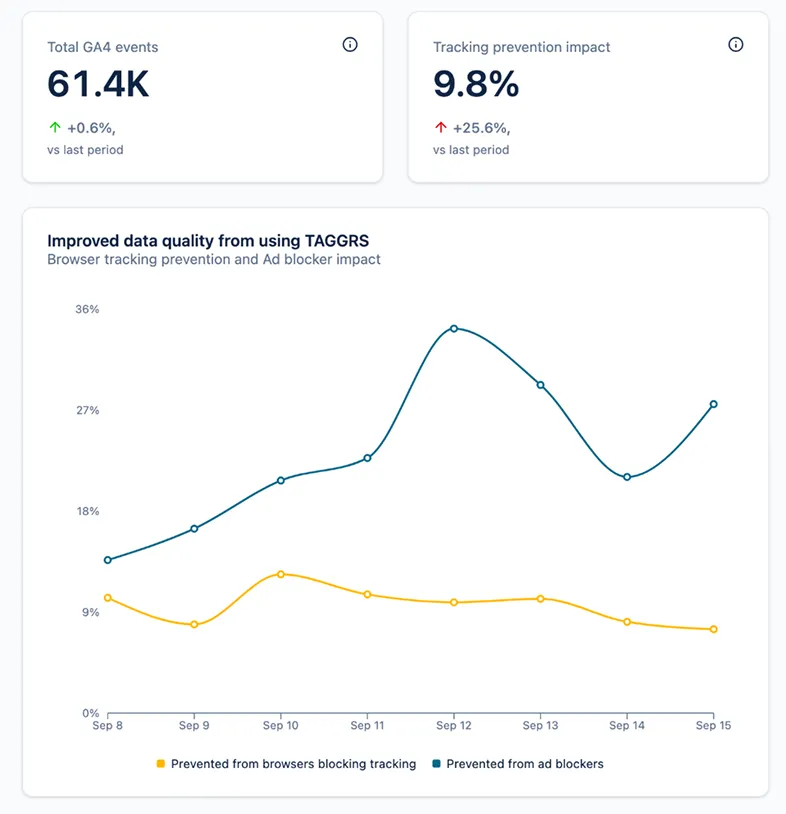
The TAGGRS dashboard shows how many of your events browser tracking prevention and ad blockers would otherwise have stopped.
Frequently asked questions
Should I use the Google Ads conversion tag or imported GA4 key events?
Use the Google Ads conversion tag for the conversions you bid on. Imported GA4 key events produce no view-through conversions, and GA4 credits a conversion to the day it happened, while Google Ads credits it to the day of the click. If you import key events as well, keep them secondary so a purchase is not counted twice for bidding.
Do I still need the Conversion Linker in a server-side setup?
Yes. The Conversion Linker in your server container stores the click ID from the landing page. Without it, server-side conversions cannot be tied to the ad click. Fire it on all pages.
Why does Google Ads count my conversions twice?
The most common cause is that a browser tag and a server tag both send the same conversion. Google Ads only drops a duplicate when both carry the same transaction ID for the same conversion action. Pass the order ID as the transaction ID, and remove the browser tag once the server tag works.
What do the enhanced conversions diagnostics show?
A status per conversion action, the share of conversions that carry customer data (coverage), how well that data matches Google accounts (match rate), and the extra conversions it brings in during the first 30 days. Find them on the Diagnostics tab of the conversion action.
Is Google Ads Server-side Tracking GDPR compliant?
It supports GDPR by letting you control and minimize what reaches Google, but it does not replace a lawful basis or consent. Set up Consent Mode v2 in the web container. The Google Ads tags in the server container follow the consent state, and remarketing gets no data when ad_personalization is denied. Read more in our guide to Server-side Tracking and the GDPR.
About the author

Content Marketer
Gosia Poddębniak is an experienced content marketer and writer with over five years in the SaaS, analytics, and SEO industries. At TAGGRS, she develops marketing materials across multiple channels and manages website content, covering topics such as data collection, marketing optimization, privacy, tracking, and analytics.