Shopify Server-side Tracking: Complete Setup Guide

 Ate Keurentjes | 22 July 2024 | Last updated:
 When you run a Shopify store, accurate conversion data is the foundation of every campaign decision. But getting that data is increasingly difficult in 2026. Ad blockers, iOS Intelligent Tracking Prevention (ITP), and third-party cookie restrictions are making client-side tracking unreliable. Shopify's web pixel sandbox dynamically rewrites checkout URLs, leading to incomplete checkout tracking and broken reporting.
Since January 2026, Shopify's default pixel setting changed to "Optimized," which can restrict or block your conversion data from reaching platforms like Meta, TikTok, or Google Ads. Merchants relying on client-side tracking alone typically miss 15-30% of their conversions. This means that your ad platform is optimizing on incomplete data and your ROAS figures may be significantly understated.
Server-side Tracking solves these issues by routing data through your own server rather than the browser, before it's sent to platforms like Meta, Google Ads or GA4. The data avoids browser-level limitations entirely and preserves the full lifespan of cookies. It also lets you control exactly what data gets shared and with whom, making privacy compliance way more manageable.
This guide walks you through how to set up Server-side Tracking for your Shopify store using Google Tag Manager and TAGGRS.
What is Server-side Tracking and what are its benefits?
Server-side Tracking is a method in which data is collected directly from the server rather than through the user's browser.
Advantages:
- More data for your campaigns: Collecting data through the server provides a more complete picture of user behavior.
- Accurate data: Server-side Tracking reduces the risk of data loss and errors. This is particularly relevant for Safari users, where ITP (Intelligent Tracking Prevention) aggressively blocks or shortens browser cookies.
- GDPR compliance: You control what data is collected, how it's stored and what gets passed to third parties. This lets you apply data minimization practices, helping you store and process data more securely and in compliance with privacy laws.
- Faster website: Less reliance on external scripts allows for faster load times, which is beneficial for conversion rates. Fewer third-party scripts loading in the browser reduces TBT and CLS – two Core Web Vitals that directly affect your Google search rankings.
- Longer cookie duration: Server-side cookies have a longer lifespan than browser cookies. They allow you to recognize returning customers and attribute conversions that happen days after the initial visit.
- Bypassing adblockers: Server-side Tracking is not blocked by adblockers, allowing you to collect more data.
See all the benefits of Server-side Tracking
What is the difference between client-side and Server-side Tracking
Client-side tracking refers to collecting data directly from your visitor’s browser. In Server-side Tracking, instead of the browser talking to Meta or Google directly, the first-party event data is sent to your own server first, which then forwards it to the ad platforms.
The Server-side equivalents of client-side pixels are:
- The Meta Conversions API (CAPI)
- Google Enhanced Conversions
- The TikTok Events API
The configuration logic is similar, but the container and the tags are set up differently.
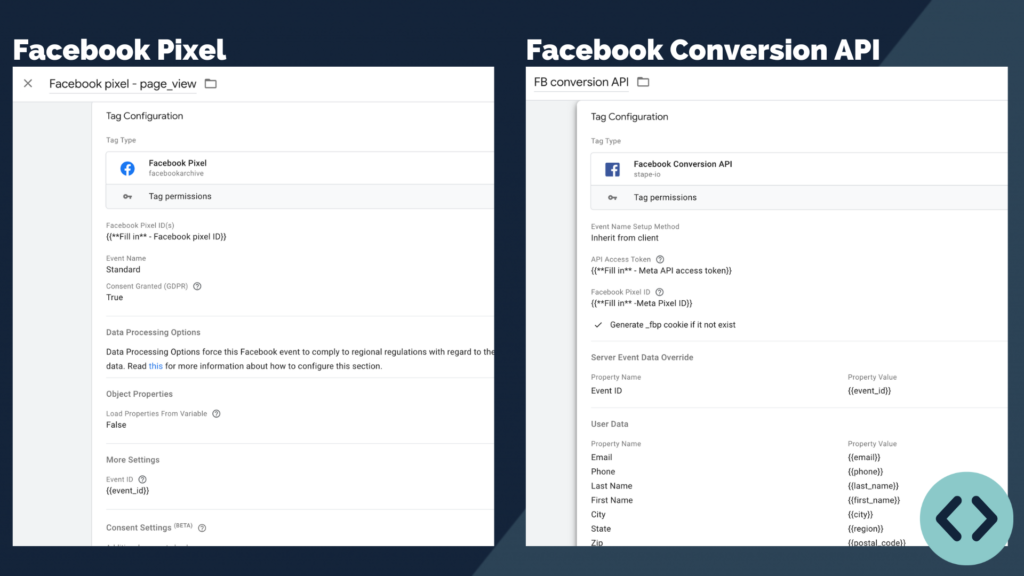
Not used to working with Google Tag Manager yet? Our templates and guides will help you figure it out on your own.
What Shopify merchants gain from Server-side Tracking
Here is how your Shopify store can benefit from Server-side Tracking.
Use case 1: Facebook - Additional data in dashboard
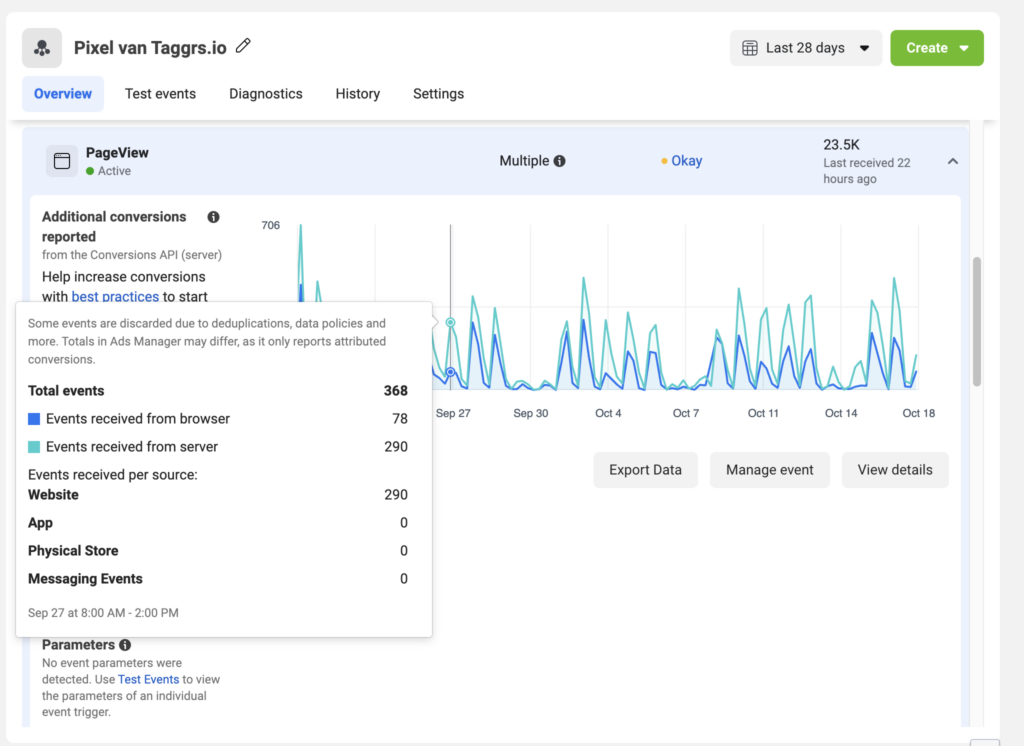
In the graphs to the right, you can see two events measured through the Meta Ads pixel. You can clearly see the difference between the measurements via the browser and the measurements via the server. The green line represents the server events and the blue line the browser events. In this example, this leads to 22% additional data.
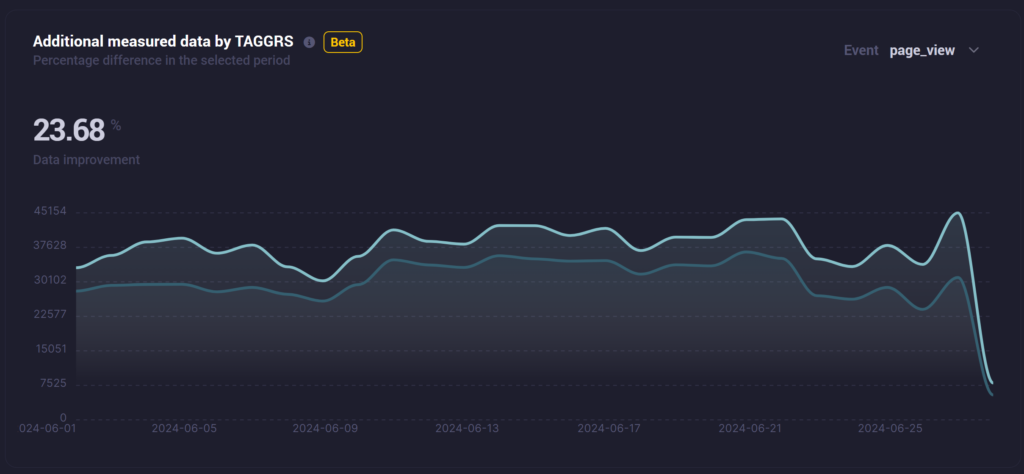
Use case 2: TAGGRS - Additional data in dashboard.
TAGGRS offers a range of Server-side Tracking analytics features that are important for anyone who wants to measure and analyze the effects of Server-side Tracking. Within the TAGGRS Analytics dashboard, you can measure the impact of Server-side Tracking across all your platforms.
Use case 3: Google Ads - Additional data in dashboard
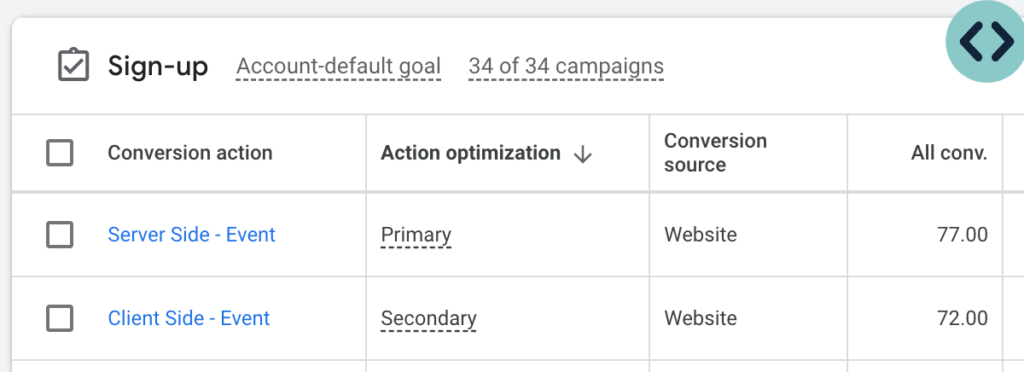
For testing, it is recommended that you first run your new Server-side Tracking configuration in parallel with your current setup in the web container. Server-side conversion often reports fewer conversions in the first two weeks because it does not yet have historical data. Once Server-side Tracking measures correctly, you can set Server-side Tracking conversions as primary and remove the web container conversions or set them to secondary.
You can then see the difference in the number of conversions measured in the Google Ads dashboard.
Implement Shopify Server-side Tracking with Google Tag Manager
Now that you know what server side tracking is and its benefits, it's time to set it up.
To get off to a good start, we've created a handy checklist you can follow
Before you can begin Server Side Tracking, the following points must be set up:
- Create a GA4 account and link it to your Google Tag Manager account
- Add a Shopify Data layer to your website.
Tip: The TAGGRS Shopify Data Layer app enables a fully compatible and efficient data layer on your website, and offers:
- Special character support in product names
- Support for Enhanced Tracking Script V3
- item_id field selection (SKU vs. variant ID vs. product ID relevant for stores where these differ)
- Correct variant data on add_to_cart events: value, price, size now passed accurately
Then, you need to create an account and container on TAGGRS. If you want to work with Server-side Tracking, you need a hosting provider. This will ensure that the data can flow through the servers.
Setting up platforms in Google Tag Manager
After covering the above points, you need to set up the platforms in Google Tag Manager that you want to measure. You have two options for this:
- Configure manually
- Using preconfigured templates.
For complete control over your tracking setup, you can choose to configure everything manually. This is ideal for companies looking to migrate or refine their existing tracking infrastructure. You can find these configuration guides within your TAGGRS Dashboard.

The quickest way is to use TAGGRS Templates. TAGGRS offers an extensive template gallery of pre-configured Server side tracking templates for popular content management systems, including Shopify. These templates speed up the implementation process and are fully customizable to your business needs.
In this case, we are going to use the templates. We are going to set up Server Side Tracking for the following platforms:
- GA4
- Google Ads
Shopify Template Download and Import
Within the TAGGRS Dashboard, go to the template gallery. Here you search for the desired Shopify template and download the JSON files.
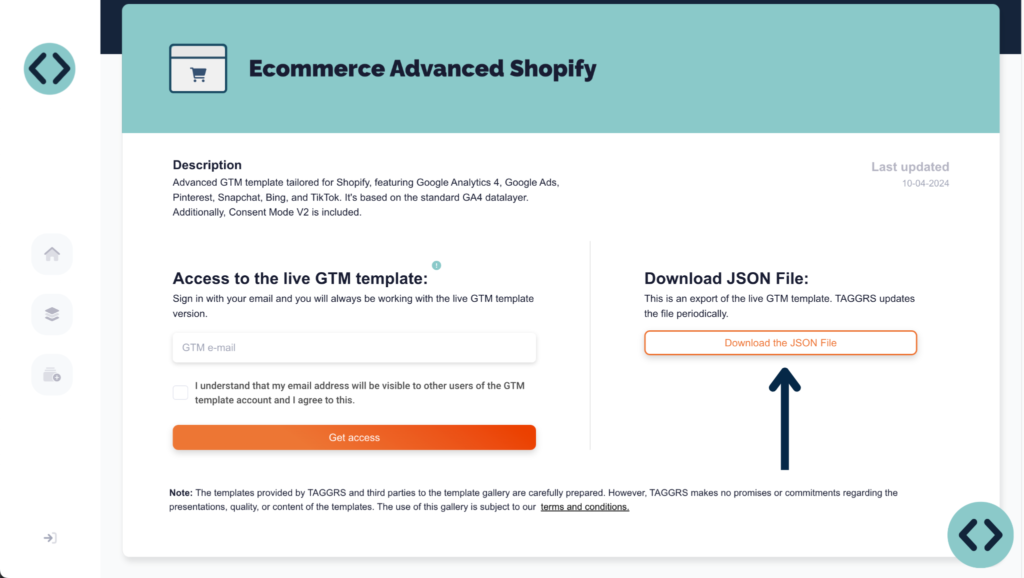
Next, extract the downloaded zip file and import the server and web container file into Google Tag Manager. You need to do this on a container-by-container basis.
Once the files are imported, it is time to pause or remove all unnecessary tags. In this case, we want to measure Facebook, GA4 and Google Ads, so we pause the rest of the tags.
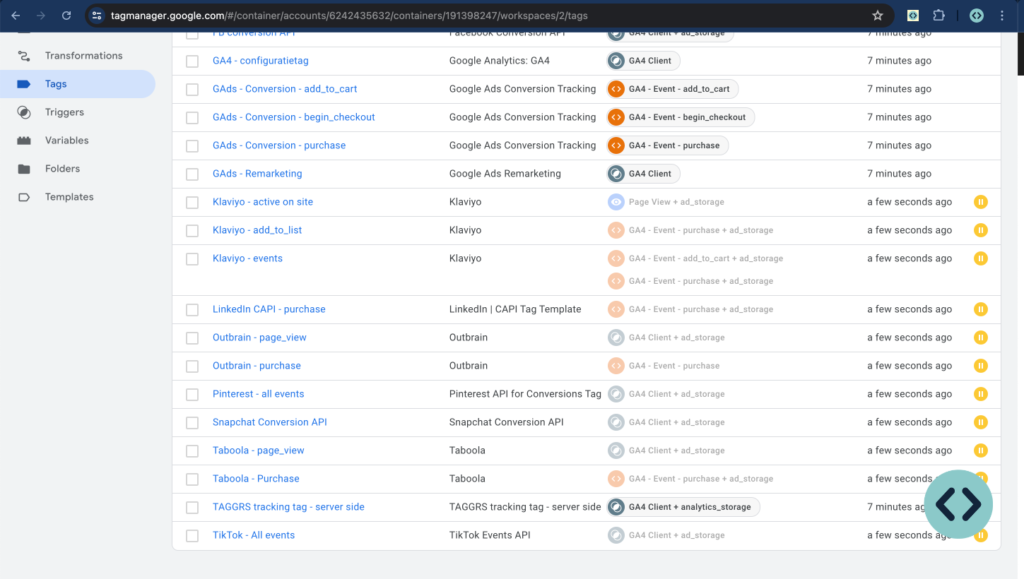
After pausing the redundant tags, enter the codes you need for the different platforms under Variables. These codes are then dynamically added to all tags. For example, you can add the TAGGRS Container ID variable to complete the configuration.
This is what a configuration might look like. TAGGRS offers much more than just server side tracking. For example, you can also set up profit tracking, but for most people the basics are sufficient.
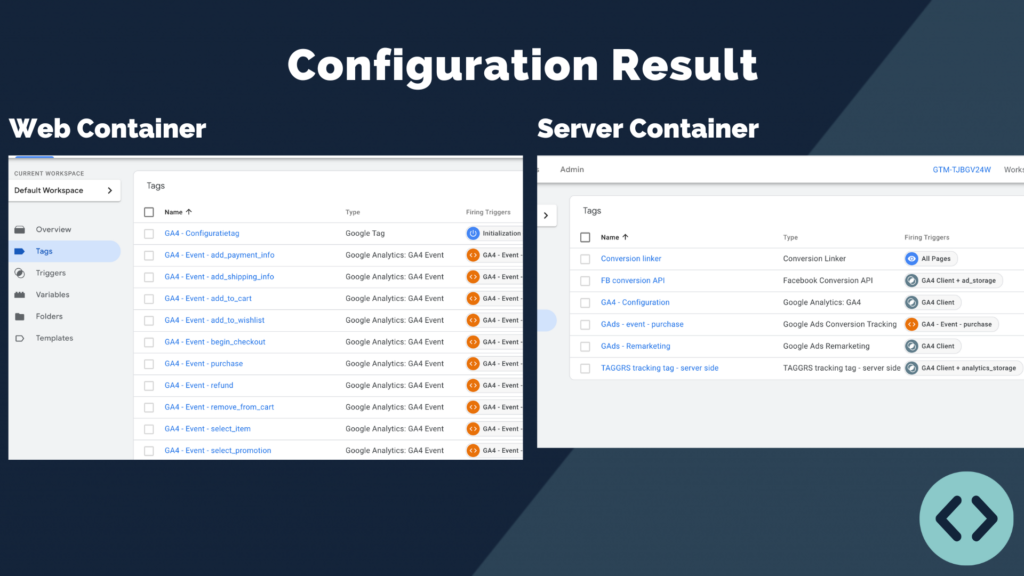
Once configured, it is important to test and debug your setup. Since this can sometimes be tricky, we've written a comprehensive testing roadmap. To enter preview mode, you need to add your subdomain URL to the container URLs in the server container.
Common Shopify Server-side Tracking mistakes to avoid
- Make sure you have a working data layer on your website. Without a functioning data layer, you can't measure many e-commerce events.
- Make sure there are no other direct links on your website. Another direct GA4 integration (not through Google Tag Manager) can cause problems because requests go through the additional integration and not through Google Tag Manager. This causes not all requests to be received correctly.
- Remove or pause all tags and triggers that are not being used. This helps prevent configuration errors. For example, if you don't use the Cookiebot tag, leaving it on may result in no more data coming in.
- Deduplication: When running both client-side and Server-side Tracking in parallel, make sure event deduplication is configured correctly. Without it, platforms like Meta and Google will count the same conversion twice, inflating your reported ROAS. Getting deduplication right is also the foundation for sending Meta richer purchase data. See how to optimize your Shopify events for lifetime value.
View the step-by-step configuration guides within the TAGGRS dashboard or consult our support platform if you are experiencing problems with the templates.
Additional tools to optimize your tracking
To further optimize your tracking and improve data quality, you can use specific TAGGRS tools. For example, if you’re impacted by Apple’s Intelligent Tracking Prevention from the iOS 16.4 update, you can install our cookie recovery tool and a Server Side CDN.
Conclusion
Between iOS restrictions, ad blockers, and Shopify's optimized pixel settings, client-side tracking alone leaves you with a dangerously incomplete picture of your conversions. As a result, Shopify Server-side Tracking is a necessity for any store running paid ads in 2026.
By routing your event data through your own server using Google Tag Manager and TAGGRS, you recover lost conversions, improve attribution accuracy, and gain full control over your first-party data.
Ready to set it up? Create a free TAGGRS account or book a personalized demo.
FAQ
What is Server-side Tracking for Shopify?
Does Shopify support Server-side Tracking natively?
How does the Meta Conversions API work with Shopify?
Is Server-side Tracking GDPR-compliant?
How much does Server-side Tracking cost for Shopify?