Pinterest Server-side Tracking: how to set up the Pinterest Conversions API
Set up the Pinterest Conversions API alongside the Pinterest Tag: deduplication, user data, Event Quality Score and the right server-side route.

Content Marketer
23 min read
Pinterest Server-side Tracking sends your conversion events to Pinterest from a server you control, through the Pinterest Conversions API, instead of relying only on the Pinterest Tag in the visitor’s browser. Most setups run both: the Tag keeps reporting from the browser while your server sends a matching copy of each event, and a shared event ID tells Pinterest the two describe the same checkout so it is counted once.
Deduplication is where most setups go wrong. Pinterest only recognizes two copies as one event when they carry the same event ID. When the IDs don’t match, both copies count, and every report and bidding decision after that uses the inflated number.
This guide covers how to set up both sources, how deduplication works, how Pinterest rates your setup in its Event Quality Score, and which server-side route to Pinterest fits your setup.
What is Pinterest Server-side Tracking?
The Pinterest Conversions API is Pinterest’s server-to-server connection for conversion events. Instead of only the visitor’s browser sending an event through the Pinterest Tag, your server sends a copy too, with the confirmed order data attached. A shared event ID tells Pinterest that both copies describe the same action.
Browser restrictions, ad blockers and privacy tools stop part of the Tag’s events before they reach Pinterest. The server copy does not depend on the browser, so those conversions still arrive. Read why your tracking setup is missing conversions for the wider picture.
Main benefits
A better Event Quality Score
Pinterest can only tie a conversion to a person when identifying data travels with the event. Server-side, you take the external ID, email and order details from the order record rather than from whatever the browser happened to hold. External ID, order ID and order value are among the parameters Pinterest weighs most in its Event Quality Score.
Conversions that happen outside the browser
Offline sales, CRM stage changes and leads that close later never reach the browser, so the Tag has nothing to capture. The Conversions API accepts web, app and offline events, so your server container can forward data from your CRM or other sources as well.
Control over what Pinterest receives
Events pass through a server container you control, so you decide which fields are forwarded, which are hashed and which are held back.
Better ad targeting and optimization
Pinterest optimizes delivery and builds audiences from the conversions it receives. When part of your checkouts never reach it, it learns from a partial sample. More complete conversion data gives it more to optimize on, which is how Server-side Tracking helps you raise ROI and lower customer acquisition costs.
Server-side Tracking can’t recover an interaction your site never captured, but it stops the browser from deciding whether a conversion counts. Learn how Server-side Tracking improves Smart Bidding and automated campaign performance.
| Criterion | Browser only | Server-side with TAGGRS |
|---|---|---|
| Customer data | Neutral: What the browser happens to hold | Advantage: From the order record |
| Browser restrictions and ad blockers | Drawback: Only what the browser lets through | Advantage: Less affected |
| Offline sales and CRM stages | Drawback: Not tracked | Advantage: Sent through the Conversions API |
| Order value | Neutral: What the page shows | Advantage: The confirmed order value |
| Control over what Pinterest receives | Drawback: Limited | Advantage: Filter, hash or hold back fields |
“We gradually started seeing data that didn't add up – collections that were selling far better in the back end than our campaigns were showing at the front. With the new webshop, we no longer wanted to depend on data that slowly falls away. That meant combining our new Shopify store with a tracking upgrade from the start. Thanks to months of preparation, Server-side Tracking now lets us work from data that actually holds up and sits far closer to the truth.”
Pinterest Tag, Conversions API or both?
Running the Conversions API does not mean removing the Pinterest Tag. Pinterest’s Event Quality Score rates the Tag and the Conversions API as separate sources and checks how well their events overlap, so it expects both. The two see different things.
| The Pinterest Tag sees | The Conversions API sees |
|---|---|
| The page URL and the browser context | The confirmed order value |
| The _epik click ID cookie | The customer record behind the order |
| What happens during the session | Conversions after the session has ended |
| Only what the browser lets through | Offline and CRM conversions |
For most advertisers with a website, the answer is both sources sending the same events, deduplicated. Step 4 below explains how.
Pick Pinterest in the checker below to see which container it goes in and how to configure it.
Interactive tool
Where does your platform belong?
Select a platform to see which container it goes in, why, and how to configure it correctly.
Google Analytics 4
Container:Both containersWeb container + server container.
Why
GA4 is the foundation of every server-side setup. The GA4 Config tag runs in the web container and sends data to the server container — feeding every downstream tag including Google Ads. Without server-side GA4 in place, no other platform in the server container receives data correctly.
Configuration steps
- Add GA4 Config tagIn your web container, add a GA4 Configuration tag. Set the Measurement ID and point the server container URL to your first-party tagging subdomain (e.g.
sst.yourdomain.com). - Deploy server container on TAGGRSConnect your GTM server container to TAGGRS. Your tagging subdomain must be a first-party subdomain of the tracked domain.
- Add GA4 server tagIn your server container, add the GA4 tag. It will automatically receive events forwarded by the web GA4 Config tag.
- Verify data flowUse GTM Preview mode and GA4 DebugView to confirm events are arriving in the server container before going live.
- Add GA4 Config tagIn your web container, add a GA4 Configuration tag. Set the Measurement ID and point the server container URL to your first-party tagging subdomain (e.g.
Google Ads
Container:Server container onlyAll data flows from the server. No browser tag.
Why
Google Ads server-side measurement depends entirely on GA4 being configured in both containers first. Once GA4 is set up, all Google Ads tags — Conversion Tracking and Remarketing — run exclusively in the server container.
Configuration steps
- Set up GA4 in both containers firstGoogle Ads has a hard dependency on GA4. Complete the GA4 server-side setup before adding any Google Ads tags.
- Add Conversion Linker tagIn your server container, add the Conversion Linker tag. This attaches click data to conversion events — the most commonly skipped step, and the one that breaks attribution when missing.
- Add Google Ads Conversion Tracking tagIn your server container, add the Google Ads Conversion Tracking tag. Configure your Conversion ID and label from your Google Ads account.
- Add Google Ads Remarketing tag (optional)If you run remarketing campaigns, add the Google Ads Remarketing tag to the server container. Same dependency chain as Conversion Tracking.
- Test with Tag AssistantVerify the full chain: GA4 Config (web) → GA4 server tag → Conversion Linker → Google Ads tag. Confirm conversions appear in Google Ads → Measurement → Conversions.
Meta / Facebook
Container:Both containersWeb container + server container.
Why
Meta recommends running both the browser pixel and server CAPI simultaneously to maximise match rates and event coverage. Running both increases the chance that each conversion is attributed correctly — even when the browser signal is blocked or degraded.
Deduplication required. When both the browser pixel and server CAPI fire for the same event, Meta receives it twice. You must pass a matching
event_idin both the browser and server events. Meta uses this ID to deduplicate and count the conversion once.Configuration steps
- Keep Meta Pixel in the web containerYour existing Meta Pixel tag stays in the web container. Do not remove it — the browser signal improves match rates.
- Add Meta CAPI tag in the server containerIn your server container, add the Meta Conversions API tag. Configure your Pixel ID and Meta access token.
- Implement event_id deduplicationGenerate a unique
event_idfor each event (e.g. a UUID or timestamp-based string). Pass the sameevent_idin both the browser pixel event and the server CAPI event. Meta matches them and counts once. - Test in Meta Events ManagerGo to Meta Events Manager → Test Events. Confirm events arrive from both browser and server, and that duplicate events are being deduplicated correctly.
TikTok
Container:Both containersWeb container + server container.
Why
TikTok recommends running the Pixel and the Events API together with event deduplication to maximise performance. The Pixel alone can miss conversions due to browser inconsistencies and connectivity issues. The Events API recovers those gaps. Run both in parallel and pass a matching
event_idso TikTok merges duplicates.Deduplication required. When both the Pixel and Events API fire for the same event, TikTok receives it twice. Pass a matching
event_idin both the browser and server events. TikTok uses this ID to merge duplicates and count the conversion once.Configuration steps
- Keep TikTok Pixel in the web containerYour existing TikTok Pixel tag stays in the web container. Do not remove it — TikTok recommends Pixel + Events API as a dual setup.
- Add TikTok Events API tag in the server containerIn your server container, add the TikTok Events API tag. Configure your Pixel ID and TikTok access token.
- Implement event_id deduplicationGenerate a unique
event_idfor each event (e.g. a UUID or timestamp-based string). Pass the sameevent_idin both the browser Pixel event and the server Events API event. TikTok matches them and counts once. - Confirm user data hashingThe server tag automatically transforms user data (email, phone) to lowercase and hashes it using SHA256 before sending to TikTok. Verify this is active in the tag settings.
- Verify in TikTok Events ManagerGo to TikTok Ads Manager → Assets → Events → Web Events (or Test Events). Confirm events arrive from both browser and server, and that matching events are deduplicated.
Pinterest
Container:Both containersWeb container + server container.
Why
Pinterest follows the same dual-signal logic as Meta: browser tag and Conversions API run in parallel. Both channels together give Pinterest the highest-fidelity view of conversion activity, improving attribution and campaign optimisation.
Deduplication required. With both the browser tag and Conversions API active, Pinterest receives each event from two sources. Pass a matching deduplication key in both the browser and server events so Pinterest counts each conversion once.
Configuration steps
- Keep Pinterest Tag in the web containerYour existing Pinterest Tag stays in the web container. It continues to fire on browser-level events.
- Add Pinterest Conversions API tag in the server containerIn your server container, add the Pinterest Conversions API tag. Configure your Tag ID and the access token you generate in Ads Manager.
- Set up event deduplicationPass a consistent deduplication key in both the browser and server events. Pinterest uses this to match and deduplicate conversion events.
- Test with Pinterest Tag HelperUse the Pinterest Tag Helper Chrome extension and Pinterest Events Manager to confirm events arrive from both channels and are deduplicated correctly.
LinkedIn
Container:Both containersWeb container + server container.
Why
The LinkedIn Insight Tag runs client-side in the web container for audience building and page view data. Conversion events are also sent server-side via LinkedIn CAPI. LinkedIn calls this a redundant setup: when both match, LinkedIn keeps the Insight Tag event and discards the CAPI copy. The server path still covers cases where the browser tag never fires.
Deduplication required. LinkedIn uses an
eventIdto match browser and server conversion events. Pass the sameeventIdin both. When both match, LinkedIn keeps the Insight Tag event and discards the Conversions API copy.Configuration steps
- Keep LinkedIn Insight Tag in the web containerThe Insight Tag stays in the web container for audience building and page view tracking.
- Add LinkedIn CAPI tag in the server containerIn your server container, add the LinkedIn Conversions API tag. Configure your LinkedIn Ad Account ID and access token.
- Configure eventId deduplicationPass a matching
eventIdin both the browser Insight Tag and the server CAPI event. LinkedIn uses this to deduplicate. Note:conversion_ididentifies the conversion rule — it is not the deduplication key. - Verify in LinkedIn Campaign ManagerGo to LinkedIn Campaign Manager → Analyze → Conversion Tracking. Confirm both Insight Tag and CAPI events show, and that redundant matches are deducted from the CAPI count.
Snapchat
Container:Both containersWeb container + server container.
Why
Snap Pixel runs in the web container; Snap Conversions API runs in the server container. Both channels run in parallel. The server tag automatically normalises and hashes user parameters — including email, mobile identifier, IP address, and phone number — before sending to Snap.
Deduplication required. Set the same ID on both sides:
client_dedup_idin the browser Snap Pixel andevent_idin the server Conversions API events. Snapchat uses this to deduplicate and count each conversion once.Configuration steps
- Keep Snap Pixel in the web containerYour existing Snap Pixel tag stays in the web container. It continues to fire browser-level events.
- Add Snapchat Conversions API tag in the server containerIn your server container, add the Snapchat CAPI tag. Configure your Snap Pixel ID and access token.
- Confirm user data normalisationThe tag automatically normalises and hashes email, phone, IP address, and mobile identifier using SHA256. Verify this is enabled in the tag configuration.
- Implement deduplicationPass one ID as
client_dedup_idin the Snap Pixel and asevent_idin the Conversions API, so Snapchat deduplicates correctly. - Test in Snap Events ManagerGo to Snap Ads Manager → Events Manager. Confirm events arrive from both channels and are being deduplicated.
Klaviyo
Container:Server container onlyAll data flows from the server. No browser tag.
Why
Klaviyo does not support event deduplication. Running both browser and server tracking sends every event twice. Configure server-side only. The tag communicates directly with the Klaviyo API and supports adding contacts, tracking on-site activity, and sending event parameters.
Configuration steps
- Remove any existing Klaviyo browser tagIf you have a Klaviyo JavaScript snippet in your web container or site code, disable it before adding the server-side tag. Running both creates duplicate events.
- Add Klaviyo tag in the server containerIn your server container, add the Klaviyo tag. Configure your Klaviyo Public API Key and Private API Key.
- Configure supported actionsThe tag supports three action types: track events, create or update a contact, and create or update a contact + track event simultaneously. Configure the action type per trigger.
- Test via Klaviyo Activity FeedGo to your Klaviyo account → Profiles. Trigger a test event and confirm it appears in the profile activity feed without duplicates.
ActiveCampaign
Container:Server container onlyAll data flows from the server. No browser tag.
Why
ActiveCampaign connects via API from the server container. The tag tracks events, creates or updates contacts, and can combine both actions in a single call. Configure server-side only for clean, deduplicated data into your CRM.
Configuration steps
- Obtain your ActiveCampaign API credentialsIn your ActiveCampaign account, go to Settings → Developer to find your API URL and API Key.
- Add ActiveCampaign tag in the server containerIn your server container, add the ActiveCampaign tag. Enter your API URL and API Key in the tag configuration.
- Select the action typeChoose from three action types: Track event, Create or update contact, or Create or update contact + track event. Set the appropriate trigger for each action.
- Map event and contact parametersConfigure which data layer variables map to ActiveCampaign event names, contact email, and any custom fields you want to populate.
- Test in ActiveCampaignTrigger a test event and confirm it appears in ActiveCampaign under Contacts → Activity or Reports → Event Tracking.
Hotjar
Container:Web container onlyNo server-side setup needed.
Why
Hotjar records sessions, heatmaps, and on-page user behaviour directly in the browser. It works by observing DOM interactions — mouse movements, scroll depth, and clicks — which only exist in the browser environment. There is no server-side equivalent, and none is needed: Hotjar does not send conversion signals to ad platforms, so there is no signal loss problem to solve here. Keep it in your web container and leave your server container untouched.
Configuration steps
- Keep Hotjar in the web containerAdd the Hotjar tracking code via a Custom HTML tag in your web container, or install it directly in your site’s
<head>. Either approach is correct. - No server container changes neededDo not add Hotjar to your server container. It has no API equivalent and routing it server-side would break its functionality entirely.
- Keep Hotjar in the web containerAdd the Hotjar tracking code via a Custom HTML tag in your web container, or install it directly in your site’s
Microsoft Clarity
Container:Web container onlyNo server-side setup needed.
Why
Microsoft Clarity works the same way as Hotjar: session recordings and heatmaps captured directly in the browser. It relies on observing real DOM interactions and cannot function outside the browser context. It is free, integrates natively with GA4, and is widely used alongside server-side setups — just not as part of them.
Configuration steps
- Add Clarity via GTM web containerIn your web container, add a Custom HTML tag with the Microsoft Clarity script. Set it to fire on All Pages.
- Connect to GA4 (optional)In the Clarity dashboard, link your GA4 property to see session recordings alongside GA4 segments. This connection is made inside Clarity — no GTM changes needed.
- No server container changes neededClarity has no server-side API. Keep it client-side only.
LiveChat
Container:Web container onlyNo server-side setup needed.
Why
LiveChat injects a chat widget into the browser DOM and detects page activity, user idle time, and scroll behaviour to trigger conversations at the right moment. All of this requires direct browser access. The widget cannot be loaded or managed from a server container.
Configuration steps
- Add LiveChat via GTM web containerIn your web container, add a Custom HTML tag with the LiveChat tracking code snippet. Fire it on All Pages.
- No server container changes neededLiveChat has no server-side API for widget delivery. It is a browser-only tool by design.
Zendesk Chat
Container:Web container onlyNo server-side setup needed.
Why
Zendesk Chat (Web Widget) renders a live chat interface directly in the browser. It uses client-side JavaScript to display the widget, detect visitor behaviour, and manage real-time conversations. Like all chat widgets of this type, it depends entirely on browser context and cannot be routed through a server container.
Configuration steps
- Add Zendesk Web Widget via GTM web containerIn your web container, add a Custom HTML tag with the Zendesk Web Widget snippet from your Zendesk account (Admin Center → Channels → Messaging). Fire on All Pages.
- No server container changes neededThe Zendesk Web Widget is browser-only. No server-side configuration is required or possible.
Typeform
Container:Web container onlyNo server-side setup needed.
Why
Typeform embedded forms and popups run entirely in the browser. They rely on client-side JavaScript to render the form, respond to user input, and trigger display logic (scroll-based, time-based, or exit intent). Typeform does offer a Responses API for pulling submission data server-to-server, but the embed itself is browser-only and belongs in the web container.
Configuration steps
- Embed Typeform via GTM web containerIn your web container, add a Custom HTML tag with the Typeform embed snippet or use the standard
<script>+<div>embed method. Set the trigger based on your display logic (All Pages, specific page, or a custom event). - No server container changes neededThe Typeform embed is client-side only. If you need to push form submission data into your data layer for conversion tracking, use Typeform’s hidden fields or webhook → server integration — but the embed itself stays in the web container.
- Embed Typeform via GTM web containerIn your web container, add a Custom HTML tag with the Typeform embed snippet or use the standard
Choose your server-side route
Pinterest lists three ways to set up the Conversions API. Which one fits depends on how many platforms you track and who does the work.
| Route | Best for | What to know |
|---|---|---|
| Conversions API through server-side GTM | Sites that also send data to GA4, Google Ads or other platforms | Full control over fields and consent. Pinterest estimates 1 to 4 hours for a tag manager setup. Needs a server container. |
| Commerce platform or partner integration | Stores on a platform Pinterest partners with, such as Shopify or WooCommerce | Which events and parameters are sent, and how much you can configure, depends on the partner. |
| Direct integration | Teams with developers who want to call the API themselves | Free, and supports web, app and offline events. Pinterest estimates 2 to 4 weeks of developer work. |
Server-side Tracking and GDPR
Server-side Tracking gives you one place to apply consent decisions and data minimization before anything reaches Pinterest. With TAGGRS, you decide which information is collected and forwarded, and you can filter or anonymize sensitive fields such as IP addresses or client IDs before they leave TAGGRS servers.
Processing data on TAGGRS infrastructure and keeping tracking IDs off the client side reduces the risk of data reaching destinations you did not choose. With server-side GTM hosting, you choose where your server processes data, including locations within the EU, so your Pinterest conversion data can be processed in line with local data residency rules.
This supports GDPR principles such as data minimization and purpose limitation. It does not replace a lawful basis for processing. An event a visitor declined should not be sent at all, whether it comes from the browser or your server, and your consent management platform still has to set consent states before any tag processes advertising data. Read more in Server-side Tracking and the GDPR and on our security page.
Expert insight. When someone clicks a Pin ad, they land on a URL with tracking parameters such as UTM tags. If Safari has classified the referring domain as a cross-site tracker, any cookie written by JavaScript on that landing page, such as the Pinterest Tag’s _epik cookie, is capped at one day. A checkout two days later then can’t be tied back to the click. A cookie set by your own server through the Set-Cookie header is not subject to this cap, as long as the server runs on your own domain (see step 1).
Set up Pinterest Server-side Tracking
Our documentation includes step-by-step guides for each part of the setup in Google Tag Manager. Work through them in this order.
In the video below, Lowie Verschelden shows step by step how to set up Pinterest Server-side Tracking.
1. Create a server container in Google Tag Manager
A server container is where your events arrive before they are forwarded to Pinterest, and it lets you manage your server-side tags in one place without changing your website’s code. It runs on a first-party tagging URL on your own domain, such as sending.example.com. Pointing a subdomain at an external service is not enough on its own, because Safari compares IP addresses before it decides whether to extend a cookie’s lifetime.
2. Install the Pinterest Tag
The Pinterest Tag tracks what people do on your website after they see your Pin, and it stays in place in a server-side setup. It captures browser context the server cannot see and supplies one half of each deduplicated pair. Install it through your GTM web container with your Tag ID from Ads Manager, so the event ID in step 4 can be passed to both tags from one place.
3. Set up the Pinterest Conversions API
The Conversions API tag lives in your server container and sends events directly from your server to Pinterest. It needs your Tag ID and an access token, which you generate in Ads Manager under Conversions. Send each event to the same Tag ID as your browser events, so Pinterest can match the two.
Every event needs an event name, an action source, an event time and an event ID, plus at least one way to identify the person: a hashed email, a hashed mobile ad ID, or the IP address together with the user agent. Email, phone, name, city, country, zip code and external ID are hashed with SHA-256 before they leave your server. The IP address, the user agent and the click ID, the value of the _epik cookie, are sent as they are.
4. Set up event deduplication
Running the Tag and the Conversions API together means Pinterest receives two copies of every checkout. Deduplication is what stops it counting them as two.
Pinterest matches the two copies on the event ID, and both sources need to send the event name too. Generate the ID once, at the moment of the action, push it to the data layer and pass the same value to the Pinterest Tag and to the Conversions API tag as event_id. An ID generated separately inside each tag will never match, which is the most common reason a setup starts double counting.
Keep in mind:
- Pinterest keeps the first copy it receives and removes duplicates that arrive within 48 hours.
- The ID has to be unique per action. Reusing one value for different checkouts removes real conversions as duplicates.
- The overlap score in your Event Quality Score shows whether deduplication works (see below).
Check your Event Quality Score
The Event Quality Score shows how effective the customer information and event details you send are at matching your events to Pinterest users. Find it in Ads Manager under Conversions, then Event Quality. Pinterest rates each source, such as the Tag and the Conversions API, as Good, Fair or Needs improvement.
A Good rating requires three important customer identifiers, important event details such as order ID, value and currency, and an overlap score above 90% for all events. Fair requires two of the three identifiers, one important event detail, and an overlap above 90% for lower-funnel events such as checkout. The overlap score is the deduplication check: it depends on the Tag and the Conversions API sending the same event ID.
For web events, Pinterest weighs IP address with user agent, external ID, page URL, order ID, order value, currency and event ID highest. Click ID and phone number count for less, and name, address and date of birth least. Click a parameter in the Event Quality view to see its coverage and the issue to fix.
Test your setup
Send test events before you rely on the numbers. Open Preview mode in your web and server containers, trigger a checkout on your site and check that the Pinterest Tag and the Conversions API tag fire with the same event ID. Requests sent with test=true go to a sandbox that is not used for reporting or optimization, and they appear under Test events in the Conversions section of Ads Manager.
On the browser side, the Pinterest Tag Helper browser extension shows which Tag events fire on a page. Then check the overlap in your Event Quality Score. If it stays low, your event IDs are not matching and step 4 needs checking. Do this before you rely on the numbers for bidding, because an inflated conversion count goes straight into Pinterest’s optimization.
How TAGGRS helps
TAGGRS hosts your server container, so you can run the Pinterest Conversions API without managing a server yourself.
- Server-side GTM hosting on your own subdomain, for first-party requests and longer cookie lifetimes.
- Data Enricher adds non-sensitive context such as city, region and device to your events.
- Cookie Recovery and Click ID Recovery help keep click IDs available across long purchase journeys.
- Ready-made templates and a GTM copy-paste option to speed up the setup.
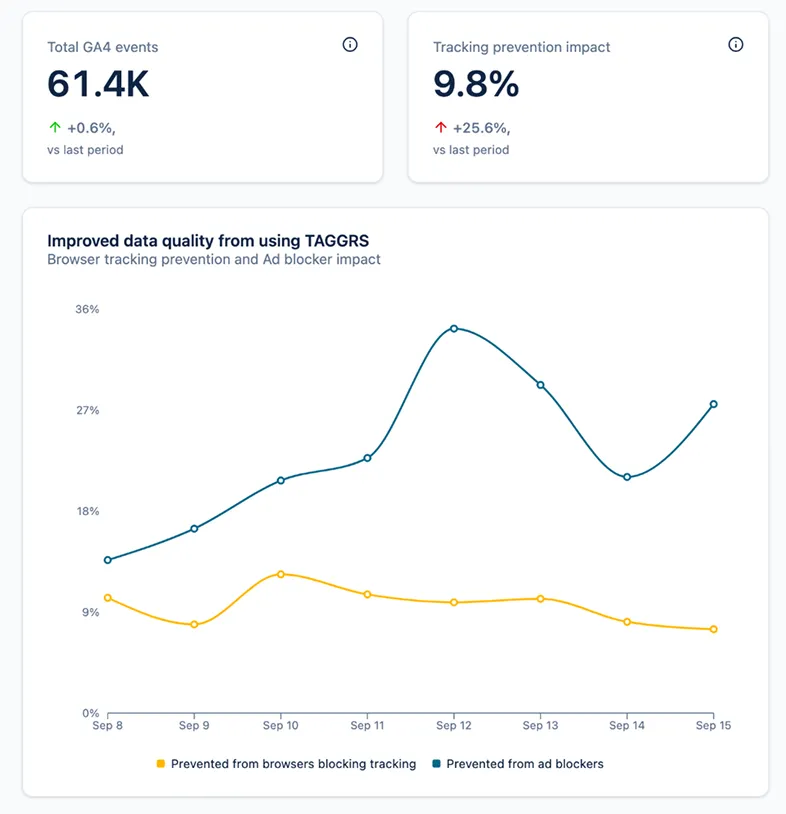
The TAGGRS dashboard shows how many of your events browser tracking prevention and ad blockers would otherwise have stopped.
Frequently asked questions
Do I need both the Pinterest Tag and the Conversions API?
Yes. The Tag captures browser context such as the page URL and the _epik click ID, and the server sends confirmed order data and conversions that happen outside the browser. Pinterest’s Event Quality Score rates both sources and checks how well their events overlap.
Why does Pinterest count my conversions twice?
The most common cause is that the event IDs from the Tag and the Conversions API don’t match. Generate one event ID at the moment of the action and pass it to both tags. Pinterest keeps the first copy and removes duplicates that arrive within 48 hours.
What is a good Event Quality Score on Pinterest?
Good is the top rating. It requires three important customer identifiers, important event details such as order ID and value, and an overlap score above 90% for all events. Fair means you meet the minimum but should improve.
Which data does Pinterest need to be hashed?
Email, phone, name, city, state, country, zip code, gender, date of birth and external ID are hashed with SHA-256. The IP address, user agent and click ID are sent as they are.
Is Pinterest Server-side Tracking GDPR compliant?
It supports GDPR by letting you control and minimize what reaches Pinterest, but it does not replace a lawful basis or consent. Events a visitor declined should not be sent from the browser or the server. Read more in our guide to Server-side Tracking and the GDPR.
About the author

Content Marketer
Gosia Poddębniak is an experienced content marketer and writer with over five years in the SaaS, analytics, and SEO industries. At TAGGRS, she develops marketing materials across multiple channels and manages website content, covering topics such as data collection, marketing optimization, privacy, tracking, and analytics.