GA4 Server-side Tracking: how to set up GA4 in a server container
Route GA4 through a server container: the Google tag, the GA4 client and tag, server-managed cookies, the Measurement Protocol and a test for double counting.

Content Marketer
23 min read
GA4 Server-side Tracking sends your Google Analytics 4 events through a server container you control before they reach Google, instead of straight from the visitor’s browser. The Google tag still runs on your site, but it sends its requests to your own subdomain, where the server container receives them and forwards them to GA4.
Most GA4 setups go wrong at the handover between the two containers. If a tag in the browser keeps sending an event directly to Google while the same event also goes through the server, GA4 counts it twice. GA4 has no event ID to merge the two copies. Only purchases that repeat a transaction ID are dropped.
This guide covers what the web container and the server container each do, the two server-side routes into GA4, how to set up both containers in five steps, and how to test that every event arrives once.
What is GA4 Server-side Tracking?
GA4 Server-side Tracking routes your Google Analytics 4 events through a server container on your own subdomain. The Google tag in the browser sends each event there, a GA4 client receives it, and a GA4 tag forwards it to your property. In between, you decide which parameters Google receives.
You keep your existing GA4 property. Browser-side and server-side collection can run side by side in it, as long as each event takes only one of the two paths.
For why GA4 numbers drift away from your ad platforms, see why your GA4 ROAS is inaccurate.
Main benefits
Returning visitors stay recognizable
GA4 recognizes a returning visitor by a client ID stored in a cookie. When the browser deletes that cookie early, the next visit counts as a new user and a later conversion loses its original source. A server container on your own domain can set the client ID cookie itself, which browsers treat more leniently than a cookie written by JavaScript. The expert insight below explains the details.
Fewer events lost in the browser
The Google tag sends its requests to your own subdomain instead of to Google’s collection endpoints. Filters that block requests to those domains no longer catch them, so more page views and conversions reach your property.
Control over what Google receives
Every event passes through a server container you control. You can remove or rewrite parameters before they are forwarded, for example to strip personal data that slipped into a page URL, and send the same event to Google Ads or other platforms from the one stream.
Data from outside your website
The server container also accepts requests from your own systems. A qualified lead in your CRM or a refund in your shop backend can reach GA4 next to the website events, so your reports reflect what happened after the visit.
Server-side Tracking can’t recover an interaction your site never captured, and it doesn’t change what a visitor consented to. What it changes is where your data goes after the browser and who controls it.
| Criterion | Browser only | Server-side with TAGGRS |
|---|---|---|
| Client ID cookie | Drawback: Browsers can delete it early | Advantage: Set from your own subdomain |
| Filters that block Google domains | Drawback: Requests can be blocked | Advantage: Requests go to your own subdomain |
| Personal data in page URLs | Drawback: Sent along with the event | Advantage: Stripped before it leaves |
| Events from your CRM or backend | Drawback: Not tracked | Advantage: Sent alongside website events |
| Control over what GA4 receives | Drawback: Limited | Advantage: Remove or rewrite parameters |
“Before switching to Server-side Tracking, we noticed more and more that data in our dashboards was far apart. Clicks in Google Ads were totally not comparable with what we saw in Google Analytics. The same was true for Meta ads. That made us look for a solution, which led us to Server-side Tracking.”
Web container, server container or both?
GA4 Server-side Tracking always needs both containers. They do different jobs, and neither replaces the other.
| The web container | The server container |
|---|---|
| Runs the Google tag and your GA4 event tags | Receives the requests with the GA4 client |
| Reads the data layer: pages, products, orders, forms | Forwards events to your property with the GA4 tag |
| Captures browser context such as page URL and referrer | Removes or rewrites parameters before they leave |
| Reads the consent state from your consent banner | Can set the client ID cookie from your own subdomain |
There is no deduplication step like the one Meta needs. Point the Google tag at your server container and every event it sends takes the server path, once. Google describes hybrid setups, where some events go directly to GA4 and others through the server, as common. They work as long as no event takes both paths.
The one safety net is the transaction ID. GA4 drops a purchase that repeats a transaction ID already received from the same user, on web streams only. Never send an empty transaction ID: GA4 treats every purchase with an empty value as a duplicate of the others.
Pick Google Analytics 4 in the checker below to see which container it goes in and how to configure it.
Interactive tool
Where does your platform belong?
Select a platform to see which container it goes in, why, and how to configure it correctly.
Google Analytics 4
Container:Both containersWeb container + server container.
Why
GA4 is the foundation of every server-side setup. The GA4 Config tag runs in the web container and sends data to the server container — feeding every downstream tag including Google Ads. Without server-side GA4 in place, no other platform in the server container receives data correctly.
Configuration steps
- Add GA4 Config tagIn your web container, add a GA4 Configuration tag. Set the Measurement ID and point the server container URL to your first-party tagging subdomain (e.g.
sst.yourdomain.com). - Deploy server container on TAGGRSConnect your GTM server container to TAGGRS. Your tagging subdomain must be a first-party subdomain of the tracked domain.
- Add GA4 server tagIn your server container, add the GA4 tag. It will automatically receive events forwarded by the web GA4 Config tag.
- Verify data flowUse GTM Preview mode and GA4 DebugView to confirm events are arriving in the server container before going live.
- Add GA4 Config tagIn your web container, add a GA4 Configuration tag. Set the Measurement ID and point the server container URL to your first-party tagging subdomain (e.g.
Google Ads
Container:Server container onlyAll data flows from the server. No browser tag.
Why
Google Ads server-side measurement depends entirely on GA4 being configured in both containers first. Once GA4 is set up, all Google Ads tags — Conversion Tracking and Remarketing — run exclusively in the server container.
Configuration steps
- Set up GA4 in both containers firstGoogle Ads has a hard dependency on GA4. Complete the GA4 server-side setup before adding any Google Ads tags.
- Add Conversion Linker tagIn your server container, add the Conversion Linker tag. This attaches click data to conversion events — the most commonly skipped step, and the one that breaks attribution when missing.
- Add Google Ads Conversion Tracking tagIn your server container, add the Google Ads Conversion Tracking tag. Configure your Conversion ID and label from your Google Ads account.
- Add Google Ads Remarketing tag (optional)If you run remarketing campaigns, add the Google Ads Remarketing tag to the server container. Same dependency chain as Conversion Tracking.
- Test with Tag AssistantVerify the full chain: GA4 Config (web) → GA4 server tag → Conversion Linker → Google Ads tag. Confirm conversions appear in Google Ads → Measurement → Conversions.
Meta / Facebook
Container:Both containersWeb container + server container.
Why
Meta recommends running both the browser pixel and server CAPI simultaneously to maximise match rates and event coverage. Running both increases the chance that each conversion is attributed correctly — even when the browser signal is blocked or degraded.
Deduplication required. When both the browser pixel and server CAPI fire for the same event, Meta receives it twice. You must pass a matching
event_idin both the browser and server events. Meta uses this ID to deduplicate and count the conversion once.Configuration steps
- Keep Meta Pixel in the web containerYour existing Meta Pixel tag stays in the web container. Do not remove it — the browser signal improves match rates.
- Add Meta CAPI tag in the server containerIn your server container, add the Meta Conversions API tag. Configure your Pixel ID and Meta access token.
- Implement event_id deduplicationGenerate a unique
event_idfor each event (e.g. a UUID or timestamp-based string). Pass the sameevent_idin both the browser pixel event and the server CAPI event. Meta matches them and counts once. - Test in Meta Events ManagerGo to Meta Events Manager → Test Events. Confirm events arrive from both browser and server, and that duplicate events are being deduplicated correctly.
TikTok
Container:Both containersWeb container + server container.
Why
TikTok recommends running the Pixel and the Events API together with event deduplication to maximise performance. The Pixel alone can miss conversions due to browser inconsistencies and connectivity issues. The Events API recovers those gaps. Run both in parallel and pass a matching
event_idso TikTok merges duplicates.Deduplication required. When both the Pixel and Events API fire for the same event, TikTok receives it twice. Pass a matching
event_idin both the browser and server events. TikTok uses this ID to merge duplicates and count the conversion once.Configuration steps
- Keep TikTok Pixel in the web containerYour existing TikTok Pixel tag stays in the web container. Do not remove it — TikTok recommends Pixel + Events API as a dual setup.
- Add TikTok Events API tag in the server containerIn your server container, add the TikTok Events API tag. Configure your Pixel ID and TikTok access token.
- Implement event_id deduplicationGenerate a unique
event_idfor each event (e.g. a UUID or timestamp-based string). Pass the sameevent_idin both the browser Pixel event and the server Events API event. TikTok matches them and counts once. - Confirm user data hashingThe server tag automatically transforms user data (email, phone) to lowercase and hashes it using SHA256 before sending to TikTok. Verify this is active in the tag settings.
- Verify in TikTok Events ManagerGo to TikTok Ads Manager → Assets → Events → Web Events (or Test Events). Confirm events arrive from both browser and server, and that matching events are deduplicated.
Pinterest
Container:Both containersWeb container + server container.
Why
Pinterest follows the same dual-signal logic as Meta: browser tag and Conversions API run in parallel. Both channels together give Pinterest the highest-fidelity view of conversion activity, improving attribution and campaign optimisation.
Deduplication required. With both the browser tag and Conversions API active, Pinterest receives each event from two sources. Pass a matching deduplication key in both the browser and server events so Pinterest counts each conversion once.
Configuration steps
- Keep Pinterest Tag in the web containerYour existing Pinterest Tag stays in the web container. It continues to fire on browser-level events.
- Add Pinterest Conversions API tag in the server containerIn your server container, add the Pinterest Conversions API tag. Configure your Tag ID and the access token you generate in Ads Manager.
- Set up event deduplicationPass a consistent deduplication key in both the browser and server events. Pinterest uses this to match and deduplicate conversion events.
- Test with Pinterest Tag HelperUse the Pinterest Tag Helper Chrome extension and Pinterest Events Manager to confirm events arrive from both channels and are deduplicated correctly.
LinkedIn
Container:Both containersWeb container + server container.
Why
The LinkedIn Insight Tag runs client-side in the web container for audience building and page view data. Conversion events are also sent server-side via LinkedIn CAPI. LinkedIn calls this a redundant setup: when both match, LinkedIn keeps the Insight Tag event and discards the CAPI copy. The server path still covers cases where the browser tag never fires.
Deduplication required. LinkedIn uses an
eventIdto match browser and server conversion events. Pass the sameeventIdin both. When both match, LinkedIn keeps the Insight Tag event and discards the Conversions API copy.Configuration steps
- Keep LinkedIn Insight Tag in the web containerThe Insight Tag stays in the web container for audience building and page view tracking.
- Add LinkedIn CAPI tag in the server containerIn your server container, add the LinkedIn Conversions API tag. Configure your LinkedIn Ad Account ID and access token.
- Configure eventId deduplicationPass a matching
eventIdin both the browser Insight Tag and the server CAPI event. LinkedIn uses this to deduplicate. Note:conversion_ididentifies the conversion rule — it is not the deduplication key. - Verify in LinkedIn Campaign ManagerGo to LinkedIn Campaign Manager → Analyze → Conversion Tracking. Confirm both Insight Tag and CAPI events show, and that redundant matches are deducted from the CAPI count.
Snapchat
Container:Both containersWeb container + server container.
Why
Snap Pixel runs in the web container; Snap Conversions API runs in the server container. Both channels run in parallel. The server tag automatically normalises and hashes user parameters — including email, mobile identifier, IP address, and phone number — before sending to Snap.
Deduplication required. Set the same ID on both sides:
client_dedup_idin the browser Snap Pixel andevent_idin the server Conversions API events. Snapchat uses this to deduplicate and count each conversion once.Configuration steps
- Keep Snap Pixel in the web containerYour existing Snap Pixel tag stays in the web container. It continues to fire browser-level events.
- Add Snapchat Conversions API tag in the server containerIn your server container, add the Snapchat CAPI tag. Configure your Snap Pixel ID and access token.
- Confirm user data normalisationThe tag automatically normalises and hashes email, phone, IP address, and mobile identifier using SHA256. Verify this is enabled in the tag configuration.
- Implement deduplicationPass one ID as
client_dedup_idin the Snap Pixel and asevent_idin the Conversions API, so Snapchat deduplicates correctly. - Test in Snap Events ManagerGo to Snap Ads Manager → Events Manager. Confirm events arrive from both channels and are being deduplicated.
Klaviyo
Container:Server container onlyAll data flows from the server. No browser tag.
Why
Klaviyo does not support event deduplication. Running both browser and server tracking sends every event twice. Configure server-side only. The tag communicates directly with the Klaviyo API and supports adding contacts, tracking on-site activity, and sending event parameters.
Configuration steps
- Remove any existing Klaviyo browser tagIf you have a Klaviyo JavaScript snippet in your web container or site code, disable it before adding the server-side tag. Running both creates duplicate events.
- Add Klaviyo tag in the server containerIn your server container, add the Klaviyo tag. Configure your Klaviyo Public API Key and Private API Key.
- Configure supported actionsThe tag supports three action types: track events, create or update a contact, and create or update a contact + track event simultaneously. Configure the action type per trigger.
- Test via Klaviyo Activity FeedGo to your Klaviyo account → Profiles. Trigger a test event and confirm it appears in the profile activity feed without duplicates.
ActiveCampaign
Container:Server container onlyAll data flows from the server. No browser tag.
Why
ActiveCampaign connects via API from the server container. The tag tracks events, creates or updates contacts, and can combine both actions in a single call. Configure server-side only for clean, deduplicated data into your CRM.
Configuration steps
- Obtain your ActiveCampaign API credentialsIn your ActiveCampaign account, go to Settings → Developer to find your API URL and API Key.
- Add ActiveCampaign tag in the server containerIn your server container, add the ActiveCampaign tag. Enter your API URL and API Key in the tag configuration.
- Select the action typeChoose from three action types: Track event, Create or update contact, or Create or update contact + track event. Set the appropriate trigger for each action.
- Map event and contact parametersConfigure which data layer variables map to ActiveCampaign event names, contact email, and any custom fields you want to populate.
- Test in ActiveCampaignTrigger a test event and confirm it appears in ActiveCampaign under Contacts → Activity or Reports → Event Tracking.
Hotjar
Container:Web container onlyNo server-side setup needed.
Why
Hotjar records sessions, heatmaps, and on-page user behaviour directly in the browser. It works by observing DOM interactions — mouse movements, scroll depth, and clicks — which only exist in the browser environment. There is no server-side equivalent, and none is needed: Hotjar does not send conversion signals to ad platforms, so there is no signal loss problem to solve here. Keep it in your web container and leave your server container untouched.
Configuration steps
- Keep Hotjar in the web containerAdd the Hotjar tracking code via a Custom HTML tag in your web container, or install it directly in your site’s
<head>. Either approach is correct. - No server container changes neededDo not add Hotjar to your server container. It has no API equivalent and routing it server-side would break its functionality entirely.
- Keep Hotjar in the web containerAdd the Hotjar tracking code via a Custom HTML tag in your web container, or install it directly in your site’s
Microsoft Clarity
Container:Web container onlyNo server-side setup needed.
Why
Microsoft Clarity works the same way as Hotjar: session recordings and heatmaps captured directly in the browser. It relies on observing real DOM interactions and cannot function outside the browser context. It is free, integrates natively with GA4, and is widely used alongside server-side setups — just not as part of them.
Configuration steps
- Add Clarity via GTM web containerIn your web container, add a Custom HTML tag with the Microsoft Clarity script. Set it to fire on All Pages.
- Connect to GA4 (optional)In the Clarity dashboard, link your GA4 property to see session recordings alongside GA4 segments. This connection is made inside Clarity — no GTM changes needed.
- No server container changes neededClarity has no server-side API. Keep it client-side only.
LiveChat
Container:Web container onlyNo server-side setup needed.
Why
LiveChat injects a chat widget into the browser DOM and detects page activity, user idle time, and scroll behaviour to trigger conversations at the right moment. All of this requires direct browser access. The widget cannot be loaded or managed from a server container.
Configuration steps
- Add LiveChat via GTM web containerIn your web container, add a Custom HTML tag with the LiveChat tracking code snippet. Fire it on All Pages.
- No server container changes neededLiveChat has no server-side API for widget delivery. It is a browser-only tool by design.
Zendesk Chat
Container:Web container onlyNo server-side setup needed.
Why
Zendesk Chat (Web Widget) renders a live chat interface directly in the browser. It uses client-side JavaScript to display the widget, detect visitor behaviour, and manage real-time conversations. Like all chat widgets of this type, it depends entirely on browser context and cannot be routed through a server container.
Configuration steps
- Add Zendesk Web Widget via GTM web containerIn your web container, add a Custom HTML tag with the Zendesk Web Widget snippet from your Zendesk account (Admin Center → Channels → Messaging). Fire on All Pages.
- No server container changes neededThe Zendesk Web Widget is browser-only. No server-side configuration is required or possible.
Typeform
Container:Web container onlyNo server-side setup needed.
Why
Typeform embedded forms and popups run entirely in the browser. They rely on client-side JavaScript to render the form, respond to user input, and trigger display logic (scroll-based, time-based, or exit intent). Typeform does offer a Responses API for pulling submission data server-to-server, but the embed itself is browser-only and belongs in the web container.
Configuration steps
- Embed Typeform via GTM web containerIn your web container, add a Custom HTML tag with the Typeform embed snippet or use the standard
<script>+<div>embed method. Set the trigger based on your display logic (All Pages, specific page, or a custom event). - No server container changes neededThe Typeform embed is client-side only. If you need to push form submission data into your data layer for conversion tracking, use Typeform’s hidden fields or webhook → server integration — but the embed itself stays in the web container.
- Embed Typeform via GTM web containerIn your web container, add a Custom HTML tag with the Typeform embed snippet or use the standard
Choose your server-side route
There are two ways to get server-side data into GA4. They cover different events, so many setups use both.
| Route | Best for | What to know |
|---|---|---|
| Server-side GTM with the GA4 client | Website events: page views, ecommerce events, form submissions | Needs the Google tag in the browser and a server container. Full control over parameters and cookies. |
| Measurement Protocol | Events that happen outside the website, such as a CRM update or a refund | Google designed it to supplement tag-based collection. An event needs the client ID from the browser to join a user’s journey, and a session ID, sent within 24 hours of the session start, to count toward that session. |
Measurement Protocol requests can also go to your server container through a Measurement Protocol client, so events from your backend pass the same filters as your website events.
Server-side Tracking and GDPR
Server-side Tracking gives you one place to apply consent decisions and data minimization before anything reaches Google. With TAGGRS, you decide which parameters are forwarded, and you can filter or anonymize sensitive fields such as IP addresses or user IDs before they leave TAGGRS servers.
With server-side GTM hosting, you choose where your server processes data, including locations within the EU. Google states that Google Analytics does not log or store individual IP addresses from users in the EU, Switzerland or the UK.
Consent mode is set up in the web container only. The Google tag sends the visitor’s consent state with each request, and the Google tags in your server container adjust to it. This supports GDPR principles such as data minimization and purpose limitation. It does not replace a lawful basis for processing, and your consent management platform still has to set consent states before any tag fires. Read more in Server-side Tracking and the GDPR, on our security page and in our guide to Google Consent Mode V2.
Expert insight. GA4 recognizes a returning visitor by the client ID in the
_gacookie, which the Google tag writes with JavaScript. Safari deletes cookies written by JavaScript after seven days without a visit, and caps them at 24 hours when someone lands from a domain Safari classifies as a cross-site tracker on a URL with a query string, such as UTM tags. A visitor who returns after that is counted as a new user, and their conversion loses its original source. In the server container, set the GA4 client’s cookie option to Server Managed. The client ID cookie is then set by your own server in the HTTP response, which these caps don’t cover, as long as the server runs on your own domain (see step 1). Every GA4 request then has to go through the server container.
Set up GA4 Server-side Tracking
Our documentation includes step-by-step guides for each part of the setup. Work through them in this order.
In the video below, Lowie Verschelden shows step by step how to set up GA4 Server-side Tracking.
1. Create a server container in Google Tag Manager
A server container is where your events arrive before they are forwarded to GA4. It runs on a first-party tagging URL on your own domain, such as sending.example.com. Pointing a subdomain at an external service is not enough on its own, because Safari compares IP addresses before it decides whether to extend a cookie’s lifetime. Read more about Safari’s seven-day cookie cap and same-origin tracking.
2. Set up GA4 in the web container
Create a Google tag in your web container with your GA4 Measurement ID, which you find under Admin, Data streams. Add the configuration parameter server_container_url with your server container URL as its value. From then on, the tag sends its requests to your subdomain instead of to Google.
Fire the tag on the Initialization - All Pages trigger. It fires before the regular All Pages trigger, so UTM parameters are captured reliably and fewer sessions end up as unassigned traffic. Read more about how to fix unassigned traffic in GA4.
3. Create your e-commerce events
GA4 reads purchases, carts and product views from the data layer. Push each event with Google’s recommended event names, such as add_to_cart and purchase, so the standard ecommerce reports fill. Give every purchase a unique transaction_id, such as the order number. It is the only value GA4 uses to drop a duplicate purchase.
4. Create GA4 event tags
Each event you want in GA4 gets a GA4 event tag in the web container, triggered by the matching data layer event. The tag uses the same Measurement ID as your Google tag, so it takes over the server container URL and sends to your subdomain too. Add parameters such as value, currency and items to give the event its context.
5. Set up the GA4 client and tag in the server container
In the server container, the GA4 client receives the requests from the browser. Google installs it in new server containers by default, but check under Clients that it is there. Then create a GA4 tag that fires on a custom trigger, Client Name equals GA4, so it only forwards events the GA4 client has received.
The GA4 client is also where you choose between JavaScript Managed and Server Managed cookies. Start with JavaScript Managed. Switch to Server Managed once your server container runs on your own domain and all GA4 traffic goes through it.
Test your setup
Open Preview mode in your server container and browse your site in the window it opens. Each page view and event should show up as a request that the GA4 client claims and the GA4 tag sends on. Then check DebugView or the Realtime report in GA4.
Make sure each event arrives once. Two page_view events for one page load mean a tag in the browser still sends directly to Google. In your browser’s network tab, GA4 requests should go to your own subdomain only. Run a test purchase too, and confirm the transaction ID in the server container matches your order number. Do this before you compare GA4 with your ad platforms, because a doubled event count changes every rate in your reports.
How TAGGRS helps
TAGGRS hosts your server container, so you can run GA4 Server-side Tracking without managing a server yourself.
- Server-side GTM hosting on your own subdomain, for first-party requests and longer cookie lifetimes, with EU server locations.
- Cookie Recovery keeps the
_gaand server-managed client ID cookies for up to 13 months. Read how Cookie Recovery works. - The Enhanced Tracking Script replaces the standard GTM snippet, so fewer requests are recognized and blocked by ad blockers.
- Ready-made templates and a GTM copy-paste option to speed up the setup.
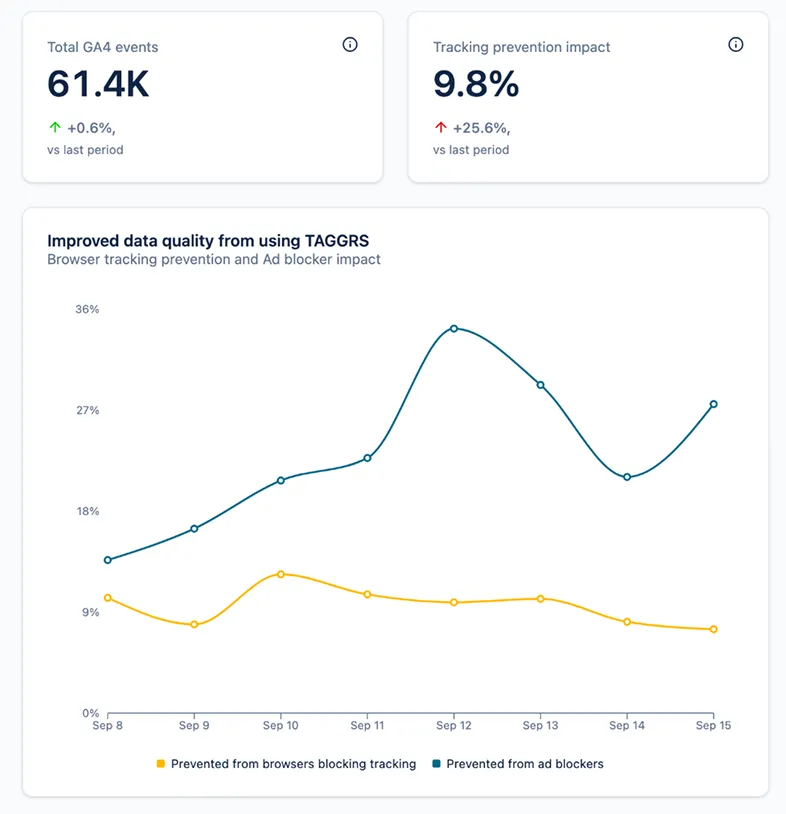
The TAGGRS dashboard shows how many of your events browser tracking prevention and ad blockers would otherwise have stopped.
Frequently asked questions
Do I need a separate GA4 property for Server-side Tracking?
No. Browser-side and server-side collection can run in the same GA4 property. Make sure each event takes only one path, either directly to Google or through your server container, or GA4 counts it twice.
Why does GA4 count my events twice after switching to server-side?
The most common cause is that a tag in the browser still sends the same event directly to Google. GA4 has no event ID to merge two copies. It only drops a purchase that repeats a transaction ID from the same user. Point the Google tag at your server container and remove any direct tags for the same events.
Can I send CRM or offline events to GA4 server-side?
Yes, with the Measurement Protocol, which you can also route through your server container. Google designed it to supplement website tracking. Include the visitor’s client ID so the event joins their journey, and a session ID within 24 hours of the session start if it belongs to that session.
Should I use JavaScript Managed or Server Managed cookies?
Start with JavaScript Managed. Server Managed sets the client ID cookie from your own server, which lasts longer in Safari, but it only works when your server container runs on your own domain and all GA4 requests go through it.
Is GA4 Server-side Tracking GDPR compliant?
It supports GDPR by letting you control and minimize what reaches Google, and by letting you process data in the EU. It does not replace a lawful basis or consent. Consent mode is set in the web container, and the Google tags in the server container follow it. Read more in our guide to Server-side Tracking and the GDPR.
About the author

Content Marketer
Gosia Poddębniak is an experienced content marketer and writer with over five years in the SaaS, analytics, and SEO industries. At TAGGRS, she develops marketing materials across multiple channels and manages website content, covering topics such as data collection, marketing optimization, privacy, tracking, and analytics.