First-party data marketing: A practical guide to server-side tracking and analytics


As options for using third-party cookies become more limited and privacy regulations even stricter, data professionals and marketers face a critical challenge: how to collect and activate data without compromising on compliance and user trust. Ongoing political and regulatory shifts have made it clear that privacy-first strategies are no longer optional, but essential.
At the heart of this shift is a change in how data is collected: moving from browser-based (client-side) tracking to server-side tracking, where data is routed through a server you control rather than fired straight to third-party scripts in the user's browser. First-party data is more accurate, durable, and privacy-compliant than third-party data, but it only works reliably when the collection layer is built for it. Getting this right means pairing a solid server-side collection layer with privacy-first, EU-owned analytics, all governed by compliant consent management and, ideally, EU-based hosting and data sovereignty.
This guide breaks down what's needed to shift towards a privacy-first approach that's both future-proof and ready for activation. Along the way, it covers the practical building blocks, such as server-side tracking, consent management, and EU-based hosting and analytics, and why getting them right is no longer just about compliance, but about building the user trust and data quality that drive marketing performance.
Why first-party data is the future of privacy-first marketing
First-party data, collected directly from users through owned channels such as website forms, email subscriptions, purchase histories, and direct customer interactions, is not just more privacy compliant, it's also more accurate and durable. Unlike third-party data, which is becoming increasingly unreliable, first-party data provides a stable foundation for long-term marketing strategies.
Several privacy-related developments have made this shift even more urgent. Browser-level tracking prevention has become the norm, with browsers like Safari and Firefox restricting third-party cookies and moving toward models that make them increasingly unreliable for marketers.
At the same time, the regulatory bar keeps rising: GDPR enforcement has sharpened around consent and data transfers, ePrivacy rules continue to tighten how tracking technologies can be used, and platforms have responded. For example, Google Consent Mode v2 requires a valid consent signal to be passed before measurement and remarketing features will work properly for advertisers in the EEA. Add the mounting scrutiny of EU-US data transfers, and the message is clear: access to data you don't own or control will continue to disappear.
To move away from using third-party cookies, organizations should implement first-party tracking mechanisms. Collecting data directly from your website or app, ideally through server-side tracking, is one of the most reliable ways of building effective long-term marketing strategies.
How server-side tracking makes first-party data work in practice
First-party data is the strategy, while server-side tracking is how you execute it reliably. With traditional client-side tags, data is collected in the user's browser and sent directly to third-party vendors — leaving it exposed to ad-blockers, browser tracking-prevention like Safari's ITP, and consent leakage. Server-side tracking moves this logic into a server-side container that you control, creating a single, governed point where data is collected, filtered, and forwarded only where you decide.
This shift changes what's possible in a few important ways:
- You own the data flow: Instead of every vendor's script pulling raw browser data independently, data passes through one environment where you decide what's collected, how you enrich it, and where you send it.
- Data minimization becomes enforceable: You can hash, truncate, or strip personal data before it's forwarded, turning a GDPR principle into a technical control rather than a policy promise.
- Consent is applied at the source: Tags fire and data forwards only after consent is verified server-side, closing the gaps that client-side setups often leave open.
- Your setup is more futureproof: Because collection no longer depends on third-party cookies or scripts surviving in the browser, your measurement holds up as browsers and regulations tighten.
- Your website is faster: Offloading tags from the browser to the server reduces page weight and improves Core Web Vitals.
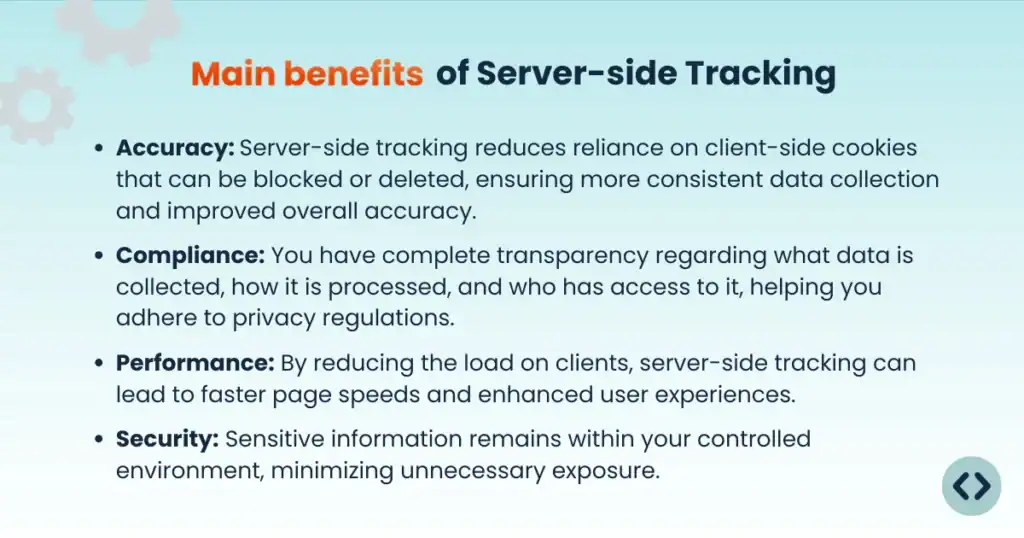
Crucially, this isn't only a privacy measure. Moving data collection server-side directly improves marketing performance. Advertising platforms increasingly reward rich, consent-based first-party signals sent server-to-server. Running Meta Conversions API (CAPI) and Google's Enhanced Conversions through a server-side setup recovers conversions lost due to browser restrictions or blocked cookies. In practice, a strong server-side setup means more accurate attribution and measurable uplift in reported conversions, all while keeping data collection first-party and consent-aware.
Setting this up no longer requires building and maintaining your own infrastructure. Fully managed server-side tracking platforms like TAGGRS host a server-side GTM container for you and work with your existing CMS, CMP, and marketing tools. This way, you can collect, enrich, and distribute consented first-party data from one environment, on independent EU-based infrastructure.
Learn more about the benefits of server-side tracking.
Controlling how data is collected is only half the picture. Once data flows through a server you operate, the next question is where that server lives and who ultimately has authority over it. The privacy benefits of server-side tracking only hold if the infrastructure underneath it is just as well governed.
Why hosting data on EU-based servers is critical
Another factor affecting the privacy of your clients’ data is where it’s stored and processed – and by whom.
The legal landscape surrounding EU-US data transfers remains unstable. Political shifts in the US have repeatedly cast doubt on the executive orders and oversight mechanisms that underpin the Transatlantic Data Privacy Framework (DPF), and questions over the independence and durability of US redress mechanisms for EU citizens continue to fuel European concern about the framework's long-term viability. Even where such arrangements hold for now, history shows they can be challenged or invalidated with little warning.
Data sovereignty represents a crucial evolution beyond simple EU hosting in privacy-conscious marketing. True data sovereignty means more than simply storing data within the EU. It requires that both the data and the organizations handling it remain entirely under the EU's legal jurisdiction, free from foreign ownership or extraterritorial influence.
While data location matters, merely hosting data in the EU does not guarantee full legal protection or true data sovereignty and won't resolve the underlying compliance issues.
Under the US CLOUD Act, American authorities can legally compel US-based companies to grant access to customer data, no matter where it is stored. This means that even EU-hosted data from US-owned companies remains vulnerable to foreign surveillance laws. The Schrems II ruling made one thing clear: sending personal data to the US creates real legal risk, but the challenge extends beyond physical storage location to questions of corporate control and jurisdictional authority.
Read more: EU hosting vs. EU sovereignty: Why the difference matters for privacy-first analytics
Achieving true data sovereignty through EU-owned infrastructure and services significantly reduces compliance risks under GDPR and similar privacy regulations. For organizations committed to long-term compliance, user privacy, and robust data governance, understanding the difference between data hosting and data sovereignty is more important than ever.
Even with frameworks like the EU-US Data Privacy Framework, there's no guarantee that such arrangements won't be invalidated in the future, making data sovereignty a foundational element of sustainable, privacy-conscious marketing strategies.
Main benefits of EU-based data hosting
- Compliance with GDPR: Keeping data within the jurisdiction of European law is vital for compliance.
- Avoid “Schrems III” issues: It helps you steer clear of the legal gray areas related to international data transfers.
- Increased user trust: Users are more likely to share their data when they know their data is being stored in accordance with the highest standards.
With your data infrastructure secured through EU-based hosting and sovereignty, the next critical component is ensuring you have proper legal grounds to collect and use that data in the first place.
Why you should use a privacy-compliant cookie consent management platform
A privacy-first approach requires effective consent management. Before collecting any personal data, companies must obtain explicit, informed, and freely given consent. It's a must, especially for non-essential cookies used for marketing or analytics.
If you're activating data, you need to know where it came from and whether you have legal grounds to use it.
An effective consent management setup ensures that:
- You only fire tags or track data after explicit user consent.
- You store and sync consent logs across platforms.
- You adapt to local laws (such as GDPR, LGPD, CCPA) dynamically.
Best practices for ensuring consent
- Use a consent management platform (CMP) that complies with GDPR and ePrivacy regulations.
- Customize consent banners by region to meet local legal requirements.
- Log and store user consents for auditing purposes.
What to look for in a privacy-first analytics solution
Server-side tracking governs how first-party data is collected and controlled, but that data still needs somewhere to be analyzed and activated. This is where your analytics layer comes in, and it deserves the same privacy scrutiny as your collection setup. There's little point routing data carefully through a server you control if it then flows into an analytics platform that over-collects or sends it outside the EU.
When selecting a privacy-first analytics solution, consider if it ensures:
- First-party data collection and processing.
- European hosting options.
- EU-based infrastructure with EU ownership.
- Full control over data access and retention policies.
- Built-in consent integration.
One of the European alternatives to popular US-owned platforms is Piwik PRO Analytics Suite. It empowers you to collect complete and accurate data and activate it to improve your marketing results, all while ensuring compliance and user privacy.
Conclusion
Privacy-led marketing is not just a trend; it is the new standard. Organizations should take action now by:
- Auditing your current data collection practices and implementing a compliant consent management platform
- Moving to server-side tracking so first-party data is collected reliably and forwarded under your control
- Pairing that collection layer with privacy-first, EU-owned analytics to analyze and activate your data compliantly
- Building data sovereignty into your infrastructure through EU-owned hosting and services
The transition may seem complex, but starting with first-party data collection through server-side tracking, proper consent management, and EU-based hosting and analytics creates a foundation for sustainable growth built on user trust. In an era of increasing regulatory scrutiny, these privacy-first approaches aren't just compliance measures – they're competitive advantages.