European Server-side Tracking: What data sovereignty actually requires

 Ate Keurentjes | 10 December 2025 | Last updated:
 Storing and processing European data inside the EU isn't strictly required by GDPR, but it removes a category of legal risk that no contractual safeguard fully closes. That distinction is the whole argument for European Server-side Tracking, and it's worth understanding properly before choosing a provider.
When it comes to Server-side Tracking in Europe, choosing a local provider is both a technical and a strategic decision. Hosting localization is crucial for businesses prioritizing data sovereignty, privacy compliance, and customer trust. Where your data is hosted and whose jurisdiction it falls under turns out to be a harder question than it first appears, and the two aren't the same thing.
In this article, you’ll discover why it’s recommended that the processing of European citizens’ data should stay within Europe, why hosting decisions matters more than many businesses often realize, and how TAGGRS is a trusted solution for data sovereignty, simplifying GDPR-compliant data collection for lasting peace of mind.
Can European data be processed outside the EU or EEA?
Technically yes, but two important clarifications must be done.
1. Data transfers require adequate data protection
Even if the GDPR doesn’t mandate that European citizens’ personal data be physically stored within the European Union (EU) or the European Economic Area (EEA), any transfer outside must be done under strict conditions ensuring an adequate level of data protection. This can be achieved through:
- Adequacy decisions recognizing countries that provide a level of data protection equivalent to that of the EU, allowing easier data transfers.
- Appropriate safeguards using encryption, anonymisation, pseudonymisation measures, and tools like the Standard Contractual Clauses (SCCs) for international transfers and the Binding Corporate Rules (BCRs), which multinational companies use internally to authorize data transfers across borders.
- Derogations: There are a few exceptions such as explicit user consent or contract necessity.
2. Data sovereignty remains the safest option
The EU-US transfer landscape has changed, but it hasn't settled. On 3 September 2025, the General Court of the European Union dismissed the first direct challenge to the Data Privacy Framework in Latombe v Commission, upholding the adequacy decision. The framework remains valid. But the Court assessed it only as it stood in July 2023 and expressly declined to consider anything that happened afterwards, while emphasising the Commission's ongoing duty to monitor the US framework and suspend or repeal the decision if needed.
That leaves an opening. Latombe appealed to the Court of Justice in October 2025 as Case C-703/25 P, and that appeal is still pending. A ruling against the DPF would be the third consecutive invalidation of a transatlantic transfer framework, after Safe Harbor and Privacy Shield. If that happened, organisations relying on the DPF would fall back to Standard Contractual Clauses or Binding Corporate Rules.
Storing and processing data within the EU isn’t a legal requirement, but it greatly reduces regulatory risks. Non‑EU providers — even those hosting data on European servers — can still be subject to extraterritorial laws like the U.S. CLOUD Act or FISA, which may conflict with EU privacy regulations.
So, keeping data under EU jurisdiction strengthens privacy, simplifies compliance, and ensures businesses maintain full control over sensitive information.
3. The rules themselves are being rewritten
In November 2025 the European Commission proposed the Digital Omnibus, a package amending the GDPR, the ePrivacy Directive, the Data Act, NIS2 and other instruments at once. For tracking specifically, the most consequential piece is a proposed new GDPR Article 88a governing storage and access on terminal equipment. Where personal data is involved, the ePrivacy rules would step back and the GDPR would take over.
Nothing has changed yet. The Data Omnibus is still in negotiation, the EDPB and EDPS published a joint opinion on it in February 2026, and realistic adoption estimates point to late 2026 at the earliest with practical application in 2027. The current ePrivacy plus GDPR framework still governs.
The takeaway is that a setup where consent is enforced centrally, and where you control the infrastructure, adapts to a rule change more easily than one stitched together across browser tags and third-party services.
Why choose a European Server-side Tracking provider?
There are a few key benefits to choosing a European Server-side Tracking solution:
True data sovereignty
Data sovereignty goes beyond mere physical storage in Europe. Data sovereignty means keeping both data and its processing fully under EU legal jurisdiction, free from foreign control or extraterritorial laws. This approach ensures complete ownership and clearer legal protection from foreign jurisdiction – paramount for companies handling personal or customer data across channels.
GDPR compliance by default
European alternatives like TAGGRS are built around “Privacy by Design” principles. This means data protection is the foundation of the development and operation of processing technologies from the very start. Transparent data handling and granular consent management must be the north star of your European provider, with solutions such as:
- Pseudonymisation
- Encryption
- User authentication
- Anonymisation
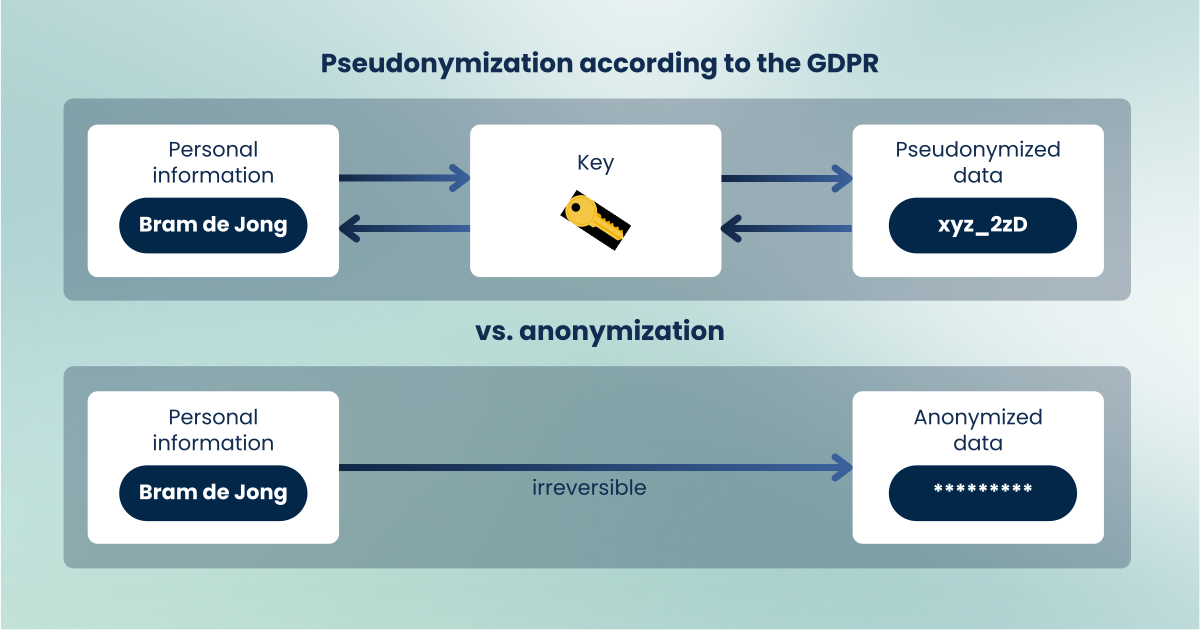
These safeguards must align with recognized standards and the specific risks involved. This ensures your business stays in line with GDPR, and personal data doesn’t leave the EU without legal grounds.
Taking into account the state of the art, the cost of implementation and the nature, scope, context and purposes of processing as well as the risks of varying likelihood and severity for rights and freedoms of natural persons posed by the processing, the controller shall, both at the time of the determination of the means for processing and at the time of the processing itself, implement appropriate technical and organisational measures.
Focus on first-party data
Server-side Tracking solutions help reduce reliance on third-party cookies and browser scripts by enabling a first-party data strategy. This improves data quality and your future-proofs tracking beyond any browser restrictions and ad blockers. This matters more now, despite the headlines suggesting otherwise. In April 2025, Google confirmed it would not deprecate third-party cookies in Chrome and would not introduce a separate choice prompt. The UK's Competition and Markets Authority subsequently released Google from its binding commitments, and the Privacy Sandbox APIs are being retired.
Safari, Firefox and Edge already block or restrict third-party cookies by default, and the erosion in Chrome continues through user settings, extensions and ad blockers rather than through a single cutoff date. The timeline changed from a hard deadline to gradual decline, which is harder to plan around, not easier. A first-party data strategy is still the most futureproof answer.
What to look for in a European Server-side Tracking provider
Unlike many providers that rely on third-party cloud services like Google Cloud, TAGGRS combines independent European server infrastructure with advanced privacy design. This technology offers transparency, control, and ease of use.
- European infrastructure
TAGGRS operates within its own dedicated server network across the Netherlands, Germany, Belgium, France, Sweden, and Norway. Clients can select their preferred hosting region, maintaining full control over data location while ensuring optimal protection, speed, and performance. Real-time server status is visible via status.taggrs.io. - Verified reliability
TAGGRS is trusted by numerous European businesses and it's ISO-certified for information security management. All of this proves technical excellence and legal reliability. - Privacy-first architecture
This means true data sovereignty, because both data storage and processing are under EU jurisdiction only. The architecture comes with:- enhanced data control and transparency as users decide what is collected, stored, and shared.
- Built-in privacy tools like IP and user-agent anonymisation to minimize exposure.
- Regulatory alignment: not only GDPR, but also the ePrivacy Directive and the European Accessibility Act.
- AES-256 encryption meeting the highest technical standards.
Overall, TAGGRS stands as the go-to European Server-side Tracking provider for teams, marketers, and DPOs who demand full sovereignty, granular control, high performance, and seamless GDPR compliance.
Getting started
The question isn't whether you're allowed to process European data outside the EU. You are, under conditions. The question is how much regulatory exposure you want sitting inside your measurement stack, and how quickly you could adjust if an adequacy decision changed.
Keeping data and processing under EU jurisdiction removes that question entirely. It also tends to produce better data, because first-party server-side collection survives browser restrictions and ad blockers that browser-side tags don't.
Create a free TAGGRS account to see how it works or run a free tracking audit to learn what data your current setup is sending and where.
FAQ
Does GDPR require European data to be stored in the EU?
No. GDPR does not mandate that personal data be physically stored inside the EU or EEA. Transfers outside are permitted under an adequacy decision, appropriate safeguards such as Standard Contractual Clauses or Binding Corporate Rules, or specific derogations like explicit consent. Keeping data in the EU is a risk decision rather than a legal requirement.
Is the EU-US Data Privacy Framework still valid?
Yes, as of now. The EU General Court upheld it in September 2025, dismissing the first direct challenge. An appeal to the Court of Justice is pending, and the General Court assessed the framework only as it stood in 2023, leaving room for challenges based on later developments. Organisations relying on it should have a fallback position.
Does hosting in Europe make a provider GDPR compliant?
Not on its own. A non-EU provider hosting data on European servers can still be subject to extraterritorial laws such as the US CLOUD Act, which can require disclosure regardless of where the servers sit. Data sovereignty means both the data and its processing fall under EU jurisdiction, and that depends on who controls the infrastructure, not just where it is.
Is hashed or pseudonymised data still personal data?
Yes. Pseudonymised data remains personal data under GDPR, because the person can be re-identified by anyone holding the additional information. Only genuinely anonymised data, where re-identification is impossible, falls outside GDPR. This distinction matters for anything involving hashed identifiers sent to ad platforms.
What changes if the Digital Omnibus passes?
The proposal would move rules on storage and access on terminal equipment from the ePrivacy Directive into a new GDPR Article 88a where personal data is involved, and introduces changes around consent mechanics. It is still in negotiation and has not been adopted. Current ePrivacy and GDPR rules continue to apply until it is.