How Robey Sportswear measured 57% more purchases with Server-side Tracking on Shopify

The overview
TO BE FOUND is a performance marketing agency from Dordrecht in the Netherlands, specializing in SEO, paid search advertising, conversion rate optimization and online growth. As a certified TAGGRS partner, they help brands make digital marketing a real driver of their wider business goals through everything from campaigns and content to dashboards and strategy.
When their client, Robey Sportswear, migrated to Shopify, TO BE FOUND used this moment to rebuild their tracking foundation rather than carry over the old setup. Browser tracking prevention, ad blockers and the known limits of Shopify's default purchase tracking were leaving a large share of conversions invisible, meaning ad platforms were optimizing based on incomplete data. TO BE FOUND chose TAGGRS’ Server-side Tracking because it's built specifically around the combination of Shopify, Google and Meta. It pulls first-party data straight from the Shopify backend instead of relying on a generic GTM setup, and runs Consent Mode v2 alongside every major ad channel in a single interface. For an advertiser with a full ecosystem of channels, that meant one technical layer and consistent, reliable data across the board.
Today, Bas de Roy, Lead SEO & Data at TO BE FOUND, shares how they built the full server-side setup for Robey, from the TAGGRS data layer that addressed Shopify's checkout tracking gaps to a privacy-proof consent setup. He also explains how that cleaner data drove sharper campaign decisions and what it unlocked across Google Ads and a brand-new Meta account.
The challenge: Making campaign decisions based on half the picture
Robey Sportswear sells only its own sportswear, with no competing brands or resale involved. Because the brand relies almost entirely on performance marketing, paid channels such as Google and Meta have a direct, daily impact on how many people find Robey and make a purchase. The algorithms behind those channels are strong, but they're only as good as the data they're fed.
Three problems were stacking up for Robey:
- Browser tracking prevention: Safari blocks third-party cookies by default, so does Firefox. A growing share of traffic has simply become invisible to traditional pixel tracking. Conversions disappear from the ad platforms entirely, so their algorithms have less to learn from and optimize worse as a result.
- Ad blockers: A meaningful part of Robey's audience runs an ad blocker. That doesn't just block banners, but also the measurement pixels from Meta, Google and other channels. The result is attribution that comes in structurally too low.
- Shopify's default purchase tracking: Shopify has well-documented limits in how it passes purchase data to ad platforms. The native integration misses transactions, duplicates some events, and gives platforms a distorted view of what's happening at checkout.
The combined effect was expensive. Campaigns were performing far better than the data suggested, but every decision about them was being made on that same flawed data.
The solution: Moving measurement server-side
TO BE FOUND implemented a full Server-side Tracking architecture with TAGGRS, which let them move the data layer out of the browser. Instead of relying on the visitor's browser to fire the measurement pixels, they are being handled by the server. Browser settings, ad blockers and iOS restrictions have no grip on that.
This forms the foundation everything else builds on, and it's far more reliable than the setup it replaced. From there, they built out the rest of the setup:
- Every channel in one setup. Robey's entire advertising ecosystem was moved server-side: GA4, Google Ads, Meta, Pinterest, TikTok, Bing and Snapchat. This ensures every channel gets the same, accurate data.
- TAGGRS data layer for Shopify. Shopify's default checkout tracking has a known weakness: purchase data is often lost before it reaches the pixels. The TAGGRS data layer fixes this by pulling first-party e-commerce data directly from the Shopify back end and sending it server-side, giving a complete view of what's happening in the store.
- Privacy-proof consent setup. Measuring more data should never come at the cost of privacy. Consent Mode v2 was configured so that consenting visitors are measured as fully as possible, and visitors who don't consent are correctly excluded. The result is clean, privacy-compliant data.
- Anouk Mourits, E-commerce Manager at Robey Sportswear
The results: Finally seeing what's actually happening
The server-side implementation went live on 29 January 2026. The comparison with the old setup was immediate:
- +57% more purchases recorded compared to GA4's standard purchase tracking. More than half of all conversions had been invisible.
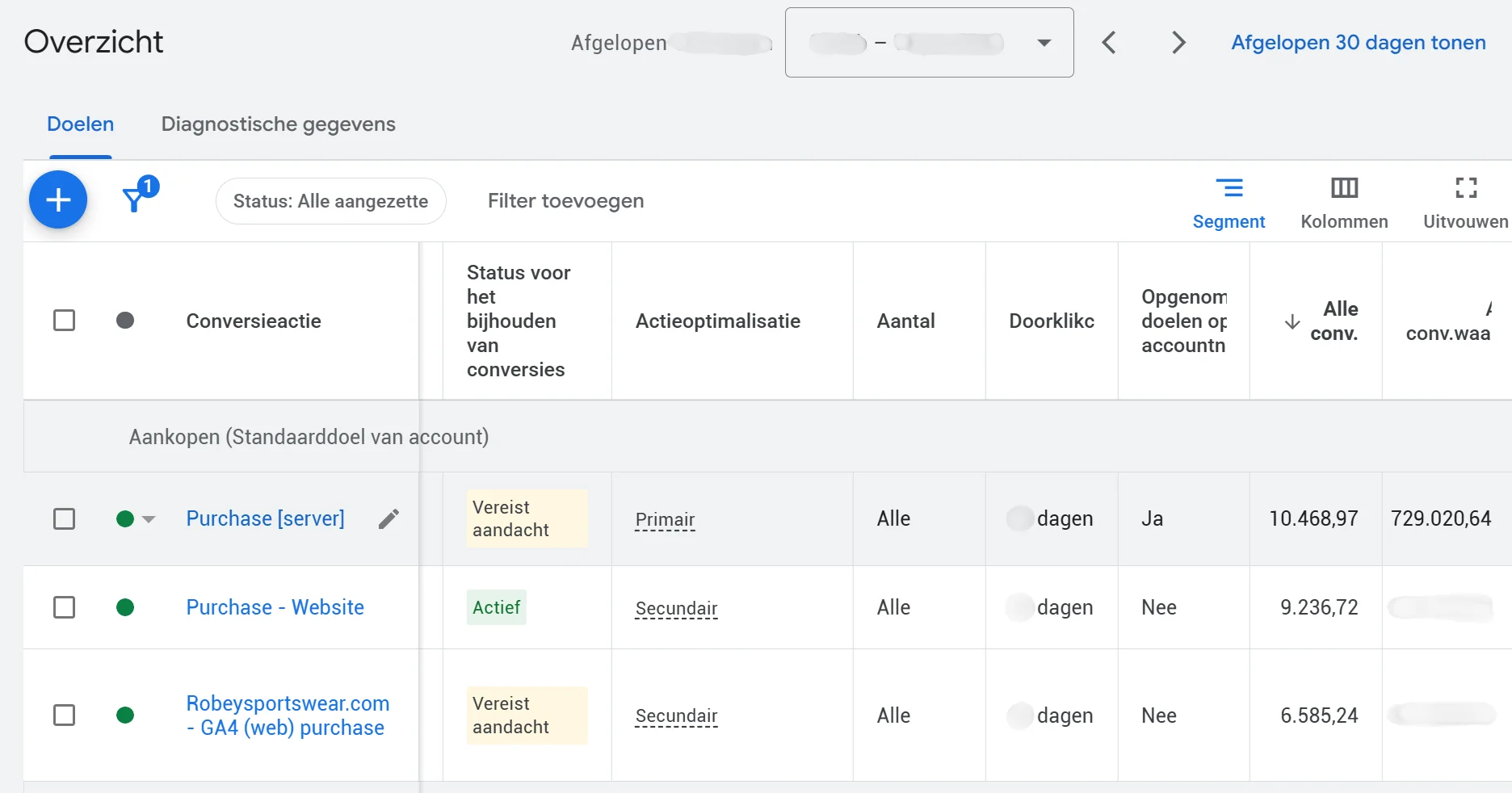
The number of extra conversions attributed to Google Ads campaigns compared to other connections like client-side Google Ads or GA4 conversions
- +13% more purchases compared to Google's own GACT measurement, which is already an improvement on pure client-side tracking.
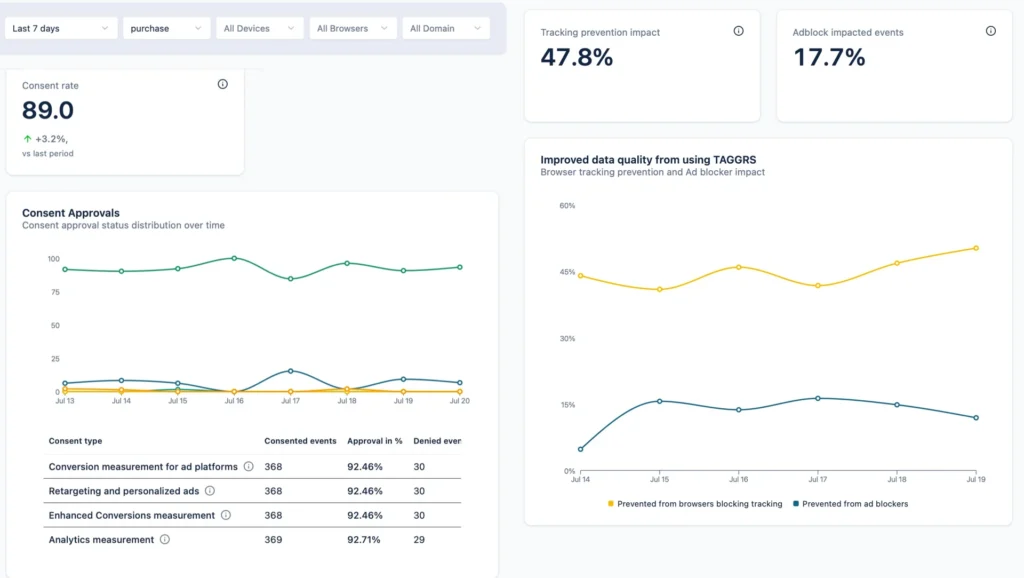
- 89% consent rate on purchases. A clean consent setup combined with server-side measurement means Robey can act on nearly every consenting visitor inside the ad platforms.
- 47.8% of events recovered from browser tracking prevention, mostly from Safari's strict ITP restrictions, with a further 17.7% reclaimed from ad blockers.
Better tracking data had a direct effect on how the campaigns could be structured. With more conversion signals coming in, TO BE FOUND was able to split the Google Ads account by product category, creating separate campaigns for Gym, Tennis & Padel, Football and Pro Clubs. This kind of split only works when each campaign gets enough conversion data to train the algorithm, which wasn’t possible with client-side tracking and only became available after moving server-side.
The results followed quickly:
- The PMax Gym campaign runs on a small share of the total budget and reaches a ROAS of 26.
- The Branded Search campaign, the only one active in both years and therefore directly comparable, delivered 42% more conversions and 40% more revenue than the same period last year.
Robey also launched a new Meta account in 2026. New accounts usually need weeks or months to gather enough data for effective optimization, but the quality of the server-side conversion signals meant it reached that point much faster than usual.
What’s next
The implementation was only the starting point. The first campaign results confirm what TO BE FOUND expected: more data leads to faster optimization, lower effective costs, and a clearer view of what each channel actually contributes.
For Robey, the next step is applying this to budget allocation. Channels that used to look weak on paper now get a fair chance to prove their value.
TO BE FOUND is already rolling this setup out for more clients who take advertising seriously and want a clear picture of what their campaigns are really doing.
Key takeaways
The project surfaced a few lessons that apply well beyond Robey, for any brand that treats advertising as a serious channel.
More than half of all purchases were invisible. This isn't a small measurement gap. It means campaign ROAS was consistently reported too low, and decisions were being made on an incomplete picture.
Shopify isn't plug-and-play for serious advertisers. The default integrations are good enough to get started, but not good enough to base decisions on. A custom data layer becomes a necessity the moment advertising turns into a serious channel.
Server-side Tracking and consent work well together. A solid consent setup combined with Server-side Tracking gives you more data from the visitors who do opt in.
The benefit goes beyond cleaner reporting. Better data also means better algorithmic optimization, and that advantage pays off every day the campaigns run.
Consistency across channels matters. Measuring one channel server-side while leaving the rest behind creates a false sense of comparability. It has to be all or nothing.