Server-side Tracking ROI: How to calculate what you recover
 Ate Keurentjes | 21 May 2026 | Last updated:
 Server-side Tracking recovers 16–21% of conversion volume that browser-based tags fail to capture. More complete conversion data improves ad platform algorithm accuracy and increases ROAS, typically within 3 months of implementation.
This article explains how that recovery happens, how to calculate the ROI for any client and how agencies use those numbers to grow their portfolio.
What is the Server-side Tracking ROI?
The ROI of Server-side Tracking is the revenue difference between campaigns optimising on complete conversion data versus campaigns optimising on the ~60% of conversions that browser-based tags manage to capture.
Every ad platform, like Google Ads and Meta Ads, runs automated bidding strategies that train on conversion signals: Target CPA, Target ROAS, Maximise Conversions. When browser tags miss conversions due to ad blockers, Apple ITP, or cross-device behaviour, the algorithm receives an incomplete dataset. So, It allocates budget based on a distorted picture of which audiences, devices, and creatives actually drive results.
On the other side, Server-side Tracking moves the conversion call from the browser to the server. Ad blockers and ITP cannot intercept it. Every completed purchase, lead, or action reaches the platform. The result? The algorithm trains (and optimizes) on the full picture.
On average, TAGGRS users record a 16–21% increase in measured conversion volume after implementation.
How does recovered conversion data improve campaign ROI?
Recovered conversion data improves campaign ROI by giving ad platform algorithms a more accurate signal, which reduces wasted spend and improves the efficiency of every euro in the budget.
Three are the financial outcomes following directly from a more complete conversion dataset:
- Lower CPA. When the algorithm sees the full set of converting audiences (including ad blocker users and cross-device converters) it stops over-bidding on incomplete proxies and reallocates budget toward the segments that actually convert.
- Higher ROAS. More conversion data means smarter spend distribution across campaigns, ad sets, and creatives. Budget moves toward the combinations that drive real revenue, not the ones that happened to fire a browser tag.
- Larger retargeting audiences. Browser-based tracking records only the sessions it can track. Server-side Tracking captures the full audience pool expanding the retargeting base without increasing spend.
How to calculate the Server-side Tracking ROI for a client (in 5 steps)
The calculation requires 3 numbers for the same 30-day timeframe:
- Monthly ad spend
- Platform-reported conversions
- Average order or lead value
Step 1: establish the signal loss gap
Signal loss % = (Backend conversions − Platform conversions) ÷ Backend conversions × 100
E.g.: 500 backend conversions, 380 platform-reported. Signal loss = (500 − 380) ÷ 500 × 100 = 24%
A gap of 5–8% is within normal attribution window variance. A gap above 10% that holds consistently month over month is signal loss.
Meta Ads carries disproportionately higher signal loss than Google Ads because it relies more heavily on browser-based pixels and is more exposed to iOS ITP and ad blockers. For clients running Meta campaigns, compare each platform individually.
Step 2: calculate monthly missing conversions
Monthly missing conversions = Backend conversions × (Signal loss % ÷ 100)
E.g.: 500 × 0.24 = 120 conversions per month outside the ad platform's attribution model.
These are completed purchases. The revenue was collected. But every optimisation algorithm made every decision as if those 120 customers did not exist.
Step 3: calculate recovered revenue signal
Recovered revenue signal = Monthly missing conversions × Average order or lead value
E.g.: 120 missing conversions × €150 = €18,000 per month in conversion value restored to the attribution model after implementing Server-side Tracking.
Step 4: calculate misallocated ad spend
Misallocated ad spend = Monthly ad spend × (Signal loss % ÷ 100)
E.g.: €30,000 monthly spend × 0.24 = €7,200 per month in budget allocation based on incomplete data.
Signal loss is not evenly distributed across campaigns. It concentrates in Safari users with ITP active, users running ad blockers, and cross-device converters. Campaigns reaching those segments carry the largest measurement gap.
Step 5: compare the cost against the fix
Server-side Tracking hosting through TAGGRS runs under €200 per month for most setups.
For agencies, infrastructure scales across a client portfolio. Meaning that the per-client cost drops significantly. If the signal loss analysis returns €7,200 per month in misallocated spend, the platform fee is less than 3% of that figure. Payback is typically measured in weeks.
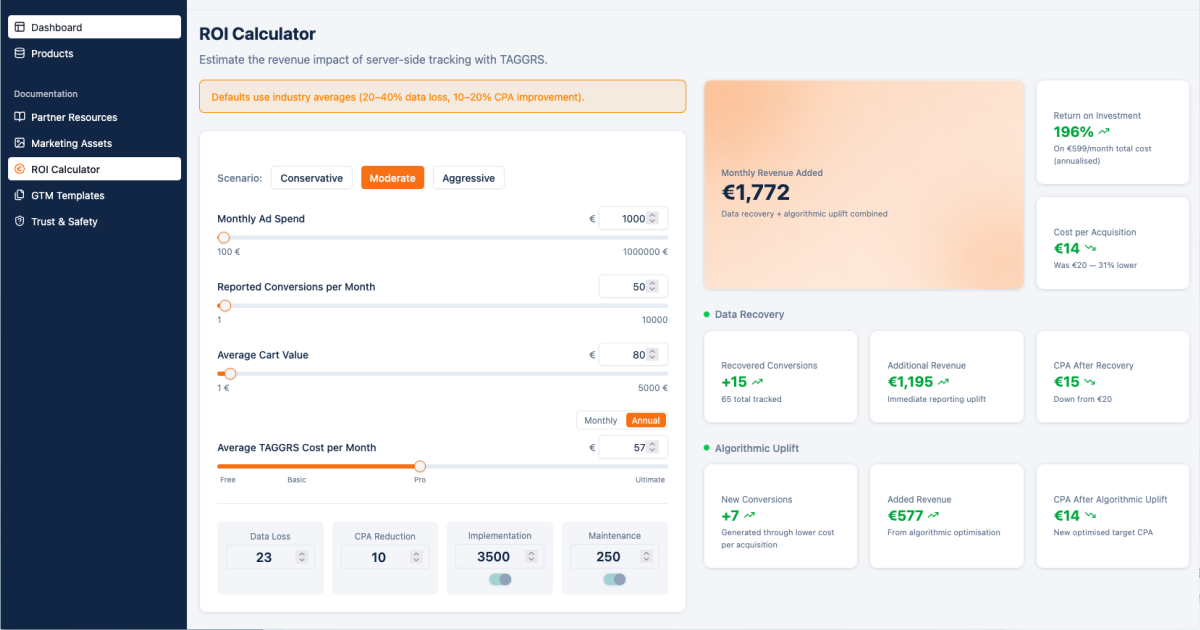
Or, use the TAGGRS ROI calculator
Use the calculator below to measure the delta in monthly revenue for any client account.
ROI Calculator (sample)
Calculate your client's revenue uplift
Enter 3 numbers. Get a projected monthly revenue recovery in real-time.
Client inputs
Monthly revenue added
€2,187
Data recovery + algorithmic uplift combined
Recovered
+18
CPA
−24%
Est. ROI
214%
These are conservative estimates based on TAGGRS internal data. The full partner calculator breaks down data recovery and algorithmic uplift separately.
Become a partnerEstimates based on TAGGRS internal data. Actual recovery varies by audience, browser mix, and ad blocker penetration. No data is stored or transmitted.
This is a simplified version of the ROI calculator every TAGGRS partner finds directly in their dashboard. The partner version goes further:
- it breaks down data recovery and algorithmic uplift as separate line items,
- lets you model conservative, moderate, and aggressive recovery scenarios,
- calculates the exact cost of signal loss against the TAGGRS platform fee,
- generates a client-ready monthly revenue breakdown with CPA before and after implementation.
What Server-side Tracking changes in practice for your business
Campaign ROI
Ad platforms receive a complete conversion dataset for the first time. Bidding algorithms retrain on real outcomes: not the 60–75% of signals that browser tags managed to capture. The result is lower CPA and higher ROAS, usually within 3 months, without changing a single campaign setting.
Client reporting
Revenue recovered through Server-side Tracking is measurable and auditable. Run backend conversions versus platform conversions 30 and 60 days after implementation. The delta (multiplied back through the signal loss formulas) gives you a concrete, client-ready number: this is how much more data your campaigns are now optimising on, and this is what it added to the bottom line.
Agency positioning
Agencies that implement Server-side Tracking for clients shift from a delivery role to a strategic one. Showing a client that their previous setup was allocating X€ per month based on incomplete data — and that it no longer is — is a retention argument, an upsell argument, and a referral argument at the same time. Read how partner agencies have built this into their client conversations in the...
Measured results from TAGGRS partners
Server-side events bypass the browser failure points that reduce conversion visibility. Event match rates improve because the tracking call originates from the server, not the user's browser. Results recorded by TAGGRS partners after implementation:
- 16–21% increase in measured conversion volume (internal data based on 2,000 users)
- Up to 40% reduction in data deviation (OMA Agency)
- Up to 20% more tracked e-commerce data (OMA Agency)
- Up to 16% more data across 50 clients (Byteffekt)
The exact improvement depends on audience composition: clients with high Safari usage or high ad blocker penetration see the largest gains, as those are the segments most heavily affected by browser-based tracking restrictions.
FAQ
What is the business impact of Server-side Tracking?
Server-side Tracking recovers 16–21% of conversion volume that browser-based tags fail to capture. Recovering that data improves ad platform algorithm accuracy, reduces CPA, and increases ROAS.
How much conversion data does a typical business lose without server-side tracking?
A gap above 10% between platform-reported and backend conversions that holds month over month indicates genuine signal loss. OMA Agency recorded a 40% data deviation before implementing Server-side Tracking.
Which ad platform loses the most data without Server-side Tracking?
Meta Ads loses more conversion data than Google Ads because it relies more heavily on browser-based pixels and is disproportionately exposed to iOS ITP restrictions and ad blockers.
How do agencies calculate Server-side Tracking ROI for clients?
Agencies calculate signal loss % by comparing backend conversions to platform-reported conversions, then multiply missing conversions by average order value to produce a monthly recovered revenue figure. The TAGGRS partner ROI calculator automates this calculation. You can find it in your dashboard, once you join our Partner Program.
How long does Server-side Tracking take to show results?
Improvements in measured conversion volume appear within the first 30 days. Bidding algorithm improvements (reflected in CPA and ROAS) typically follow within 3 months as platforms retrain on the recovered data.
Not sure where to start? Book a demo and we'll run the signal loss calculation on a live client account.