Maximizing e-commerce performance with Server-Side Tracking
 Ate Keurentjes | 13 October 2025 | Last updated:
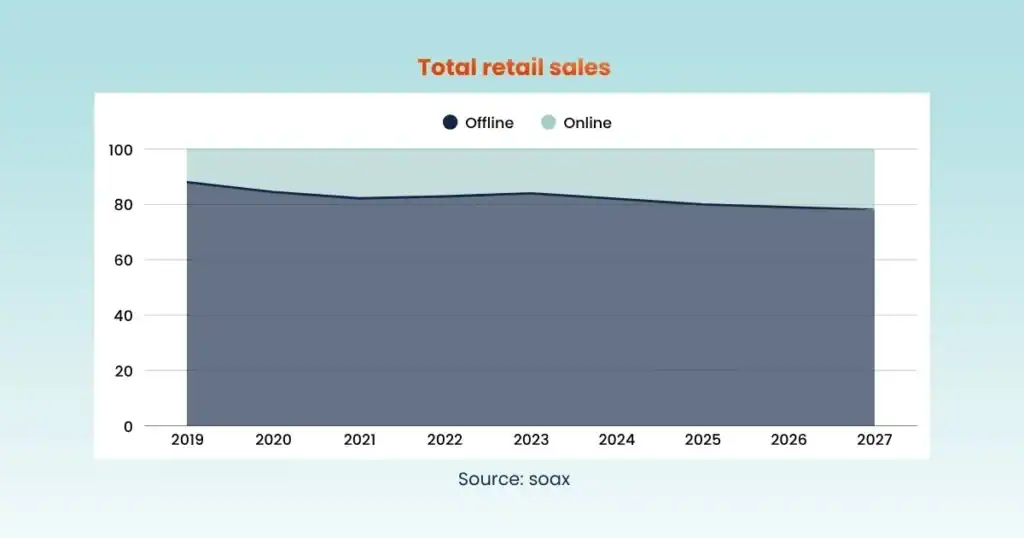
 In 2025, the global e-commerce market has reached $7.391 trillion, nearly doubling its size since 2020, according to the most recent research by Soax. And it is projected to grow year over year. With almost 1 in 3 people worldwide shopping online and 19.1% of total retail sales now occurring online, competition tightens and customer expectations increase. As this market continues to expand – adding more than $600 billion in value each year – data accuracy and performance optimization have become paramount for e-commerce growth.
The ability to collect and act on reliable, privacy-compliant data shapes the difference between scaling effectively and falling behind. But traditional client-side tracking methods are losing ground due to browser-based privacy restrictions, cookie limitations, and consent management challenges. That’s where Server-side Tracking becomes an essential tool to clean the data collection, get in-depth insights, and measure marketing performance accurately.
This article takes a deep dive into how to maximize your e-commerce performance with Server-side Tracking, exploring e-commerce KPIs, essential customer actions to track, best practices for an effective server-side setup, and integrations that deliver faster insights with little to no code needed.
With Server-side Tracking, the results were compelling: an average 10–28% increase in data capture, alongside a 12% conversion uplift for a key e-commerce client. - Romy Brookhuis, Online Content Marketer @ Byteffekt
Starting with the right metrics: e-commerce KPIs
As a marketer or e-commerce owner, tracking growth metrics is essential to gain insights about customer behaviour and trends, measure the effectiveness of your strategies, and set the foundation to truly shape e-commerce success.
But, what are the most actionable KPIs for online stores? It certainly depends on the stage of your business: in the early phases, focus tends to be on metrics like traffic acquisition and engagement, while for more mature or grown e-commerce stores, the most insightful KPIs include CAC, CLV, Conversion Rate, Average Order Value, Profit on Ad Spend (which goes beyond traditional ROAS), Customer Retention Rate, and Bounce Rate. Here is the breakdown:
| Metric | Formula | What is it about |
| CAC (Customer Acquisition Cost) | Total marketing and sales expenses / Number of new customers acquired | Tracks the marketing cost to gain a new customer. |
| CLV (Customer Lifetime Value) | Average purchase value × Purchase frequency × Average customer lifespan | Estimates the total revenue a customer contributes throughout their relationship with your brand. |
| Conversion Rate | (Number of Conversions /Total number of visitors) × 100 | Measures how effectively your site turns visitors into customers. |
| Average Order Value | Number of orders / Total revenue | Indicates the typical revenue per transaction and helps assess up- and cross-sell success. |
| Profit on Ad Spend (POAS) | Revenue − Cost of goods sold − Ad spend / Ad spend | Evaluates the profit generated per advertising dollar/euro spent, going beyond the traditional ROAS (return on ad spend). |
| Customer Retention Rate | [(Customers at period end − New customers acquired during period) / Customer at period start] × 100 | Reflects long-term loyalty and repeated purchase behavior. |
| Bounce Rate & Time on site | (Number of single-page sessions / Total sessions) × 100 | Gauge engagement and user satisfaction with your content and navigation. |
Key actions to track for effective e-commerce analysis
When it comes to maximizing e-commerce performance, tracking key events is crucial. Through Server-side Tracking, online stores can monitor specific actions that drive conversion and revenue growth.
1. Page views
Which pages are popular and which ones are not attracting much attention? Page views help in identifying opportunities for improvement and optimizing the user experience.
2. Clicks
Monitoring clicks on links and buttons provides insights into user engagement and interaction with the website. By tracking popular links, businesses can identify high-converting elements and replicate them across the site.
3. Cart abandonment
This information is crucial for identifying pain points and implementing strategies to reduce cart abandonment rates. Or even creating retargeting campaigns to remind the users to finalize the purchase, potentially turning them into customers.
4. Form submissions
Tracking form submissions helps measure the effectiveness of lead generation efforts and conversion rates. By monitoring which forms are completed and which ones are abandoned, businesses can optimize their forms for better user experience and increase conversions.
5. E-commerce transactions
E-commerce transactions are essential for analyzing sales performance, implementing remarketing strategies, and understanding customer behavior.
Why Server-side Tracking matters for e-commerce stores
Browser-based (client-side) tracking faces multiple challenges: ad blockers, iOS consent restrictions, browser privacy updates, and third-party cookie deprecation. These cause data loss, incomplete attribution, and unreliable ROI insights.
Server-side Tracking solves this by sending tracking events directly from your own server to analytics and ad platforms: not from the user’s browser. This method ensures:
- Accurate and complete data collection
Server-side Tracking recovers lost conversions and improves campaign attribution by feeding precise event data to platforms like Google Analytics 4, Meta (Facebook CAPI), TikTok, and others. This elevates your marketing ROAS and customer acquisition insights.
- Enhanced customer experience
By offloading tracking scripts from the browser, page load times improve drastically. Since mobile users now make up over 57% of global e-commerce sales, faster websites across devices reduce bounce rates and increase conversions.
- Improved security and privacy compliance
Handling sensitive user data within your own server environment lowers third-party exposure, ensuring compliance with GDPR, CCPA, and related regulations. Some Server-side Tracking platforms are built with privacy by design and certified to comply with the highest security standards. This builds customer trust and future-proofs your tracking approach.
All these perks are crucial for e-commerce businesses striving to offer seamless, fast, and trustworthy digital experiences as consumer expectations for privacy and performance increase.
How Server-side Tracking elevates e-commerce performance analytics
Not being affected by browser blocks but staying compliant, Server-side Tracking enhances the data collection revealing richer insights and turning reliable data into a competitive marketing asset. Here is how you can finally get data you can trust for modern e-commerce analytics:
- Attribution accuracy: Recovers conversions lost due to browser blockers and sync them precisely back to advertising platforms.
- First-Party data enrichment: Extends attribution windows beyond the typical 7 days and associates events with real user profiles for deeper insights.
- Cross-platform consistency: Maintains unified and aligned data streams across analytics, advertising, and CRM systems.
With clean, reliable data, e-commerce owners and marketers can work on their strategy backed by real data to optimize the entire buying journey, improve marketing precision, and enhance customer experiences through the following capabilities:
- Optimize the buying journey: Identify popular pages, pinpoint where customers abandon carts, and discover which CTAs work best. Use these insights to streamline navigation, simplify checkout funnels, and boost conversion rates.
- Measure form effectiveness: Track submissions and abandonment of contact forms, newsletter sign-ups, and account creations to improve user experience (if needed) or maximize lead generation.
- Fuel smarter marketing: Improving data attribution and accuracy, you can leverage customer data to build targeted multichannel remarketing campaigns, segment audiences, and personalize offerings while staying compliant to privacy regulations.
- Analyze login behavior: Monitor customer login activity to detect friction points, improve account security, and encourage engagement.
This 360-degree approach based on Server-side Tracking strengthens marketing ROI, enhances user experience, and supports scalable, data-driven e-commerce growth.
Key e-commerce events to track on server-side
To map comprehensive customer journeys and optimize conversion funnels, configure essential events such as:
| view_item | Tracks product page views to gauge interest. |
| add_to_cart | Captures intent by monitoring cart additions. |
| begin_checkout | Marks the start of the purchase process. |
| purchase | Records transaction completions and purchase details. |
Is it really worth it to implement Server-side Tracking for e-commerce?
For e-commerce businesses wondering if the investment in Server-side Tracking is justified budget-wise, our client Teun Verkleef, Lead Advertising & Data at Social Brothers, offers valuable insight:
According to our experience, from approximately €2,000 per month of ad spend upward is the threshold where Server-side Tracking becomes a must.
This means that once your marketing budgets grow beyond this point, relying solely on client-side tracking risks significant data loss, inaccurate attribution, and missed growth opportunities.
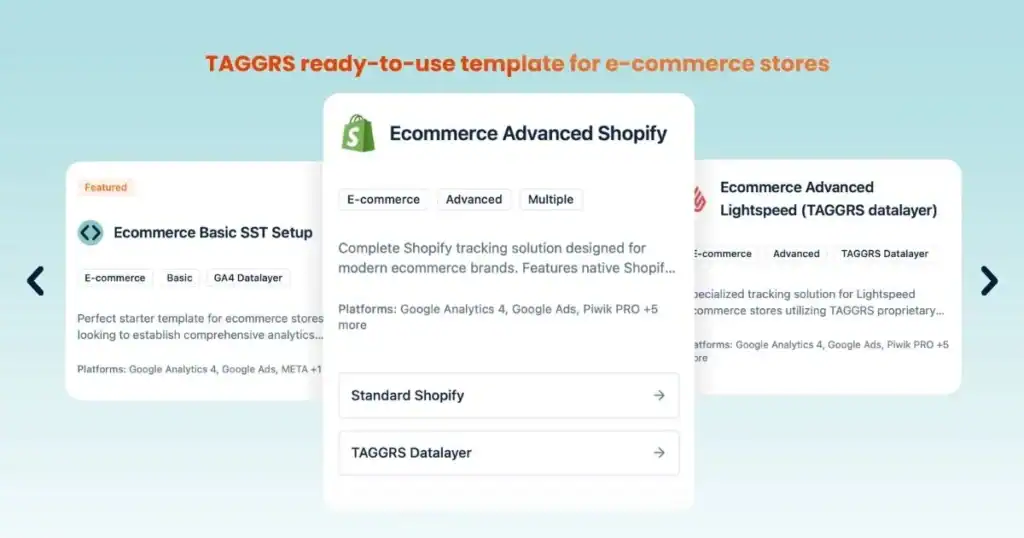
Wondering if the setup complexity pays off? Well, Server-side Tracking can be technically complex, but this challenge is significantly reduced by the availability of ready-made templates and integrations. To make Server-side Tracking accessible, TAGGRS provides 6+ preconfigured plug-ins for the most popular e-commerce platforms like Shopify, Shopware, WooCommerce, Magento, and PrestaShop. This means faster deployments, reduced technical barriers, and easier maintenance, enabling marketing teams to benefit from server-side data accuracy without deep engineering overhead.
For most clients now, we start from the templates, especially for e-commerce, which makes the process much faster. - Teun van Kleef, Lead Advertising & Data at Social Brothers
Another compelling reason to implement Server-side Tracking is the growing need for unified first-party data capture across the entire e-commerce technology stack. With servers collecting and synchronizing user interactions centrally, businesses build a comprehensive, privacy-compliant data foundation that fuels accurate marketing attribution, personalized experiences, and long-term customer value optimization.
Want to get a setup tailored to your e-commerce tracking needs? Book a demo with our first-party data experts.