First-party vs third-party cookies: what you need to know
 Ate Keurentjes | 30 October 2023 | Last updated:
 Cookies are a cornerstone of how websites track user behavior and personalize online experiences. However, not all cookies operate the same way or have the same impact on privacy and data reliability. Understanding the key differences between first-party and third-party cookies is essential for marketers and website owners aiming to optimize tracking and comply with regulations.
In this post, you’ll get a clear, practical breakdown of what first-party and third-party cookies are, the difference between them, and why understanding these distinctions matters in 2025 and beyond.
Comparison: first-party vs. third-party cookies
| Feature | First-party cookies | Third-party cookies |
| Host | Current site’s server (or script that runs in that origin) | External ad servers and ad platforms via code loaded on the publisher’s website |
| Usage purpose | Track users on the website they are built in | Track users across multiple sites for ad targeting, personalization, analytics across sites, affiliate tracking |
| Browser support | Supported by all browsers. Users are given tools to manage them. | Depends on browser settings and privacy policies. |
| When can the cookie be read? | If the user is active on the original website. | At any time, regardless of the website you visit. |
| Impact on user privacy | Low: user data is easier to manage | High due to cross-site tracking and extensive user profiling |
| Privacy compliance | Easier to comply to privacy regulations like GDPR and CCPA | Requires advanced consent controls |
| Lifetime | Can be session or persistent, depending on the site’s settings and browser policies | Can be session or persistent, but typically short-lived due to browser policies |
| Reliability | High because they are not affected by most browser privacy features | Low because of browsers block or delete them by default |
The 2 main differences between first-party and third-party cookies boil down to who sets and controls them, and what they’re used for. First-party cookies are created and managed by the website (or app) the user is visiting, helping improve their experience by storing data related to the user journey. On the other hand, third-party cookies come from external domains embedded in the site (or app) and are mainly used to track the same user across multiple sites enabling cross-tracking for targeted advertising and broader insights, like their overall digital behavior.
This distinction has important consequences for data control, user privacy, and how websites comply with privacy laws. Major browser developers, in response to privacy concerns toward this huge impact, have announced that they will discontinue support for third-party cookies. For example, Google created the Private Sandbox and Safari enabled the tracking prevention.
What are First-Party Cookies?
First-party cookies are created, stored, and managed directly by the website a user visits. They help create a smooth user experience by storing user data. Examples of first-party cookies are:
- login status
- language preferences
- shopping cart contents
- Analytics for website/app improvements.
As first-party cookies are restricted to the originating domain and often require user consent to operate, they align well with privacy regulations such as GDPR and CCPA. Users have greater control and visibility over first-party cookies, making them the preferred choice for privacy-conscious website owners.
However, not all first-party cookies require consent: strictly necessary first-party cookies (for example, session cookies for login or shopping cart functionality) do not require consent under GDPR because they are essential for the website’s operation. In contrast, non-essential first-party cookies (like those used for analytics or storing user preferences) do require explicit user consent before activation. This clear distinction helps website owners comply with regulations while optimizing user experience and trust.

What are Third-Party Cookies?
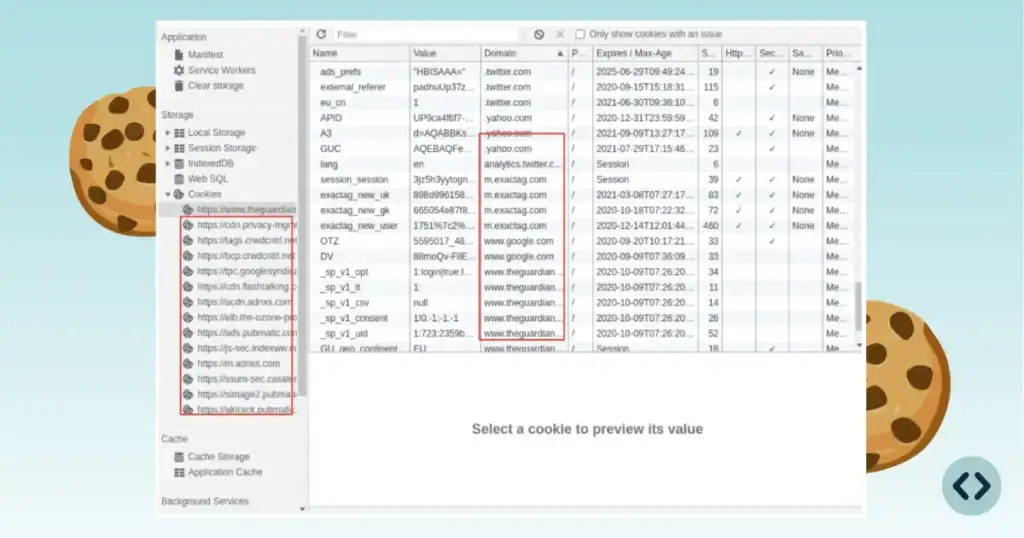
Third-party cookies are created by external parties and not by the domain the user directly visits. They are often the result of ad servers and other external entities seeking to understand your browsing behavior and respond accordingly. Companies such as Facebook, Google and other ad platforms exploit these cookies to present you with targeted ads or direct you to a specific landing page, with the goal of conversion.
These cookies are primarily aimed at understanding users’ online behavior by:
- tracking users’ behavior across websites
- retargeting, meaning that they refer the users to websites with products that may interest them
- showing personalized ads that match their interests.
How are Third-Party Cookies Made?
Third-party cookies are often the result of ad servers and other external entities seeking to understand your browsing behavior and respond accordingly. Companies such as Facebook , Google and other ad platforms exploit these cookies to present you with targeted ads or direct you to a specific landing page, with the goal of conversion.
The distinction between first-party and third-party cookies lies primarily in their origin and purpose. While the originating website produces exclusively first-party cookies, third-party sources may generate third-party cookies that enable cross-site tracking.
Third party cookies phasing out
Third-party cookies are being phased out. Although Google recently canceled its planned phase-out of third-party cookies, browsers such as Safari have been blocking them since 2003. Companies that want reliable and useful information about their users would therefore do well to switch to first-party data.
Cookies, privacy concerns and a future-proof solution
The cookie landscape is rapidly changing under pressure from privacy laws like GDPR and CCPA, and browser restrictions from Safari, Firefox, and others blocking third-party cookies by default.
With third-party cookies steadily being phased out, relying solely on them is no longer sustainable for marketers or website owners. Instead, a shift toward first-party data collection and privacy-first tracking methods is crucial. One such method gaining traction is Server-side Tracking, which allows robust user behavior analysis without compromising privacy or relying on traditional third-party cookies. Understanding this industry shift and embracing solutions like Server-side Tracking will help businesses stay compliant, retain data accuracy, and continue delivering personalized experiences in a privacy-conscious digital world.
With TAGGRS, you can set up Server-side Tracking for free up to 10.000 requests. Otherwise, check our implemention service.
Key takeaways
- First-party cookies are set and controlled by the website you visit, improving user experience by storing preferences, login info, and analytics data within that domain.
- Third-party cookies are created by external domains embedded in the visited site, primarily used for cross-site tracking, targeted advertising, and affiliate marketing.
- First-party cookies have a lower privacy impact and are easier to manage under regulations like GDPR and CCPA, while third-party cookies face increasing browser restrictions and legal scrutiny.
- The industry is moving away from third-party cookies toward privacy-first solutions like first-party data collection.
- Embracing Server-side Tracking helps businesses maintain data accuracy, privacy compliance, and personalized user experiences amidst evolving privacy laws and browser policies.