BigQuery vs GA4: why agencies rethink their data stack

 Ate Keurentjes | 24 February 2026 | Last updated:
 For years, Google Analytics has been the default analytics layer for agencies: easy to deploy, familiar dashboards, and quick answers. But today, marketing agencies are facing clients questioning reported performance, misalignment between ad platforms and backend revenue, ever-increasing privacy pressure, and margins under pressure.
We sat down with Jos Ijntema, Data Specialist at Grain, to understand why more agencies are re-evaluating GA4 and why owning your data stack with BigQuery is becoming a strategic move.
Performance is harder to achieve. Costs are higher. So decisions matter more — and suddenly teams realize the data doesn’t fully add up.
This article breaks down what that means for agency owners who want to scale, differentiate, and stay credible.
Problems aren’t new (but they’re getting expensive)
The problems were always there. It didn't get much worse. But the realization that we have to do something about this—that's what's changed.
On one hand, performance pressure is intensifying with CPAs and CPCs continuing to climb and competition getting fiercer. On the other hand, privacy legislation enforcement is ramping up and companies are finally putting Google tools behind consent walls… but that creates its own data gaps.
In this scenario, the margin for error in budget allocation decisions has disappeared.
Reports are agencies' best tool to represent expertise, shape strategic conversations, and determine whether clients trust you. If numbers don't match, the halo effect is brutal: campaign quality is questioned, strategy credibility drops, and relationships weaken.
Clean, consistent, explainable data flips this dynamic entirely. The conversation shifts from defending your data to "How do we improve this together?" That's the difference between being interrogated and being a strategic partner.
Three crucial limits of GA4
GA4 still plays an important role in channel comparison, funnel analysis, and website behavior insights. But its limitations become visible once agencies move beyond surface-level optimization.
Working alongside marketing agencies, Jos notices 3 GA4 limitations repeatedly:
1. Missing data at scale
Tracking blockers, browser restrictions (like Safari's ITP), and consent requirements can block 40-50% of your data before it ever reaches GA4. A structural percentage of data is missing.
2. Web-only perspective
GA4 fundamentally tracks website behavior. But clients don't care about website metrics in isolation: they care about revenue, margin, customer lifetime value, and return rates.
Very often your client asks to have as much turnover as possible. But then I ask, okay, but what if I deliver your turnover that goes all the way back, or I deliver your turnover with low margins, or I deliver your turnover with only customers who only order once?
To answer these questions, you need to combine web data with backend systems, CRM data, and financial metrics. GA4 can import some of this data, but what about offline sales or revenue quality? These parameters rarely live natively inside GA4.
3. Platform and interpretation biases
For agencies managing multi-channel strategies, relying on a Google-owned analytics platform to fairly attribute value across Google Ads, Meta, TikTok, and other channels creates an inherent conflict of interest. "Since that's the biggest channel for a lot of companies... personally, I find that very unpleasant from a strategic point of view."
But the transparency problem runs deeper than platform bias. GA4's attribution logic relies on models and assumptions that aren't always visible to users.
Something is presented as a number, but behind it is an interpretation. That's dangerous if you base your strategy on it.
Take A/B testing, for example. GA4 uses HyperLogLog++ to estimate user counts, which sounds technical and precise. But as Jos points out, "even if you see the figures... behind it is an interpretation, a collection of models", which means that that data is fundamentally unsuitable for rigorous experiment analysis. If you run CRO programs, media optimization at scale, or any form of structured experimentation, this is a serious constraint: you're making strategic decisions based on numbers that look definitive but are actually statistical estimates optimized for different use cases.
Why BigQuery, and why now?
The French data protection authority has already ruled that GA4 isn't compliant without consent. Other European regulators are likely to follow. You can already see it coming here. Are you going to take that risk?
This regulatory shift is part of a broader European movement toward stricter enforcement and technical scrutiny, which we break down in detail in our guide to European server-side tracking requirements.
Grain made a deliberate choice to build everything on BigQuery while using GA4 as one of the sources. Their reasoning reveals a strategic vision that forward-thinking agencies should pay attention to:
1. Full transparency into raw data
BigQuery combines marketing data, backend data, CRM data, and financial data letting you have the full picture.
2. Privacy by design
"Tracking blockers, why are they there? Because they think it's terrible that Meta, TikTok, Pinterest, Google are on all websites." First-party data collection for your own analytics, instead, is normal business operations not privacy-invasive. This is exactly the principle behind privacy-focused, first-party data marketing: collecting data for your own analytics and decision-making, rather than feeding opaque third-party ecosystems.
3. Future-readiness
Data will soon be part of your competitive advantage. Or maybe even hygiene, that you can no longer exist without good data management at all.
4. Data sovereignty
You own your data warehouse. You control what data flows in, who can access it, and how long it's retained. Without dependence on third-party tools, you have the freedom to build on your data foundation over time, rather than rebuilding every time a platform shifts its priorities. This matters because the competitive landscape is shifting. Having access to data won't differentiate you: every agency has analytics running. What will separate strategic agencies from execution vendors is data ownership.
The contrast is self-explanatory:
- Agencies relying on third-party platforms hand over client data, depend on platform logic, and accept blind spots as "normal." They're renting their infrastructure and hoping the landlord doesn't change the terms.
- Agencies that own their data control quality, interpretation, and long-term flexibility. They build institutional knowledge that compounds over time rather than evaporating when a platform changes its API.
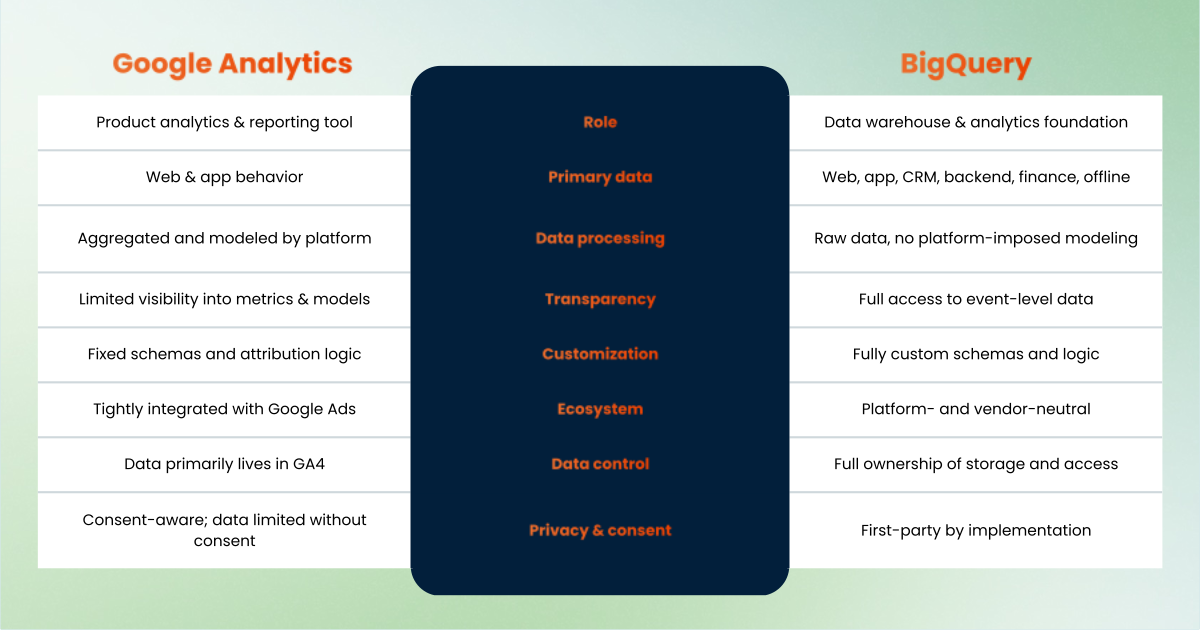
GA4 vs BigQuery: different roles in a modern data stack
Is BigQuery really too complex?
When Jos mentions BigQuery to agencies, the most common response is that it seems very technical. Which is true, indeed, but here's where the conversation needs to shift: people compare BigQuery to the status quo which is expensive in ways they're not counting.
The real risk isn’t implementation cost: it’s wrong decisions based on wrong data.
Consider a €10,000 campaign budget. "You make a decision that campaign A was better than B. And so you're going to design new landing pages, new creatives, you're going to send your marketing agency. You're going to set up everything. Well, that costs you a few thousand euros and then your budget. And then it turns out that it's the wrong campaign."
Or consider a Black Friday campaign that looks successful in GA4: "You think this is going really well. We get a lot of revenue out of it. But it turns out that all that revenue was against articles that had very low margins. And those customers were also returning everything."
In those scenarios, bad data is far more expensive than a data stack.
So, here's the reality check: the complexity exists whether you acknowledge it or not. GA4 with 40-50% data loss, mismatched attribution, and Google's black-box algorithms… that's complex too. You've just gotten used to it.
Where Server-side Tracking comes in
Server-side tracking alone is not a silver bullet, and Jos is clear about that. But when combined with clear data ownership, a warehouse (like BigQuery), and structured agency proposition, it becomes the foundation of a scalable data stack.
Server-side Tracking enables agencies to:
- Standardize server-side setups
- Maintain privacy-first pipelines
- Feed reliable data into analytics and ad platforms
- Activate multiple clients with a scalable approach
That’s exactly what defines a strategic agency.
Ready to explore what Server-side Tracking could look like for your agency?
Agency roadmap to step up their data stack
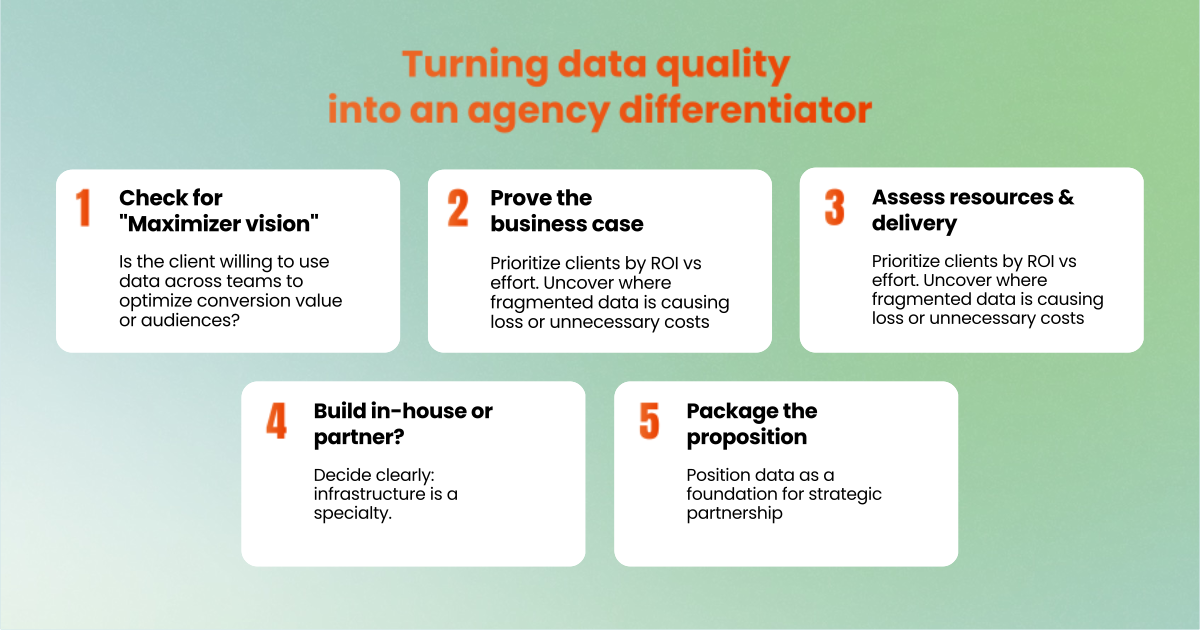
Step 1: Check for "Maximizer Vision"
Jos Ijntema emphasizes starting with vision, especially for e-commerce clients. Not every client is ready. Filter for those with what he calls a "Maximizer vision": willing to use data across departments (marketing, procurement, finance, etc.) to drive optimization across 3 key pillars:
- product feed
- conversion value
- audiences.
Step 2: Start with the business case
Before investing time in training or implementation, talk to your customer and understand their pain points. This way you can understand if you can actually monetize the improvement.
Shift to a value-pricing model, by asking yourself "what value do we deliver?" instead of "what does this cost me". Ask your client what revenue loss, cost drivers, or growth opportunities fragmented data is causing. Crucial questions for your clients:
- What is costing you revenue right now?
- What is driving unnecessary costs?
- Where do you see opportunities for growth?
Usually it's fragmented data: fulfillment sees stock going out of fashion, but marketing can't act without it. Data warehouses, or Server-side Tracking, combine departmental data to unlock opportunities. Here is the process Jos recommends:
- Define use cases and value
- Evaluate options like warehouses or SST
- Prioritize by ROI or effort to pick your strongest client.
Step 3: Make realistic resource estimates
Don't build everything on one person’s enthusiasm. "I see that happen a lot too. Then there is one person in the agency who is super enthusiastic and pulls the cart. All kinds of customer projects revolve around their solution. When that person goes away, you really have a huge problem.
You need:
- At least two people with capability
- Realistic time estimates for setup and ongoing maintenance
- A clear understanding of what complexity level you can actually support: start simple before scaling to warehouses.
Step 4: Define build vs. partner
Jos is adamant about this: "At Grain, we are in 7. Yes, we cannot support both Azure and AWS and Google Cloud. So we made one choice that we are good at." The same logic applies to agencies. You're excellent at Google Ads, Meta campaigns, creative development, or strategic planning. Data infrastructure is a different specialty.
"From my own experience... If you're very good at Google Ads, why would you want to add all those data things? It takes time. Energy. There are all kinds of support questions that you have to answer. You run risks."
The question isn't whether data matters (it does). The question is whether building and maintaining the infrastructure yourself is the highest-value use of your team's time.
Step 5: Build the proposition
Only after validating client needs, estimating resources, and deciding on your delivery model should you package this as a client offering.
Position your data capabilities as:
- Foundation for more strategic partnership, not a technical add-on.
- Fix for trust gaps (e.g., "one report matching backend reality").
- Enabler of proactive talks: "Let's clear that aging stock before it hits markdowns."
The strategic agency checklist
Looking at TAGGRS' most successful agency partners, a pattern emerges. Strategic agencies:
- Embed data infrastructure as standard. They don't sell it as an upsell or premium feature. Clean, complete, transparent data is the foundation of everything else they do.
- Focus on activation speed. They can onboard new clients to their data stack within 90 days, because they've standardized their approach.
- Scale through repeatability. Each new client implementation gets faster and more reliable, because they're reusing proven infrastructure rather than rebuilding from scratch each time.
- Position data as strategic advantage. They talk about data capabilities in business outcomes: faster decision-making, confident budget allocation, integrated view of customer journey.
These aren't the agencies trying to do everything themselves. They're the ones who recognized that data infrastructure—like server management before it—is essential but not differentiating. They partner with specialists who eat, sleep, and breathe data warehousing, so they can focus on what makes them exceptional.
FAQ
What does "single source of truth" actually mean?
According to Jos, three essential pillars:
Complete data collection. You need to capture the full picture before tracking blockers, browser restrictions, and consent walls strip it away.
Transparency. When attribution looks wrong or channels don't add up, you need to examine the underlying data, not just the dashboard. "Actually you just want to be able to look at the data behind the reports to see exactly what's going on. And that is shielded" in GA4.True data ownership. Your data should power your competitive advantage, not enrich Google's ad targeting capabilities. "As a company you should collect your own data... collect your own data, keep it to yourself and share as little as possible."