Campaign success in the AI era: insights from Webwinkel Vakdagen
 Ate Keurentjes | 1 April 2026 | Last updated:
 In digital marketing, AI is everywhere. And that’s one of the reasons why Server-side Tracking is moving from a "nice-to-have" for specialists to a strategic priority for mainstream marketing teams. This was the biggest takeaway from Webwinkel Vakdagen, the largest e-commerce event in the Netherlands, bringing together thousands of online retailers, marketers, agencies, and tech providers in Utrecht every year.
This year, TAGGRS was there not just as an exhibitor. We were on stage. Together with Lynn van Eijk, Campaign Manager at Flitsmeister, our co-founder and Head of Support Niek Schlepers presented a session on how one of the Netherlands' most popular navigation apps tackled the challenge of campaign measurement in the AI era using Server-side Tracking.
Below, we share what we discussed and what every strategic marketer should take away from the conversation.

The big picture: AI is changing the online marketing game
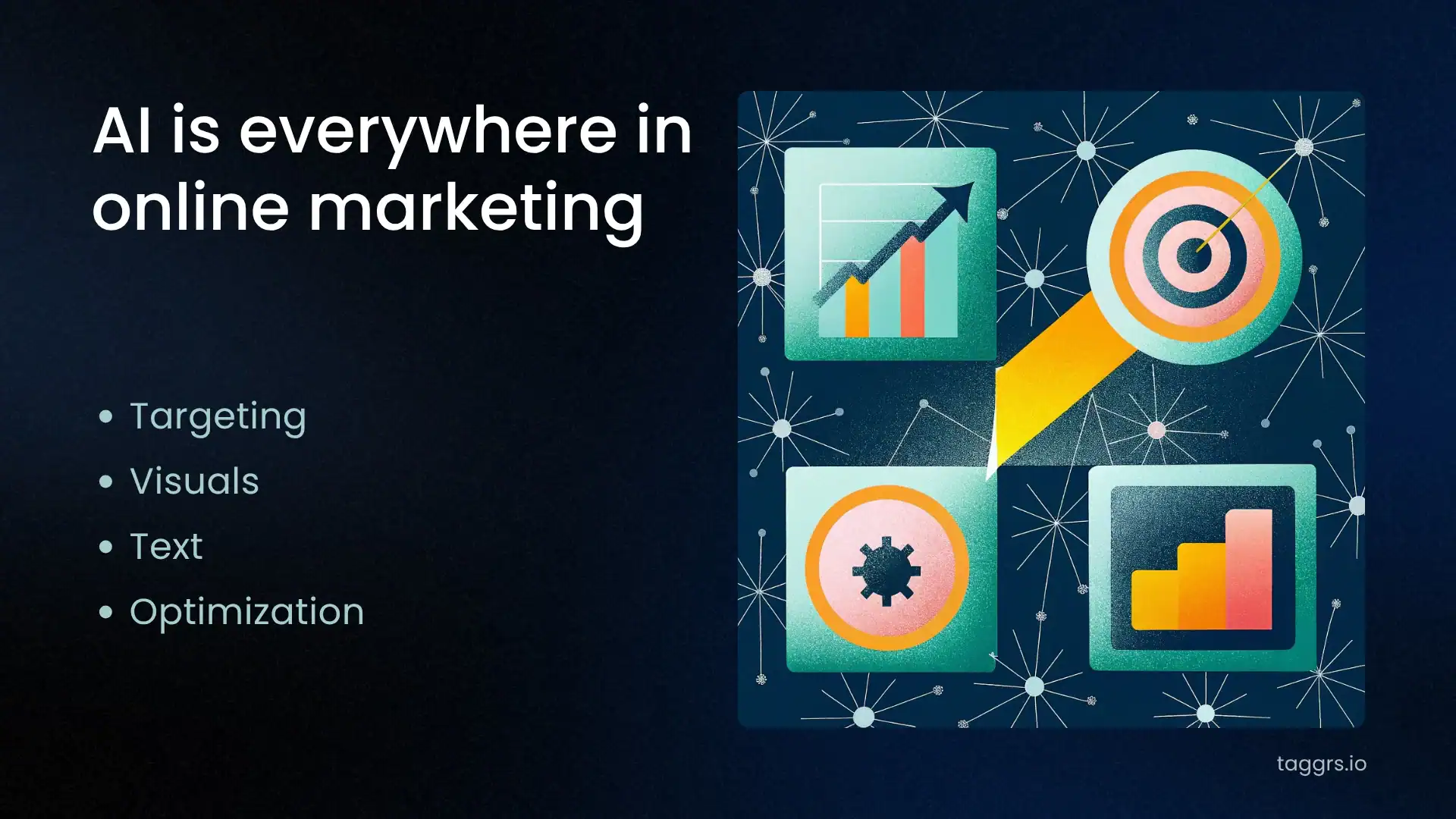
Copy, visuals, analytics tools… you name it! AI is all over the place everywhere in online marketing, but the data that feeds it is quietly broken. Google, Meta, and every major ad platform lean into machine learning to optimize campaigns, from AI-powered bidding to dynamic creative. But they all do need one thing not to waste ad spend: high-quality conversion signals.
On stage, we used an analogy: AI is like a powerful engine and data is its fuel. A bigger engine with dirty fuel won't outperform a smaller one running clean.
More personalization and yet less data
Online marketing is being pulled in two directions at the same time.
On one side, privacy regulations, browsers, and users are restricting the data you can collect. AVG/GDPR, Safari ITP, Firefox ETP, uncertainties around third-party cookies, and cookie consent banners are limiting your tracking. On the other side, the ad platforms you rely on are demanding richer, more accurate signals to train and improve their algorithms.
The numbers make the scale of the problem concrete:
- Ad blockers block 2–10% of tracking
- Browser restrictions block 5–10%
- Cookie banner rejections block up to 60%.
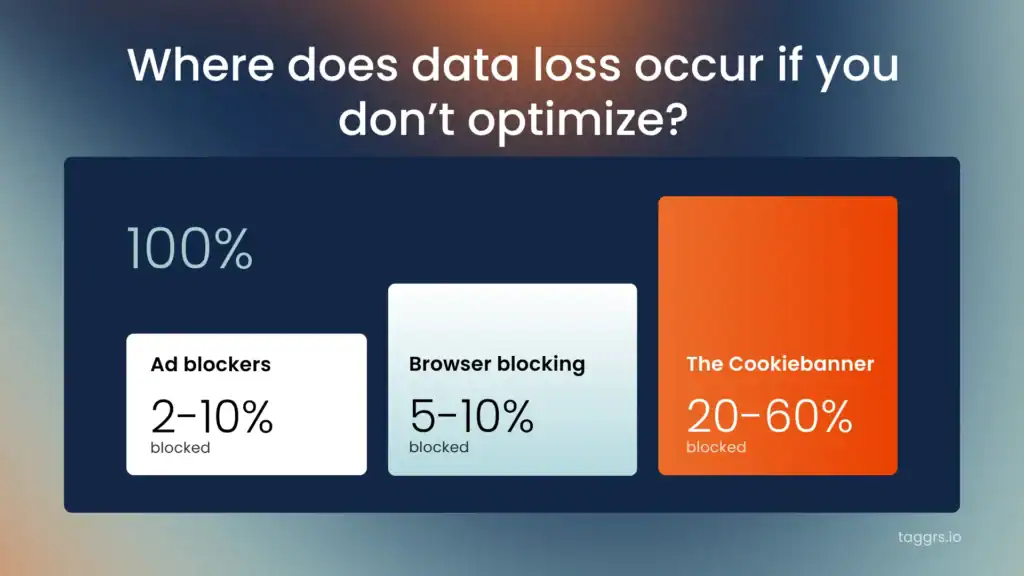
That last number is the one that tends to surprise people. Cookie consent rejection rates in the Netherlands (particularly in the Flitsmeister app's context, where millions of users access the product on mobile) are high enough that client-side tracking alone can leave enormous blind spots in your data.
This situation creates a real tension that every performance team feels but few articulate clearly: every user experience must become more personalized, but with less data.
That’s why companies nailing the paid media strategy in 2026 are the ones whose AI algorithms are better trained. And the only way to do so is to feed AI algorithms with better data. Server-side Tracking, first-party data strategies, and privacy-compliant measurement infrastructure are core parts of any performance marketing strategy. Not just backend technical concerns.
Use case on stage: how Flitsmeister minimized the data gap
Flitsmeister is one of the Netherlands' most popular navigation and traffic apps, with millions of active users accessing it primarily on mobile. Their campaign team faced a concrete problem: in-app performance was being measured inaccurately at scale, because client-side tracking was majorly limited due to mobile consent rejections and browser restrictions.
Together, we walked the audience through how they solved it: a six-month implementation built around a Firebase-to-TAGGRS server pipeline, routing clean first-party data to Google Analytics, Meta, and Google Ads entirely server-side.
Wondering how Server-side Tracking runs on mobile apps?
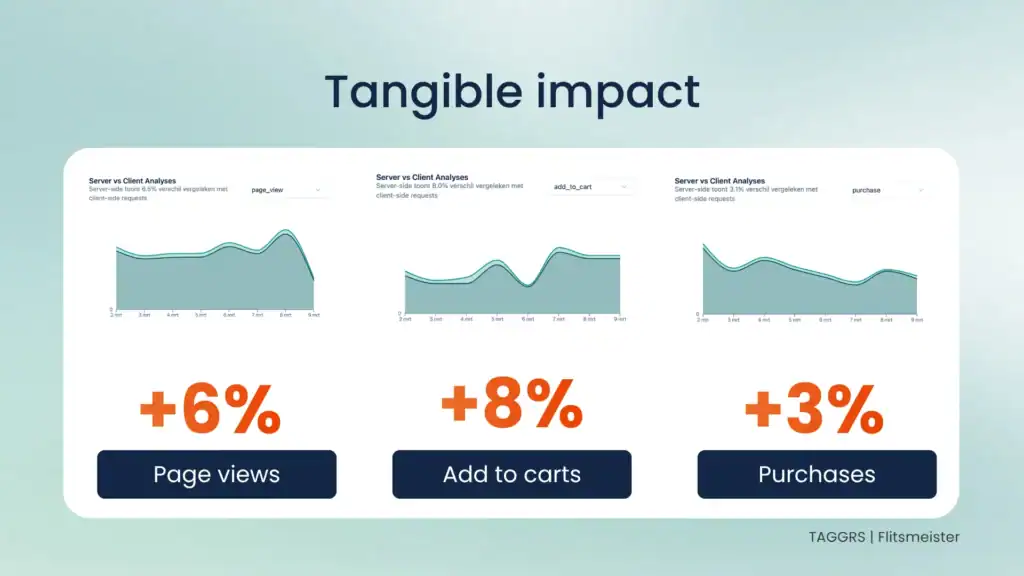
The before/after comparison showed clear, measurable uplift when comparing server-side to client-side data:
- +6.5% more page views captured
- +8.0% more add-to-cart events captured
- +3.1% more purchases captured
This is all about recovering signals that were always there but being lost. When those recovered signals feed Meta's Conversions API or Google's enhanced conversions, the compounding effect on bidding performance and audience quality can be significant over time.
Three key insights
1. Privacy requirements vary enormously by company
For a consumer app like Flitsmeister, privacy is core to the product's reputation. Users trust it with their location data. Server-side tracking, when done correctly, actually helps here: it’s GDPR-compliant and gives you full control over what data leaves your environment, and you can hash or anonymize PII before it reaches any ad platform.
2. Infrastructure is almost always underestimated
The biggest source of delays in the Flitsmeister project was the surrounding infrastructure: data layers, app event schemas, Firebase configurations, and consent management platform integrations all require coordination across multiple teams. If you're planning a server-side implementation, budget more time for infrastructure than you think you need.
3. Performance uplift doesn't always show up immediately
The algorithms need time to learn. Better data doesn't translate to better ROAS overnight: it tends to show up over weeks or months because models retrain and bidding strategies recalibrate. This is important for setting expectations. Anyone promising to "immediately improve ROAS by X%" might be overselling. Results will come, but the data foundation must be set up and tested.
What to do next?
If the Flitsmeister case resonates with your situation, here are 3 practical starting points:
- Audit your current tracking loss. Compare server-side and client-side event counts. If you don't have server-side set up yet, run a gap analysis using your consent rejection rates as a proxy.
- Start with a clear goal. Don't implement server-side tracking as a technology project. Start with the business question: what conversions are you not capturing, and what would it mean for your campaigns if you did?
- Test and validate before you optimize. Data quality has to come before data use. Build in a validation phase before you connect server-side data to ad platforms.
Beyond the stage: Webwinkel Vakdagen 2026
During the WWV, we talked with partners, competitors, and attendees who didn’t know us. Here are our learnings from the event:
Awareness of server-side tracking is growing, but it's uneven. Agencies and in-house teams who work closely with data are already asking the right questions. But many brands are still operating under the assumption that their Google Tag Manager setup is capturing everything it used to. Reality is: it isn't.
The cookie banner conversation has matured. Attendees at WWV were noticeably more sophisticated about consent than in previous years. The question is no longer "do we need a cookie banner?" — it's "how do we minimize signal loss while respecting consent?" That's exactly the problem server-side tracking is designed to address.



We'll be back at events like the Webwinkel Vakdagen 2026 throughout 2026 and we're continuing to build out case studies like the Flitsmeister project to show what's actually possible. If you want to explore what Server-side Tracking could mean for your measurement setup, feel free to reach out.
Happy tagging!