

How a 3-million-user app recovered missing conversions with Server-side Tracking

The overview
Flitsmeister is one of the Netherlands' most popular navigation and speed camera apps, with 3 million active users, primarily on mobile. As a consumer product built on user trust, Flitsmeister has always taken a privacy-first approach to data. But that mobile-first reality created a measurement problem: conversions were disappearing, and nobody could quantify the real data loss. When they partnered with TAGGRS, Flitsmeister had one goal: to collect the right data, reliably.
The result? A 6-month server-side implementation built around a Firebase-to-TAGGRS pipeline, routing clean first-party signals to Google Analytics, Meta, and Google Ads. Entirely server-side.
Here's the full case study, told by Ate Keurentjes, Head of Marketing at TAGGRS, and Lynn van Eijk, Campaign Manager at Flitsmeister, responsible for performance marketing across Google Ads and Meta, with a focus on subscription acquisition and in-app purchase optimization.
The challenges

Cross-device visits and unattributed conversions
The moment Flitsmeister knew something had to change wasn't a technical audit. It was a simple comparison that didn't add up. Cross-referencing website visits with CRM purchase data revealed a clear discrepancy: not every visitor was being counted, and not every conversion was being attributed.
Flitsmeister's business model means users frequently move from the app into a web environment for subscription flows, premium features, or purchase completions. These transitions created a blind spot. When a user clicked through from the app to the web, they effectively disappeared from the measurement layer. Client-side tracking on the web couldn't recognize them as existing app users. Purchases completed in that flow went entirely unrecorded.
Over time, this gap had been silently growing: a slow decline in data quality that only became visible when the team looked hard at the numbers side by side.

Mobile tracking pressures
The typical mobile tracking pressures made things worse:
- Consent banner rejections can block up to 60% of tracking signals
- Browser restrictions (especially those on Safari and iOS) shorten cookie windows and limit third-party data collection
- Ad blockers strip out client-side scripts before a single event fires
Budget and optimization decisions were backed by incomplete conversion data, which was even impossible to fully quantify.
And the problem went beyond campaign performance. At Flitsmeister, data drives decisions across the entire business.
Relying on accurate data wasn't only a marketing need. It was a product need.

Why privacy made this more than a technical decision
Flitsmeister's users share their live location with the app. That's a relationship based on trust. The company has built its reputation on handling that data responsibly, which means any tracking change had to be genuinely privacy-compliant, not just technically defensible.
For Flitsmeister, implementing Server-side Tracking was a priority for its own brand values. That rule out approaches that would bulk-send raw user data to ad platforms. The implementation had to meet 3 requirements:
- Data processing within an environment Flitsmeister controlled
- Proper hashing and anonymization of PII before forwarding to platforms
- Full GDPR compliance with auditable data flows.
Server-side Tracking through TAGGRS met all three. Because data flows through Flitsmeister's own server container rather than a third-party browser script, the company retains full control over what gets sent, to whom, and in what form.
The solution:
implementation Firebase to TAGGRS
Flitsmeister app → Firebase
Firebase → TAGGRS server
TAGGRS Server → destinations
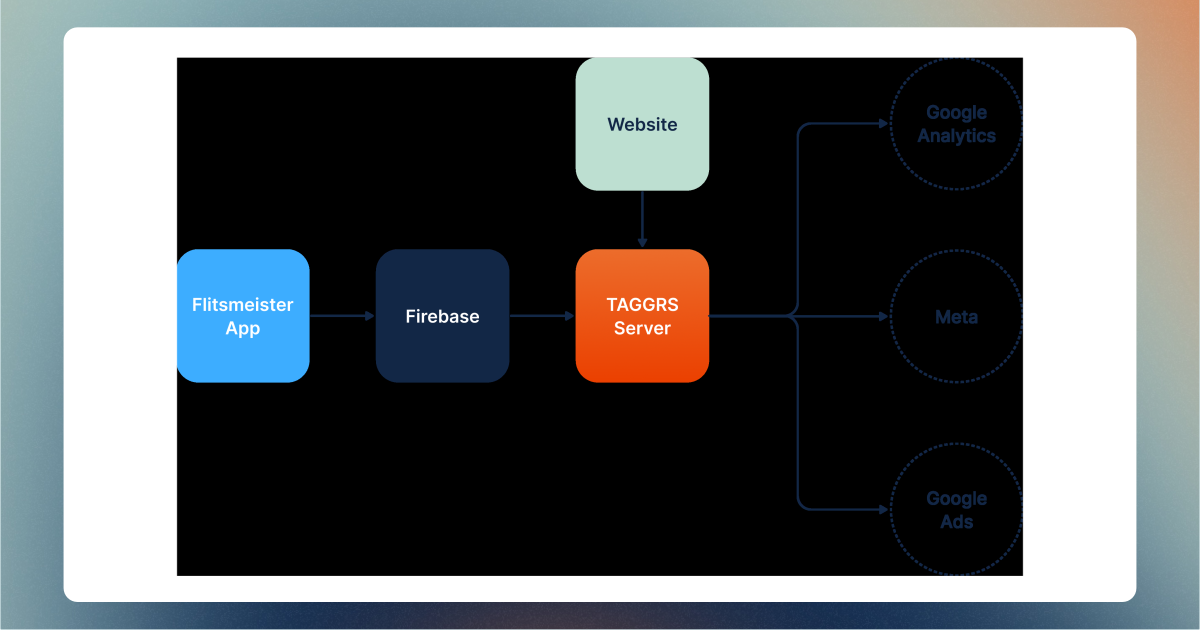
With this setup, the browser — with all its consent limitations, ad blockers, and cookie restrictions — is no longer in the critical path for conversion measurement. Events originate on the server and are delivered server-to-server.
A highly reliable custom setup
Compared to a standard web implementation, the Flitsmeister project touched more systems:
- App event schemas: Firebase events needed to be mapped and validated against the expected format for each downstream destination
- Consent management: Mobile consent flows operate differently from web cookie banners, requiring custom logic to ensure events respect user preferences end-to-end
- Cross-environment user matching: Stitching together app events and web events from the same user required careful handling of identifiers across environments
The results: recovered signals, trusted data
The uplift across +6.5% page views, +8.0% add-to-carts, and +3.1% purchases represents events that were always happening, but lost before they could be recorded. This distinction matters for how you interpret the impact.
Recovered signals feed better algorithms. When server-side conversions are sent to Google Ads or Meta, they expand the matched audience the bidding algorithm can learn from. More accurate conversion data means models can identify higher-quality segments, allocate budgets more efficiently, and optimize toward outcomes that actually close. It’s a virtuous cycle that has a tangible impact on the whole business.
Attribution becomes trustworthy. One of the hidden costs of client-side tracking on mobile is misattributed "direct" traffic. When click identifiers (gclid, fbclid) aren't preserved through a purchase flow, conversions that came from paid campaigns get credited to direct. Server-side tracking preserves those identifiers and corrects the attribution picture.
The team can trust what they're looking at. For Lynn, this was the most important shift: "You need to trust the data."
When you know your tracking is incomplete, every campaign decision carries an asterisk. With server-side tracking in place, Flitsmeister's team can make budget, audience, and bid strategy decisions based on numbers they believe.