Retargeting in a scattered digital world

 Ate Keurentjes | 6 January 2026 | Last updated:
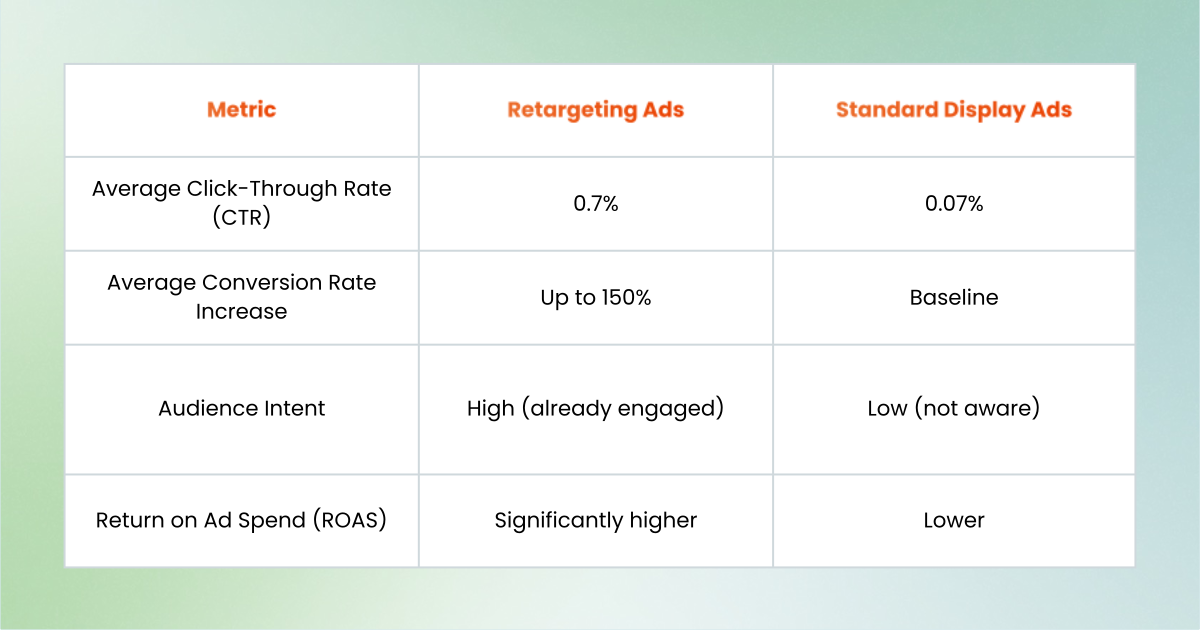
 Retargeting can increase CTR by up to 10x compared to regular display ads1, with retargeted users are 43% more likely to convert than first-time visitors. This makes it still one of the most effective ad strategies for ROAS, especially in the e-commerce world where still 70% of users abandon their carts before converting2.
But with the digital landscape getting more intricate and user behaviour harder to trace, the rules of retargeting have changed. Today, the customer journey looks less like a straight line from ad → landing page → conversion and more like a fragmented loop across social platforms, websites, search engines, apps, AI answers, and privacy‑first browsers — all environments that often don’t share identifiers, don’t respect traditional tracking methods, and increasingly don’t execute browser scripts at all.
For marketers, this leads to a fundamental question: is retargeting still possible in today’s scattered digital world? The answer is yes. But not the way it used to work.
In this article, we’ll cover:
- Why retargeting still works, even as cookies fade and browsers get stricter.
- How fragmented journeys break traditional tracking and why “cookieless” oversimplifies the real problem: signal loss.
- How to shift from fragile browser pixels to durable first‑party signals and server‑side tracking for future‑proof retargeting.
- Practical best practices to build resilient audiences that survive ad blockers, in‑app browsers, and platform silos.
- Common mistakes (like over‑relying on browser scripts) and how to avoid them.
- How TAGGRS helps marketers maintain reliable, privacy‑safe retargeting performance in a world where tracking is getting harder.
Retargeting today = moving beyond cookie-only tracking
Retargeting is still one of the highest‑ROAS tactics in performance marketing, especially for e‑commerce, SaaS, and lead gen. The core idea of showing relevant ads to people who already showed interest remains powerful. What has changed is the underlying assumption: that a single browser cookie can reliably follow a user across the web. That model made sense in the early 2010s, when most journeys happened on desktop Internet Explorer, Firefox, or Chrome, and third‑party cookies were widely accepted.
Today, that assumption breaks down in (at least) five ways:
- Multi‑device behavior. Users switch constantly between mobile, tablet, and desktop, often using different browsers and logins.
- In‑app browsers. Platforms like Facebook, TikTok, and LinkedIn limit script execution and block many tracking methods.
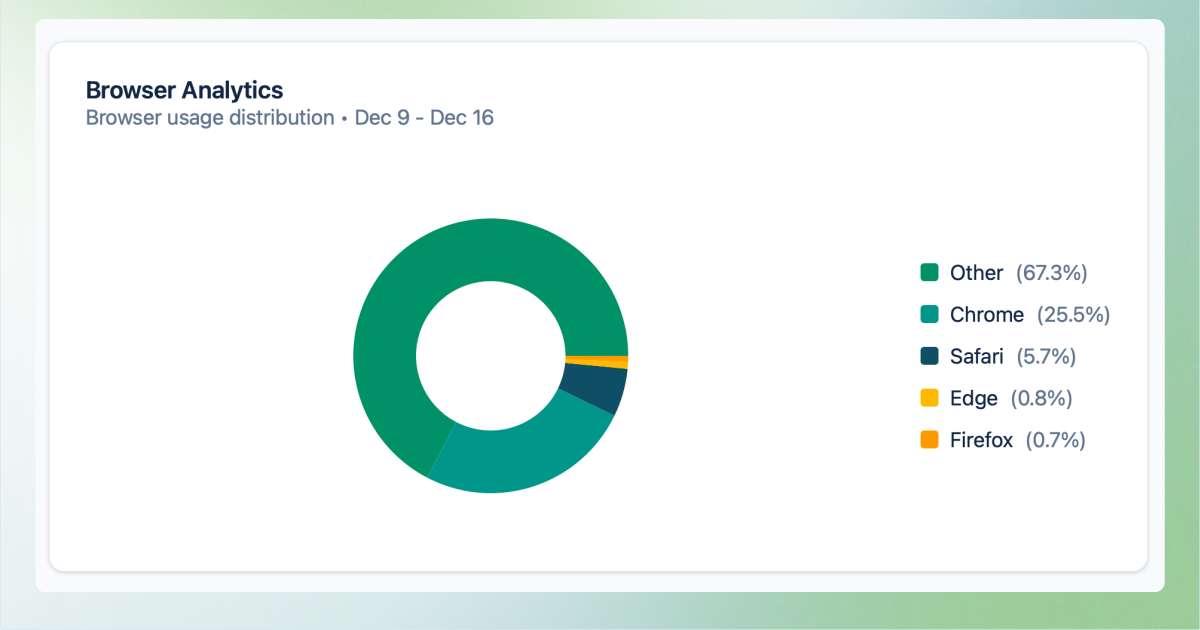
- Privacy‑first browsers. Browsers like Safari have changed their tracking rules, by limiting cookie lifetime and blocking third‑party scripts.
- AI‑powered discovery. AI assistants and search answers often suppress or rewrite referrer and tracking signals, making it hard to track users and attribute visits.
- Platform silos. Google, Meta, Apple, and others increasingly prioritize their own signals and restrict cross‑platform visibility.
Add inconsistent user identifiers to the mix, and the result is predictable: shrinking audiences, missing conversions, and attribution reports that no longer line up.
This doesn’t make retargeting impossible. It simply makes cookie‑only tracking models obsolete. And it’s not about the uncertain future of cookies.
Why “cookieless” is an oversimplification
Much of the conversation around retargeting focuses on cookieless tracking. While third-party cookies are undeniably losing relevance, they’re not the core problem. The real issue is signal loss.
Browsers behave differently. Devices don’t share identifiers. Platforms restrict data flows. AI browsers and assistants often suppress or rewrite tracking signals entirely. Even when cookies still exist, they capture only a fragment of the user journey.
Calling this “cookieless” misses the point. The challenge isn’t the absence of cookies — it’s the loss of consistent, reliable signals across fragmented environments.
Signal loss: the real problem advertisers face
Signal loss is what happens when real user behavior can’t be observed reliably anymore.
In practice, this shows up as conversions that can’t be attributed, retargeting audiences that decline over time, delayed or missing events, and rising acquisition costs despite stable traffic. Users are still there: your systems just fail to recognize them consistently. And AI browsers and assistants have accelerated this shift, disrupting tracking and attribution.
This is also why pixel-only setups no longer reflect reality. Browser pixels depend entirely on client-side execution, which is increasingly unreliable in modern browsing environments. When pixels fail, both retargeting and attribution models suffer.
What makes retargeting future-proof?
With client-side solutions, one day you can measure 90% and the next day only 20%. You can’t send good data like that and you can’t train a machine either. — Teun van Kleef, Lead Advertising & Data @ Social Brothers
See how Social Brothers relies on a consistent data collection
Future-proof retargeting isn’t about tracking more aggressively. It’s about tracking more intelligently. At the core of resilient retargeting strategies is first-party data. First-party events are:
- more durable
- less dependent on browser behavior
- easier to align with privacy regulations.
When combined with consent-aware logic, they allow data collection to continue even as environments change. Consistency matters more than perfection. You don’t need flawless tracking — you need signals that are collected reliably over time and delivered in a way ad platforms can actually use.
This is where server-side event collection plays a critical role. By shifting signal delivery away from the browser, Server-side Tracking reduces dependency on scripts, stabilizes data flows, and improves event reliability across devices and environments.
Before switching to Server-side Tracking, we noticed more and more that data in our dashboards was far apart. Clicks in Google Ads were totally not comparable with what we saw in Google Analytics. The same was true for Meta ads. That made us look for a solution, which led us to Server-side Tracking. — Romy Brookhuis, Online Content Marketer @ byteffekt
Read the full case study
Platform-native Conversion APIs further strengthen this setup. They allow signals to be matched and processed in ways platforms prefer, improving both attribution and retargeting performance. Where durable identifiers are available, privacy-safe hashing enables better matching without compromising compliance.
The most common retargeting mistakes
According to our experience, many performance issues stem from familiar patterns. Here is the 5 most common retargeting mistakes we’ve come across in the latest years:
- Relying exclusively on browser pixels. When tracking depends entirely on client-side execution, it becomes fragile by design. Every browser update, privacy change, or in-app environment increases the risk of data loss.
- Postponing Server-side Tracking. Teams often wait until performance drops significantly before addressing data quality, by which point algorithms have already been trained on incomplete or inconsistent signals.
- Over-segmentation. Creating dozens of small retargeting audiences might look sophisticated, but in a world of signal loss, it often leads to underpowered campaigns that never exit the learning phase.
- Chasing the illusion of 100% tracking accuracy. In reality, trying to measure everything perfectly often results in unstable setups that break as soon as the environment changes. Consistency is far more valuable than completeness.
- Focusing exclusively on “cookieless” strategies can be misleading. Treating cookies as the only problem ignores the broader challenge of fragmented journeys, platform silos, and disappearing identifiers.
Best practices for future-proof retargeting
At a practical level, effective retargeting today follows 5 core principles:
- Avoid dependency on third-party cookies and browser-only pixels
- Build retargeting audiences using first-party events
- Use Server-side Tracking to stabilize signal delivery
- Enable platform-side matching where appropriate
- Ensure data flows respect user consent by design
Just as importantly, rely on infrastructure that adapts to browser and platform changes without requiring constant manual intervention.
We are not developers, nor do we aspire to be. We are marketers, so we like to use tools that make our lives easier. — Peter van der Harg, Google Ads AI Optimization Expert @ Adbrains
Read the full case study
FAQs
Is retargeting still legal under GDPR?
Yes, provided it’s built on proper consent management, transparency, and first-party data practices. Read more about privacy compliance in Marketing.
Can I retarget users coming from AI browsers?
Yes, but only if you rely on server-side and first-party signals rather than browser-only tracking. See how to fix attribution in GA4.
Why are my retargeting audiences shrinking?
Because signals are lost across fragmented touchpoints, not because users stopped engaging.How does TAGGRS improve retargeting performance?
By helping marketers collect consistent first-party signals, reduce browser dependency, and maintain privacy-safe retargeting audiences across platforms. Try it out for free.
- Cropink, Retargeting Statistics ↩︎
- Baymard, Cart Abandonment Stats ↩︎