Why the best tracking conversations happen away from the sales floor: TAGGRS at Analytics Pioneers Munich

 Małgorzata Poddębniak | 29 September 2026 | Last updated:
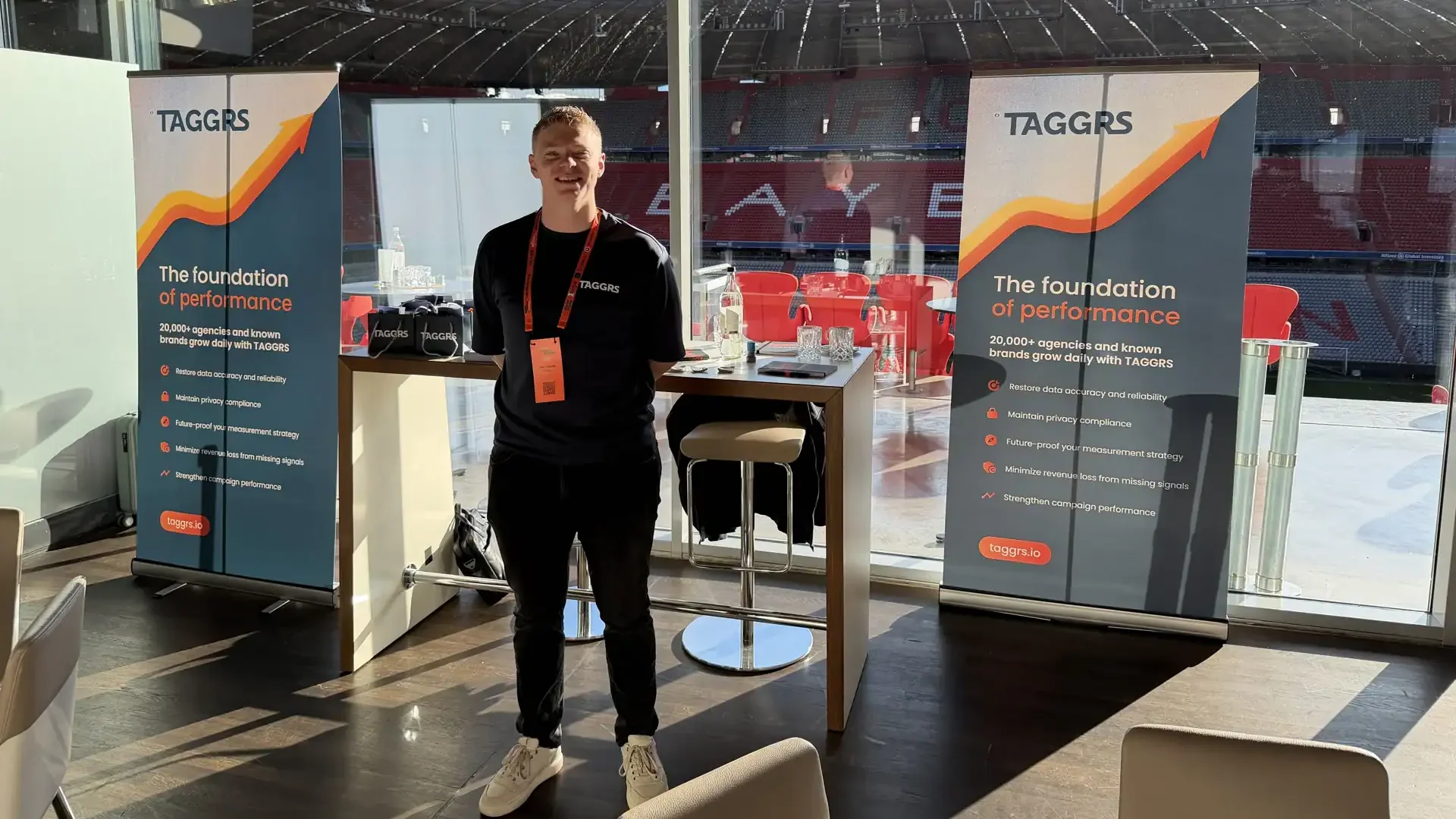
 Analytics Pioneers is an unconference for the digital analytics and marketing technology community. The 2026 edition ran on 17 September at the Allianz Arena in Munich and it was fully booked.
The format is a barcamp, so the agenda comes from the participants rather than a fixed program of vendor talks. Sessions cover the MarTech field as a whole: strategic, technical, and marketing topics, alongside whatever the community is currently working through. Participation is free and the event is built around networking, sharing knowledge and solving problems together.

For us, it was a chance to spend time with the analytics community in Germany and the wider DACH region, and to talk about tracking with people who already know how it works. Alongside sponsoring the event, our Head of Customer Support, Niek Schlepers, ran a session called Where sGTM still leaves data gaps.
Here is what we covered and what we took away.
What was on the agenda
The day ran on seven parallel session slots spread across stages throughout the stadium, including in the rows of seats around the arena.
The session board showed what the analytics community is currently paying attention to. AI and agents ran throughout, from agentic tag management to practical MCPs for GTM, GA4 and Google Ads.
Server-side infrastructure was the other major theme, with talks on cutting sGTM costs, cookieless tracking and a server-side decision guide. Consent, compliance and data quality filled out the rest.
On stage: Where sGTM still leaves data gaps
Niek Schlepers ran a session on the part of the tracking chain that server-side setups tend to overlook.

Moving to server-side GTM is a good start, but it does not solve the problem on its own. Before an event reaches your container, the browser still has to load the script and send the request, and both steps remain exposed to ad blockers and ITP. A correctly built server-side setup can still leak a meaningful share of signal.
Google Tag Gateway addresses only part of that gap, and Niek’s session covered what it fixes and where it stops: it protects Google's own scripts, which leaves Meta and everything else exposed.
Our Enhanced Tracking Script covers that wider gap. Events from visitors running ad blockers or privacy-focused browser settings start arriving again in GA4 and your ad platforms, cookie resilience improves on ITP-restricted browsers like Safari, and the TAGGRS dashboard reports how many events would have been lost without it, so the recovery is clearly visible.
What we took away: The questions change with the audience
What stood out to our team was the level of the audience. It skewed toward large enterprise organisations with strong in-house technical knowledge, so conversations started from shared ground. People already knew how Server-side Tracking works and wanted to go a level deeper.
That audience brought a different set of questions than we usually get. Most people had already decided that Server-side Tracking was worth doing.
Now they wanted to find out how to do it properly:
- How to handle the technical constraints.
- How to keep an implementation maintainable as it grows.
- How to be confident the data coming out the other end is complete.
The topic of container sizing came up repeatedly, both in sessions and in conversation, and remains a notable problem for teams running at scale.
Those are the right questions to be asking. As tracking gets harder, the distance between having tracking in place and being able to trust your numbers keeps widening. Browser restrictions, ad blockers, and consent requirements each remove a portion of what reaches your analytics. The platform can only report what arrives and a blocked event never does. The data gap shows up as a slightly smaller number, which looks like a slow week.
It is a solvable problem, but only once you can see the size of it.
Where your data lives is part of the decision
The topic of jurisdiction carried more weight in this room than it usually does.
For companies in regulated European markets, the question of where tracking data is stored and who has access to it is a real consideration. The issue comes up in legal review whether or not anyone raised it earlier.
TAGGRS runs on independent European infrastructure, with every processor in the chain based in the EU. That keeps the data inside EU jurisdiction and gives your legal team a straightforward answer.
Conclusion
The most valuable conversations about measurement happen when you skip the sales pitch and get into the details. Analytics Pioneers is built for exactly that, and the community around it, technically sharp and happy to share its knowledge, is one we want to keep being part of.
If you would like to continue the conversation around analytics, measurement or Server-side Tracking, book a slot with one of our experts.
Ready to see what your own setup is recovering? Run a free audit of your site or create a free TAGGRS account and test it against your own numbers.