ChatGPT Ads are live. How to measure them?


ChatGPT ads launched in February 2026, initially for US users on the Free and Go tiers. But overseas the program hit $100 million in annualised revenue within six weeks. Over 600 advertisers joined the pilot. Major agency holding groups committed testing budgets. By any early commercial measure, this looks like a success.
But ask the advertisers what the results were. Two agency executives who participated in the early tests confirmed they couldn't demonstrate measurable business results for their clients. Not because the ads didn't work. Because there was no way to tell.
That's the actual story here. Not whether ChatGPT can sell ads. It clearly can. The question is whether it can build the measurement layer that makes those ads worth buying at scale. And right now, the answer is that nobody knows, because the data isn't there yet.
Read more on Search Engine Land: ChatGPT ads pilot leaves advertisers without proof of ROI
What advertisers are actually getting right now
Early participants in the ChatGPT ad pilot receive a weekly CSV file. Clicks. Impressions. That's mostly it. No click-through rate benchmarks, no conversion tracking, no viewability scores. Deals are negotiated manually, through calls and emails.
One client trial saw a 0.91% CTR against a 6.4% benchmark for traditional Google search in the same sector. A separate enterprise advertiser had used just 3% of a $250K budget after several weeks, partly due to a reporting glitch that blocked visibility into their own data.
The missing piece isn't surprising if you think about how this channel works. Google didn't just build an ad network. They built Analytics, Tag Manager, BigQuery pipelines, attribution models, because ads are only worth buying if you can prove they work. The measurement infrastructure came alongside the ad product, and in many ways before it. OpenAI launched the ad product first, whereas the measurement infrastructure is still being figured out.
At a minimum, any advertising platform operating inside a conversational interface needs to expose:
- Impressions: when was the ad shown, in which conversation context
- Engagement: did the user interact with it, follow up on it, or continue past it
- Conversions: did the session eventually turn into a signup, purchase, or lead
- Attribution logic: what counts as success across multiple conversation turns
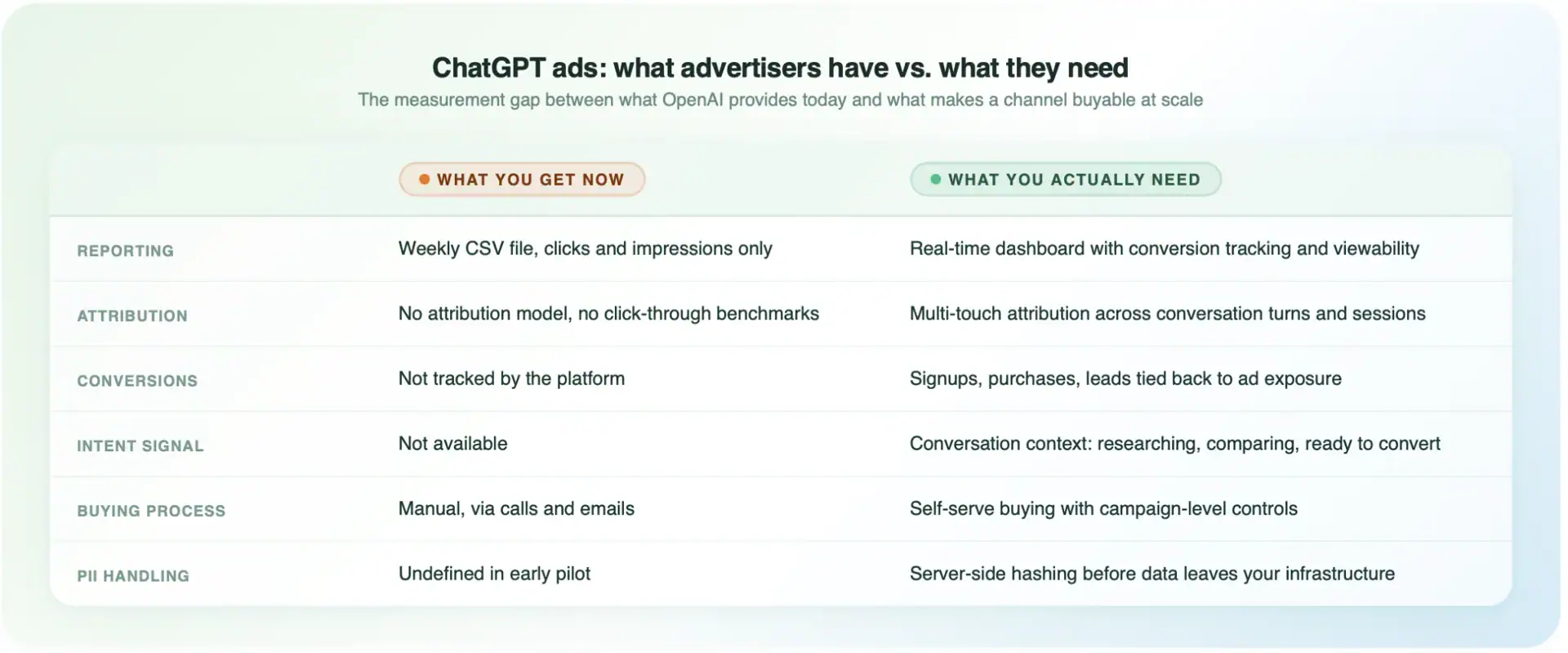
The more interesting question is what comes after that. Will OpenAI eventually expose intent classifications based on conversation context, "researching", "comparing", "ready to convert"? Can advertisers see how a conversation drifted around a brand or offer over multiple sessions? Can you segment performance by what the user was actually trying to accomplish? That kind of signal would get you closer to something like conversational intent analytics: reading real behavioural signals from natural dialogue rather than inferring intent from clicks alone. Whether OpenAI moves in that direction is still an open question.
Why standard attribution won't cover it
Conversations are a different unit
Attribution in search and social runs on a fairly stable model: someone clicks, they land on a page, something happens. The click is the event. The conversion path has a beginning you can identify.
ChatGPT breaks that unit. What would traditionally be seven to ten touchpoints in a B2B buying cycle can be compressed into a single asynchronous conversation thread. And the "destination" after an ad interaction isn't always a webpage. Sometimes the user just keeps chatting.
The referral source problem
Where ChatGPT traffic shows up in your analytics depends on whether OpenAI preserves the referrer header. You might see chatgpt.com, openai.com, or direct, depending on how the link is surfaced inside the interface. UTM parameters on click URLs should work in principle, but ad environments that render inside AI-generated responses don't always pass URL parameters cleanly.
Even with a correct source, campaign-level attribution is limited. Which creative drove the session? Which conversation had the highest purchase intent? Those questions are hard to answer from a weekly CSV and nearly impossible with client-side measurement alone.
AI browsers are already creating a version of the same problem, altering or stripping referral data before a visit registers. We've covered how that pattern plays out for attribution here. ChatGPT ads layer a similar issue on top of an already complex picture.
How to set up tracking before you test this channel
The good news is that the tracking infrastructure worth building for ChatGPT ads is the same infrastructure that improves measurement across every channel you already run. The investment isn't single-use.
Move events to the server side
Client-side tracking depends on JavaScript firing in the browser. Browsers block scripts, expire cookies, and sometimes drop referral data before a request makes it to your analytics platform. For a channel already giving you thin data, every additional failure point makes the picture harder to read.
Server-side Tracking captures events on your own infrastructure before browser restrictions apply. You control what gets sent to GA4, Meta, and Google Ads. Data that gets dropped by an extension or expires on a Safari session isn't a reporting gap you can footnote. It's a structural problem in your attribution.
Use server-side cookies to extend attribution windows
Safari limits cookies set by JavaScript to seven days. Other browsers are moving in the same direction. A user who engages with a ChatGPT ad today and converts three weeks later, after a second touchpoint on a different device, will fall outside a browser cookie's attribution window entirely.
Server-side cookies bypass the restrictions that cause browser-set cookies to expire early. You can hold attribution data for 30, 60, or 90 days. For a channel where the consideration window may run longer than standard search, that matters more than it sounds. More on how this works in practice: cookie recovery explained.
Layer UTMs, server-side identifiers, and landing page enrichment
No single method closes all the gaps. A more reliable setup combines:
- UTM parameters on ad click URLs, for the cases where the platform preserves them
- Server-side session identifiers that persist across devices and browser sessions
- Landing page enrichment on entry, capturing user-level signal at session start so attribution holds even when the referral data arrives incomplete
If UTMs get stripped, the session identifier still connects the session to the campaign. If the user switches devices mid-journey, the enriched session data can still reconstruct the path.
Hash PII Before It Leaves Your Server
Conversion signals sent to ad platforms for customer matching typically involve email addresses or phone numbers. Doing that hashing in the browser means the logic is visible in the page source and the data passes through an environment you don't fully control.
On the server, you control the hashing before data leaves your infrastructure. The platform gets what it needs for matching. Nothing else travels. That's cleaner for GDPR compliance, and it doesn't break if JavaScript execution behaves unexpectedly in a new ad environment.
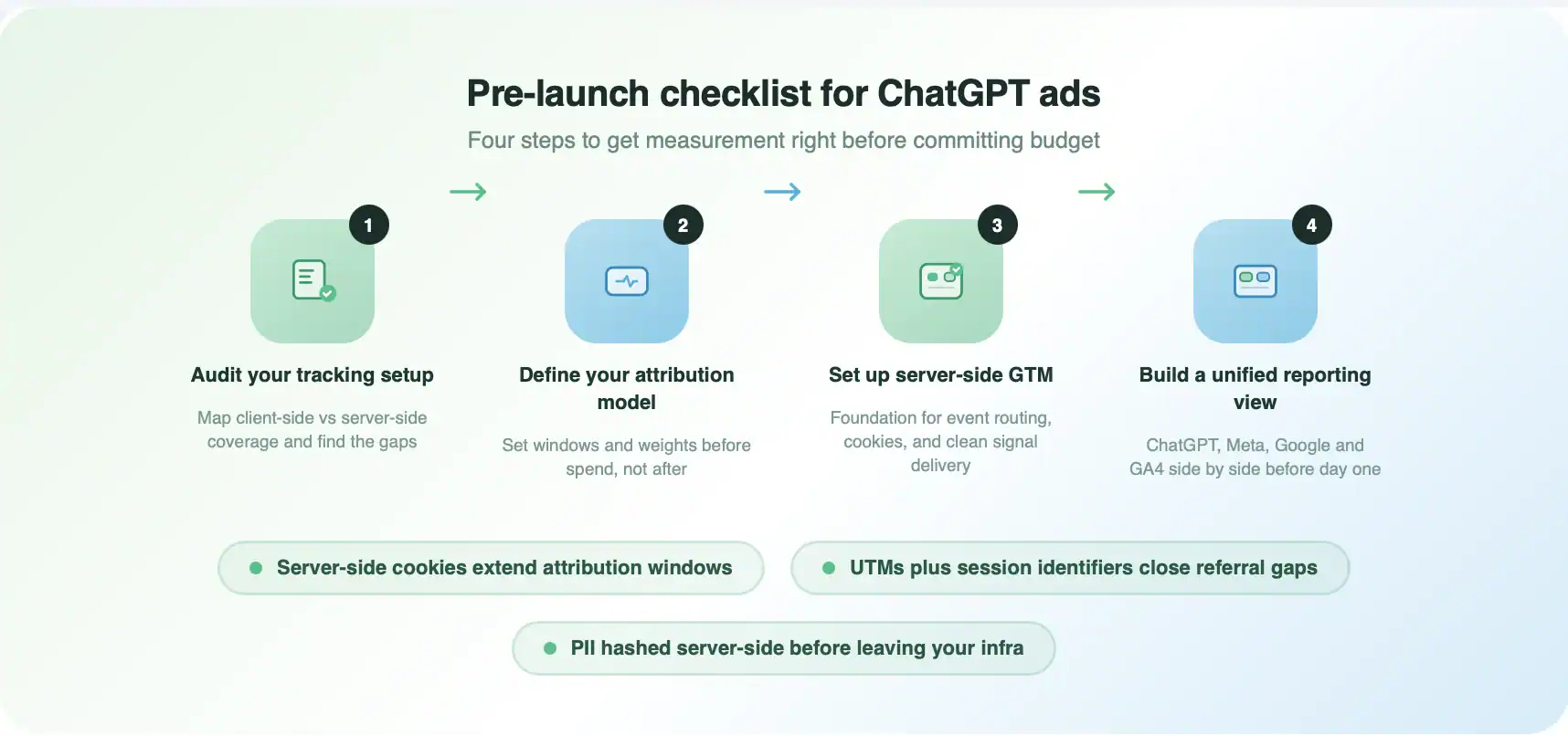
Pre-Launch checklist
Before committing a budget, these four steps are worth working through.
1. Audit your current tracking setup
Map what's running client-side versus server-side. If most of your conversion tracking still depends on GTM firing in the browser and JavaScript-set cookies, that setup will underperform on a channel with multi-session, multi-device attribution paths. Drawing this out usually surfaces a couple of gaps that weren't obvious from the inside.
2. Define your attribution model before the first campaign
ChatGPT doesn't fit into last-click or even most data-driven attribution models built around clean click paths. Before launch, decide how you'll weight conversational touchpoints and what attribution window applies to this channel. Doing that before you spend means you can compare ChatGPT to Meta and Google on consistent terms. Doing it retroactively means rebuilding the analysis with the budget already gone.
3. Set up server-side GTM
A server-side GTM container is the foundation for event routing, server-side cookie management, and clean signal delivery. It also improves attribution across your existing channels, so the setup pays off whether or not ChatGPT ads become part of your media mix.
4. Build a unified reporting view
A new channel fragments reporting if you don't plan for it. Get a dashboard that puts ChatGPT, Meta, Google Ads, and GA4 side by side before the first campaign runs. Comparing cost-per-conversion across channels is what tells you whether ChatGPT spend is generating real returns or just adding noise to your attribution model.
Want to do the extra step?
sGTM template for ChatGPT Ads Conversions API
At TAGGRS, we built an open-source sGTM tag for the OpenAI Conversions API. The template handles oppref tracking, user data hashing, event deduplication, and flexible parameter mapping, without editing template code. It includes a debug mode to validate the setup against OpenAI's API before going live.
Where TAGGRS fits
The infrastructure described here, server-side event collection, extended attribution windows, landing page enrichment, server-side PII handling, is what a well-configured server-side GTM environment gives you. TAGGRS provides server-side GTM hosting with event routing, cookie management, data transformations, and ad platform integrations built in, without requiring you to manage the underlying infrastructure yourself.
For teams thinking ahead about channels like ChatGPT ads, the setup handles attribution that doesn't fall apart when user journeys don't follow clean click paths. The same infrastructure improves signal quality for Meta, Google Ads, and GA4, so it addresses more than a single channel's measurement problem.
What we're still waiting to find out
The measurement picture for ChatGPT ads will change. OpenAI has a dedicated Ads Manager in development, along with self-serve buying tools planned for the coming months. The weekly CSV era won't last forever.
What's less clear is how deep the data will go. Basic click and conversion reporting is the floor. Whether advertisers will eventually get intent-level context from conversations, signal on how a user's thinking evolved across sessions, or structured event data they can pull into their own pipelines, is still an open question. The industry has been asking for it. OpenAI hasn't committed to it.
Until that clarity arrives, the teams that will get the most from this channel are the ones that don't rely on the platform to do their measurement for them. The infrastructure you build on your side is the part you control.
The pilot is currently live in the US and expanding to Canada, Australia, and New Zealand. The rollout in Europe is expected to happen in Q4 of 2026.
This article will be updated as OpenAI's measurement tools and data-sharing model develop.