How to build a sustainable business model around Server-side Tracking

 Ate Keurentjes | 21 April 2026 | Last updated:
 As Arjen de Groot, our partner at Converseon, said, "Server-side Tracking is often mistakenly treated as a quick 'install and forget' solution.” But if you include it into your strategic planning, Server-side Tracking becomes the infrastructure your entire marketing performance is built on.
At MeasureCamp Amsterdam 2026, we went hands-on presenting:
- the commercial case for treating Server-side Tracking as infrastructure,
- 3 revenue streams that make the model work and the numbers behind it
- 3 pitfalls that collapse margins when the right structure isn't in place.
This is the full written version of that session.
Want the event overview first? Start with the 2026 MeasureCamp Amsterdam recap.
The question clients are already asking
Clients are asking uncomfortable questions such as Why am I paying €150 per hour for something an AI agent can do in seconds?, or they state they can write SEO copy with ChatGPT now.
Fair enough. AI has genuinely automated large parts of what agencies used to charge for: copy, visuals, basic campaign setup, or reporting. The services that once justified a retainer are becoming commoditised, and clients are noticing. But here's the thing: AI hasn't automated tracking. More importantly, AI has made tracking more valuable than it has ever been.
Why AI raises the stakes for data quality
Today, ad platforms like Meta, Google, and TikTok are AI-driven optimization engines. They don't follow rules set by campaign managers. They learn from the signals they receive: conversion events, audience data, click IDs, match rates. The quality and completeness of those signals directly determines the quality of what the algorithm produces.
The data points that feed those algorithms are more granular than most people realise. First name, last name, email, phone number, IP address, click IDs, city, zip code, device type, browser, screen resolution, new vs. returning customer status. Each one improves the algorithm's ability to find the right person at the right moment.
The problem: most companies are feeding their campaigns with a fraction of what they could be sending. The average company tracks less than 60% of the conversions that actually happen. The rest disappears before it reaches the platform: blocked by ad blockers, stripped by browser restrictions, or lost because a visitor declined the cookie banner.

That gap isn't a reporting problem. It's a campaign performance problem. And the mission for marketers in the AI advertising era is clear: optimise the quantity and quality of your data input for maximum ad performance.
Server-side Tracking is the infrastructure that closes that gap. Which makes it one of the most defensible, highest-value services an agency can offer right now, if it's structured correctly and compliant with GDPR.
Tracking as a service line
Most tracking work gets scoped, delivered, and closed. The client gets a working setup, the agency moves on, and nobody checks what happens six months later when a CMS update quietly breaks three tags, or when a platform change degrades the quality of the data going into ad algorithms. That model leaves value on the table, though. Both for the agency and the client. Server-side Tracking requires the same ongoing attention as any other piece of marketing infrastructure. The agencies that recognise this are the ones building something durable around it.
We see it structured around 3 recurring revenue streams.
The three revenue streams
We built our framework around three recurring revenue streams that stack on top of the initial implementation:
- Implementation
- Monitoring
- Hosting
Together, they transform tracking from a project into a practice.
What follows is a breakdown with figures and calculations based on conversations with 10 agencies actively offering TAGGRS Server-side Tracking as a service (you can read their successful stories in our Case Studies section). It’s important to stress that numbers vary significantly depending on setup complexity, team size, and country. For example, an agency in the Netherlands prices differently from one in Eastern Europe or the UK. Use them as directional benchmarks, not fixed rates.
1. Implementation
1.1 Initial setup: building the foundation
The first stream is the implementation itself: the one-off project that establishes the foundation. This covers: connecting the data layer, configuring server-side tags for GA4, Meta, Google Ads, LinkedIn, TikTok, and any other relevant platforms, setting up the sGTM container, configuring consent mode, and validating the output against the client's existing client-side setup.
Depending on the complexity of the environment (number of platforms, CMS, ecommerce stack, existing data layer maturity) this typically comes in at €700 to €3,500.
This is where the real model begins.
1.2 Ongoing optimization: where value compounds
A server-side setup at launch is a snapshot. It reflects the platforms connected, the consent configuration in place, and the data layer as it existed on the day of delivery. None of those things stay fixed.
Platforms update their APIs. Consent rates change after banner design tweaks and need recalibrating. New advertising channels get added to the media mix and need connecting to the server. Websites get rebuilt and events stop firing. Offline conversions go unconnected because nobody budgeted for the integration work after the initial setup.
Four hours of monthly optimization work per client addresses all of this. It keeps the setup current, catches degradation before it affects campaign performance, and produces a consistent reporting touchpoint that makes the agency's contribution visible. At standard agency rates, that's roughly €400 per month per client.
This is also the stream that creates the stickiest client relationships. When a client can see, month over month, that their server-side event count is consistently higher than their client-side count and that the gap is being actively managed, they understand exactly what they're paying for.
2. Monitoring: turning fragility into a retainer
Server-side environments might be fragile if not handled correctly. You know the feeling: it's time to present your monthly numbers and you open the dashboard to find a flat line of conversions. The tracking was down, and nobody knew. That is exactly the problem monitoring solves.
A template update changes a variable name and a key event stops firing. A platform-side change alters how click IDs are processed and match rates drop. An A/B testing configuration disrupts event attribution. Bot traffic inflates conversion numbers and distorts algorithm optimization without anyone noticing. The GA4 event count trends slowly downward for 3 weeks before someone thinks to check the server container.
By the time any of these get caught without a monitoring layer, the damage has been accumulating for weeks: sometimes months. Campaign budgets have been optimised toward corrupted signals. Audience lists have been built on incomplete data. The cost of finding out late is always higher than the cost of monitoring proactively. We cover exactly what these failure patterns look like in our article on why your tracking setup is missing conversions.
Offering proactive monitoring (tracking tag execution rates, flagging anomalies, alerting when something looks wrong) turns this fragility into a service. Clients who have experienced a silent tracking failure once are highly motivated to pay for monitoring. Those who haven't are easy to convince once they understand the cost of the alternative.
This retainer typically runs €250–€500/month, though the exact amount depends on factors like the number of platforms being monitored, the frequency of checks, and how much active intervention is included in the scope. It generates predictable revenue with low overhead and creates a natural reason to stay in regular contact with the client, which reinforces the broader relationship.
3. Hosting: passive income at scale
The final stream, the hosting margin, comes in two forms:
- Managed service: You manage server hosting directly on behalf of the client and invoice at a marked-up rate. On a €100 hosting cost, a 30% margin means you invoice €130 for managed hosting. Profit: €30 per month, per client. You control the environment and the client has a single point of contact for everything.
- Kickback fees: The client pays the provider directly and the provider sends you a commission. Same €30 per month per client, zero maintenance on your side. The trade-off is less control over the hosting environment, but for clients who prefer to own their infrastructure directly, it's a cleaner arrangement. Worth noting: this model is available through providers like TAGGRS, but not through infrastructure-level providers like Google Cloud. Not every hosting option supports a kickback structure, so it's worth checking before building it into your pricing.
Mind that neither option is transformative on its own. Across a client base of ten, twenty, or thirty accounts, it becomes a meaningful layer of baseline revenue that costs nothing to maintain.
The full business case
Put all four streams together and the numbers become significant quickly.
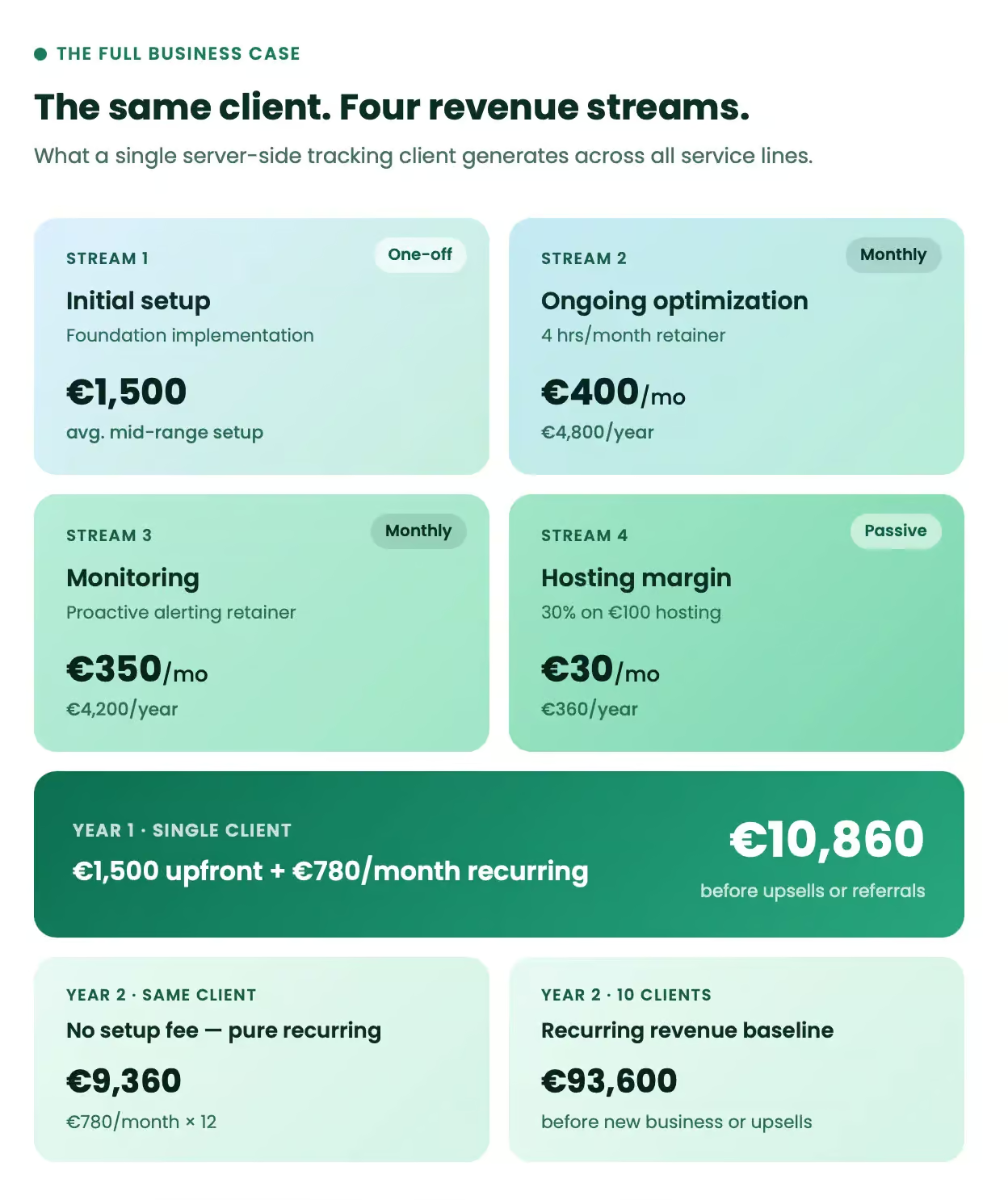
A single client on this model generates €10,860 in Year 1: €1,500 upfront plus €780 per month recurring across twelve months.
From Year 2, with no setup fee, the same client generates €9,360 annually with the setup already in place and the relationship established.
Across ten clients in Year 2: €93,600 in recurring revenue before any new business, upsells, or referrals. The model compounds because clients on optimization and monitoring retainers tend to expand, adding new platforms, connecting offline conversion pipelines, or upgrading toward more sophisticated data stack setups (with BigQuery, for example) as their business grows.
3 common pitfalls to avoid
1. Unclear scope
The "just one more event" trap is the most common margin killer in tracking (as much as in marketing, in general). Without clearly defined deliverables upfront, implementations stretch indefinitely. Every additional request gets absorbed into the original fee because the scope was never explicit enough to address.
How to fix it? Document what's in scope before work starts: which platforms will be connected, which events will be tracked, what the acceptance criteria are, and what falls outside the engagement. Treat everything beyond that as a separate quote.
This also sets the client's expectations correctly for what the monitoring and optimization retainer covers, making conversations much easier when the time comes.
2. Knowledge silos
When one person holds the complete technical understanding of a client's tracking setup (from the data layer logic to the container structure) that's a single point of failure. If they leave, the client relationship is immediately at risk.
Good, shared documentation is the minimum response. A setup that's properly documented can be handed over, audited, or picked up by someone new without weeks of reverse-engineering. This is also one of the reasons we built enterprise-grade SSO and centralized access management into TAGGRS: so agencies managing multiple client environments don't depend on individual logins, shared credentials, or one person's institutional memory.
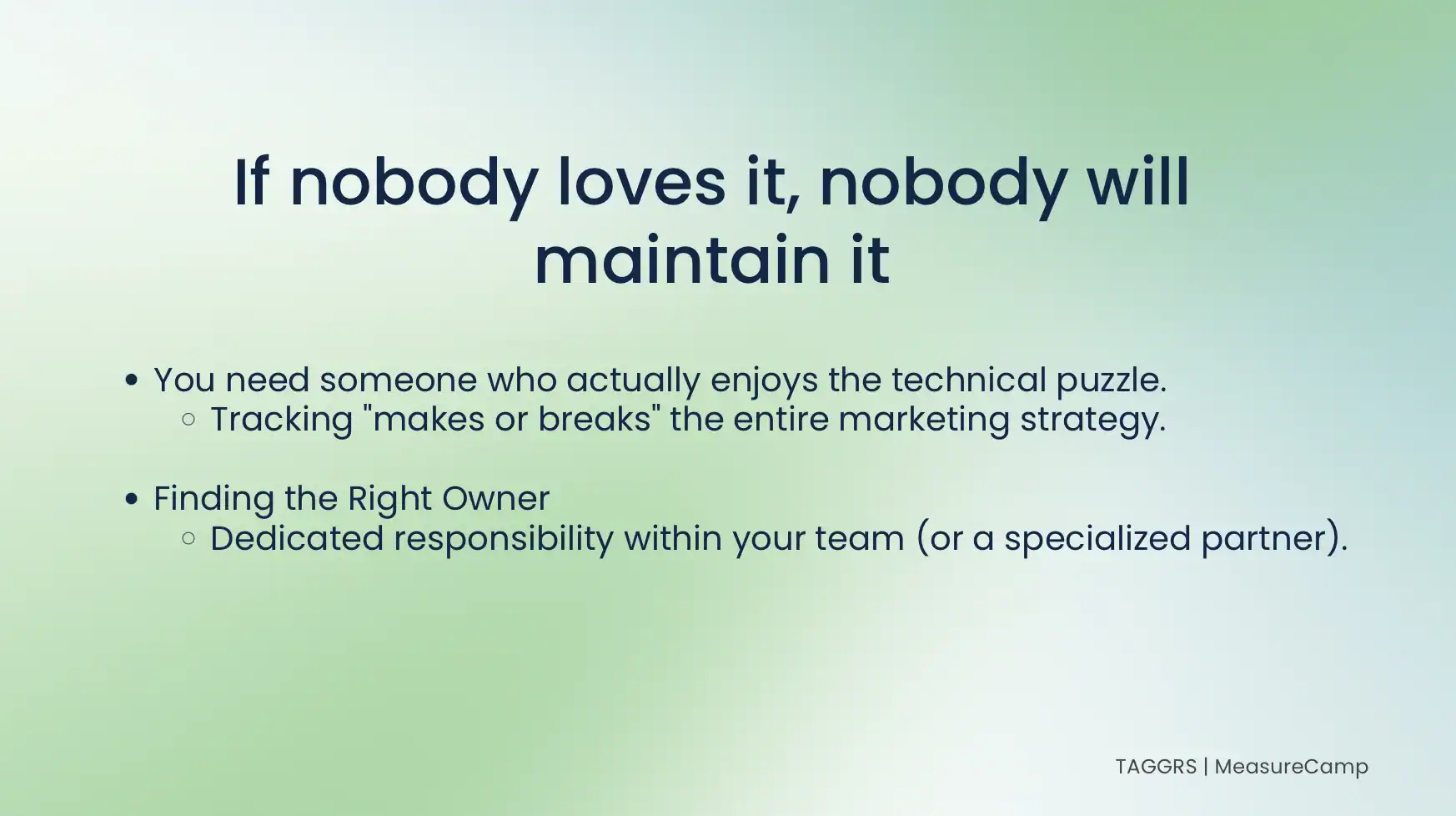
3. No genuine owner
Tracking is detail-oriented, technically demanding, and produces no visible output when it's working correctly. It's the kind of work that gets deprioritized when other projects feel more urgent or more visible to clients.
The solution is to find the right owner, either someone internally who takes genuine responsibility for tracking quality across the client base, or a specialist partner whose entire focus is this space.
What comes next?
The slides from the session How to build a sustainable business model around Server-side Tracking are available on SpeakerDeck: free to download and share.
We also covered a closely related question at MeasureCamp: Google Tag Gateway or server-side GTM? The technical choice affects setup complexity, hosting cost, platform coverage, and what the ongoing optimization work looks like. Niek Schlepers walked through that decision in his own session.
In the meantime, if this session raised questions you'd like to explore, reach out to me at [email protected] or on LinkedIn.